
A homeowner posts a request. Four contractors call within the day. Two leave voicemails. One sends a text. One does both.
By evening, the homeowner has returned exactly one call.
Contractors treat the callback as a coin flip. It is not. The GTA contractors homeowner callback rate varies wildly between businesses that offer identical services at identical prices, and the variance traces back to decisions made in the first three hours after a lead arrives.
Most contractors never examine those decisions. They assume the homeowner was busy, or price-shopping, or never serious. Sometimes that is true. More often, the contractor gave the homeowner a reason to skip them and never learned what it was.
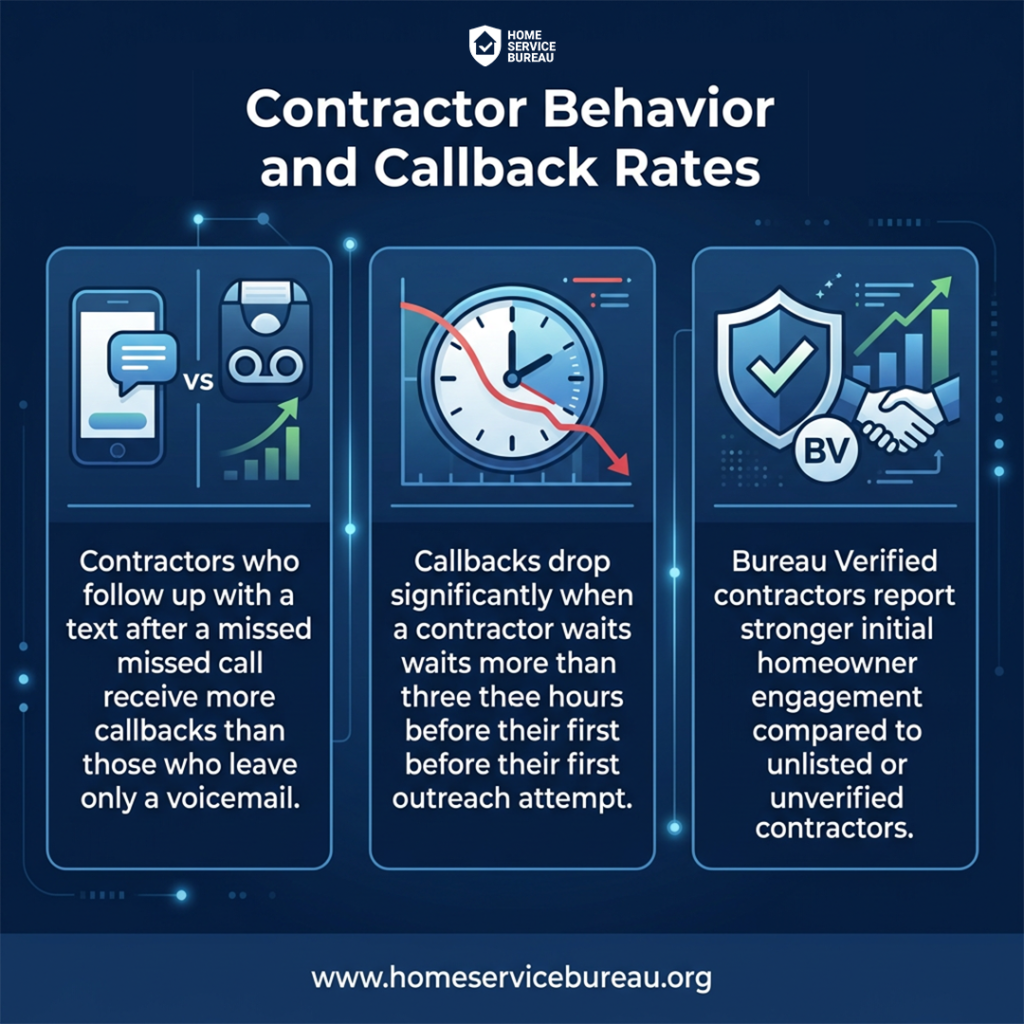
Contractor Behavior and Callback Rates
Three patterns separate contractors who get returned calls from contractors who do not.
Text beats voicemail. Contractors who follow up with a text after a missed call receive more callbacks than contractors who leave only a voicemail. The reason is mechanical rather than psychological. A voicemail requires the homeowner to stop, listen, extract a phone number, and dial. A text requires a thumb. Friction determines response.
Delay destroys the lead. Callbacks drop sharply once a contractor waits more than three hours before their first outreach attempt. The homeowner has not forgotten the request. They have simply spoken to someone else and mentally closed the file. Canadian home services callback behaviour follows a decay curve, not a straight line — the first hour carries more weight than the next twelve combined.
Verification lifts engagement. Bureau Verified contractors report stronger initial homeowner engagement compared with unlisted or unverified contractors. The badge does not persuade anyone to hire. It persuades them to answer the phone, which is a different and earlier decision.
Contractors invest almost nothing in these three variables. They invest heavily in their pricing sheet, which the homeowner never sees if the call goes unreturned.
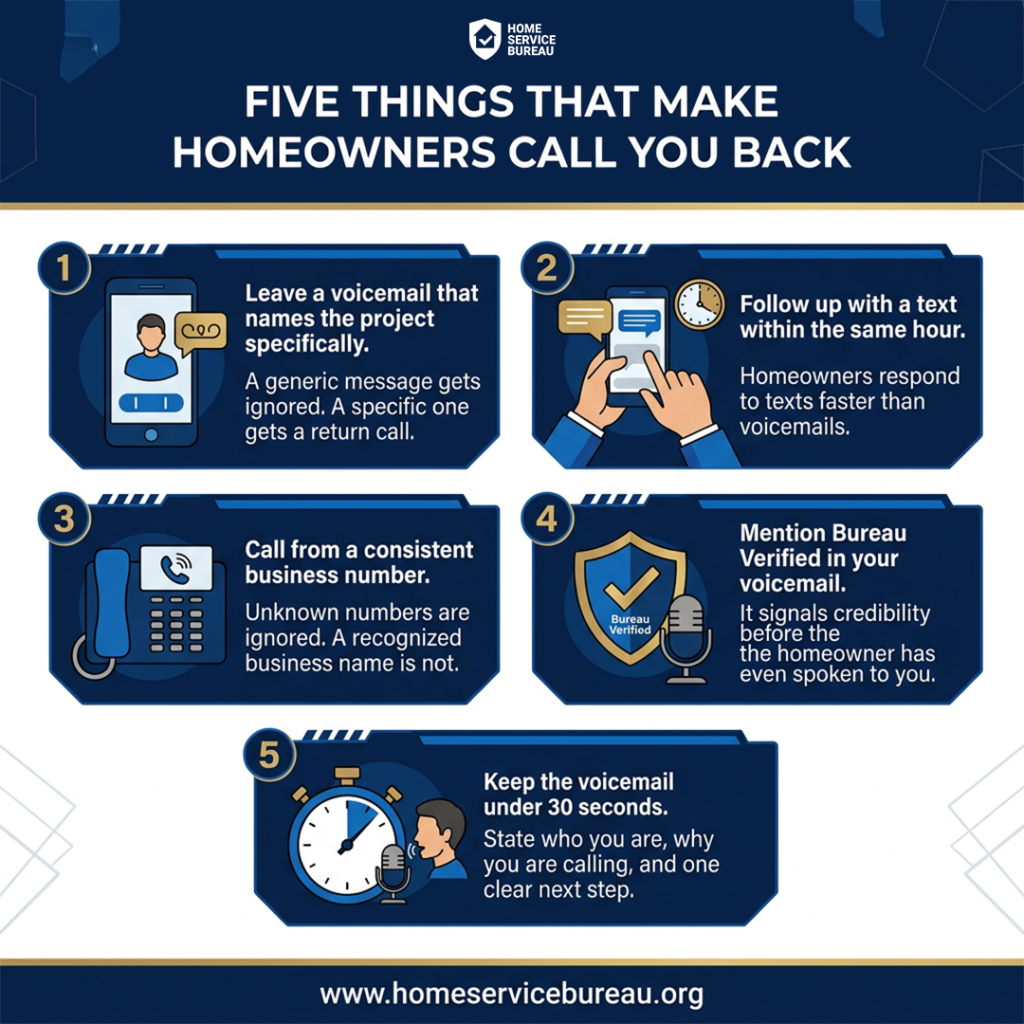
Five Things That Make Homeowners Call You Back
The gap between a high GTA contractors callback rate and a low one narrows to five specific actions.
1. Leave a voicemail that names the project specifically
A generic message gets ignored. A specific one gets a return call. “Calling about the estimate request” tells the homeowner nothing. “Calling about the basement bathroom rough-in you posted this morning” tells them you read what they wrote. That distinction takes four extra seconds and changes the callback outcome more than any script improvement.
2. Follow up with a text within the same hour
Homeowners respond to texts faster than voicemails. Send both. The voicemail establishes that a person called. The text gives them a low-effort way to reply. Contractors who send only one of the two cut their own response rate for no reason.
3. Call from a consistent business number
Unknown numbers are ignored. A recognized business name is not. Contractors who rotate between a personal mobile, a job-site phone, and an office line train homeowners to treat their calls as spam. Contractor callback improvement Canada wide begins with something as unglamorous as caller ID configuration.
4. Mention Bureau Verified status in the voicemail
Credibility stated before the conversation starts anchors trust before the homeowner has spoken a word to you. It signals that a third party reviewed your licensing and insurance. For licensed contractors in Ontario homeowner response rates, this single sentence in a voicemail does more work than an entire follow-up sequence sent afterward.
5. Keep the voicemail under 30 seconds
State who you are, why you are calling, and one clear next step. Nothing else. Long voicemails get deleted at the twenty-second mark, before the phone number arrives. Brevity is not a stylistic preference here. It is a delivery mechanism.
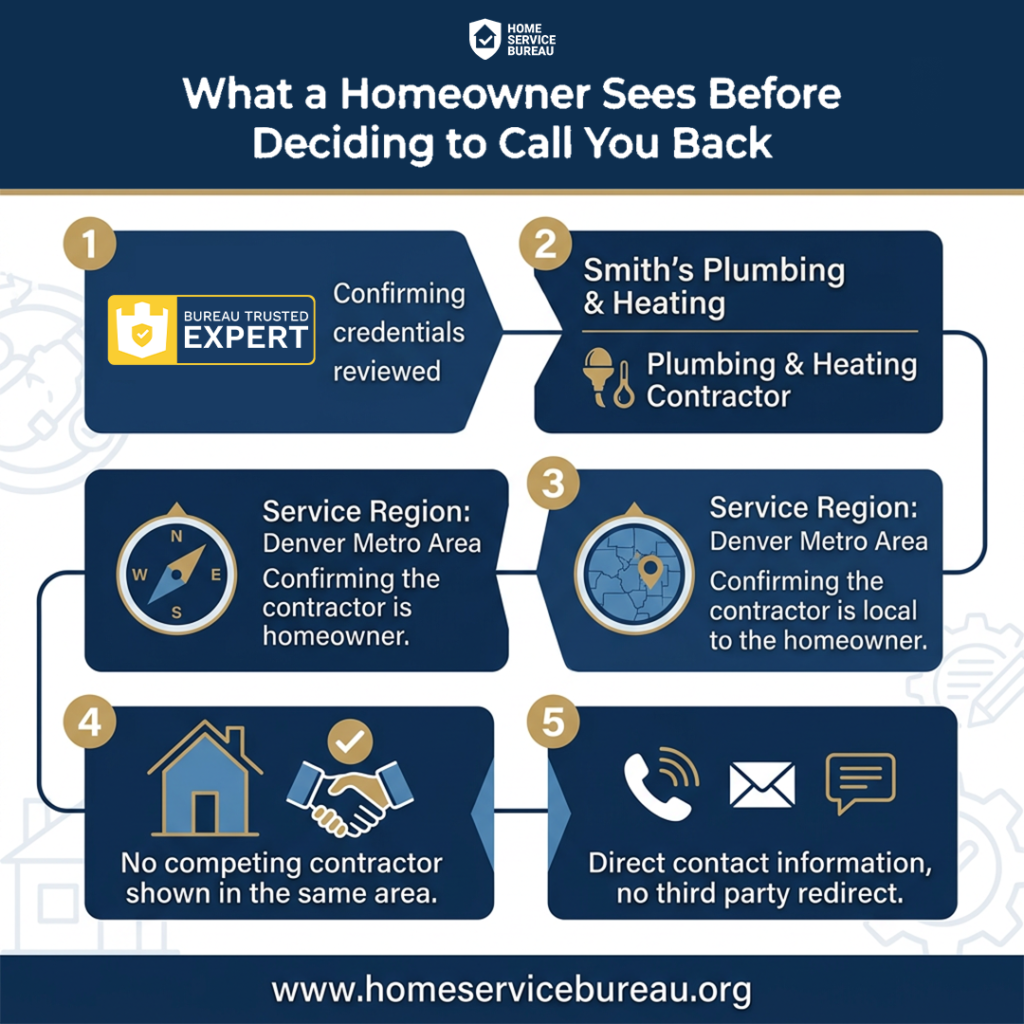
What a Homeowner Sees Before Deciding to Call You Back
Before the homeowner picks up the phone, they run a short verification sequence. Most of it happens on a screen, silently, in under sixty seconds.
They check whether credentials have been reviewed by someone other than the contractor. Self-declared licensing carries almost no weight. Independently confirmed licensing carries a great deal.
They check the business name and trade category to confirm the contractor actually does the work being requested, rather than subcontracting it out.
They check the service region to confirm the contractor operates locally. A contractor who covers half the province reads as a lead-broker, not a tradesperson.
They check whether the platform is showing them a competing contractor in the same slot. Directories that redirect the homeowner to a competitor destroy the callback before it forms.
They check for direct contact information with no third-party redirect. A phone number that routes through a call-tracking intermediary tells the homeowner their enquiry becomes someone else’s inventory.
Each of these checks reduces perceived risk. Fail any of them and the homeowner moves to the next name on the list, having never spoken to you.
How Contractors Fix Their Callback Rate Without Spending More
Nothing above requires a marketing budget.
Set a sixty-minute internal response rule and route after-hours enquiries to an automated acknowledgment that commits to a specific callback window. Standardise on a single outbound business number and register it properly. Write a thirty-second voicemail template and adapt only the project detail. Pair every voicemail with a same-hour text. Display independent verification everywhere the homeowner will look before deciding whether to answer.
Contractors chasing homeowner call back contractor GTA performance usually reach for lead volume first. Volume compounds the problem. A low callback rate applied to more leads produces more wasted spend, not more jobs.

Final Words
The callback is not luck. It is the sum of how fast you reached out, what format you used, whether the homeowner recognised your number, and whether anyone independent had confirmed you are who you claim to be.
The GTA contractors homeowner callback rate rewards contractors who remove doubt before the phone rings.
The Home Service Bureau addresses the part of that equation contractors cannot solve on their own. Bureau Verified status gives homeowners an independently reviewed credential to look at during the sixty silent seconds before they decide whether to return your call. It converts a self-declared claim into a confirmed one.
Contractors serious about contractor callback improvement Canada wide can start at HSB.
Frequently Asked Questions
How quickly should a contractor make first contact after a lead arrives?
Within the first hour. Callback rates decline sharply past the three-hour mark, and the decline accelerates from there.
Does a text really outperform a voicemail?
Yes. Homeowners reply to texts faster because replying requires no phone call. Send both, with the text arriving within the same hour.
Why do homeowners ignore contractor voicemails?
Because most voicemails are generic and too long. A message naming the specific project, kept under thirty seconds, gets returned far more often.
Does calling from a mobile number hurt callback rates?
It does. Unrecognised numbers get ignored. A consistent, registered business line appears as a name rather than a string of digits.
How much does verification affect whether someone calls back?
Verified contractors report stronger initial engagement. The badge influences whether the homeowner answers, which happens before any hiring decision.
Should a contractor call twice if the first attempt fails?
Yes, once, paired with a text. Beyond two attempts within twenty-four hours, persistence reads as pressure rather than professionalism.
Do more leads solve a low callback rate?
No. Additional volume multiplies the same failure. The response process has to be fixed before the lead count matters.
How long before response-time changes show up in results?
Response-time improvements tend to surface within a few weeks. Verification and caller-ID effects accumulate more slowly.