
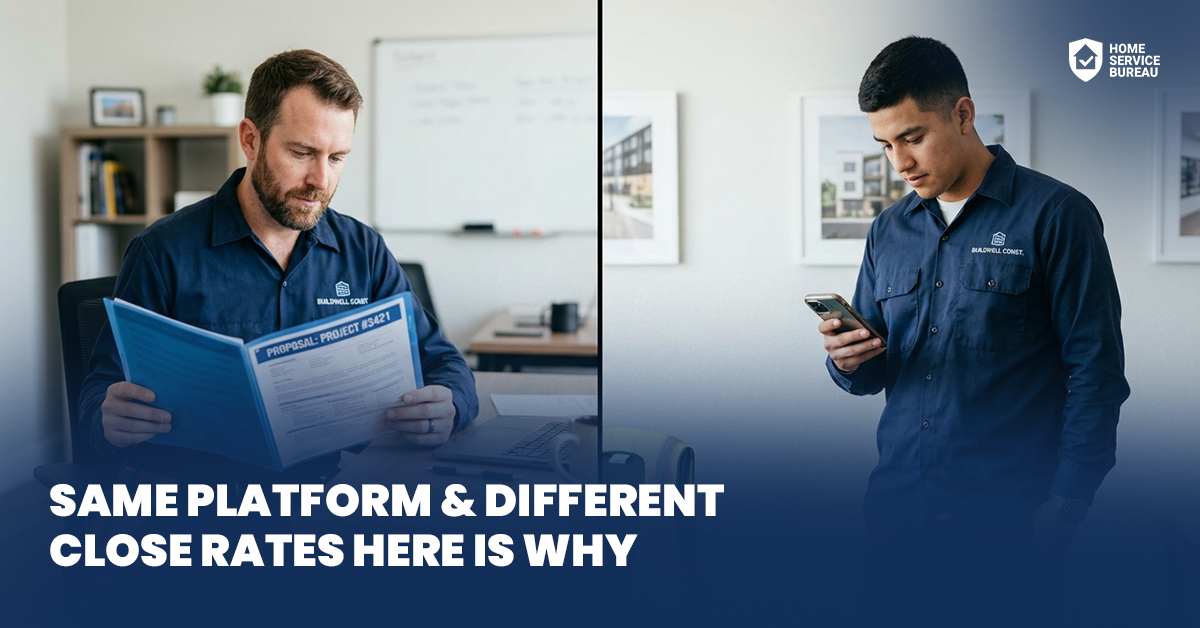
Two contractors sit on the same listing platform. They serve the same postal codes. Then, they quote the same scope of work. They price within a few hundred dollars of each other. One closes roughly half the estimates he books. The other closes fewer than one in five.
Nothing about the platform explains that spread. The GTA contractors close rate difference same platform produces comes down to behaviour that happens before, during, and after the estimate, not the listing itself.
Homeowners rarely articulate why they chose one contractor over another. They say the winner “seemed more professional” or “felt easier to deal with.” Those phrases describe an impression, not a reason. Underneath the impression sit four specific, repeatable actions.
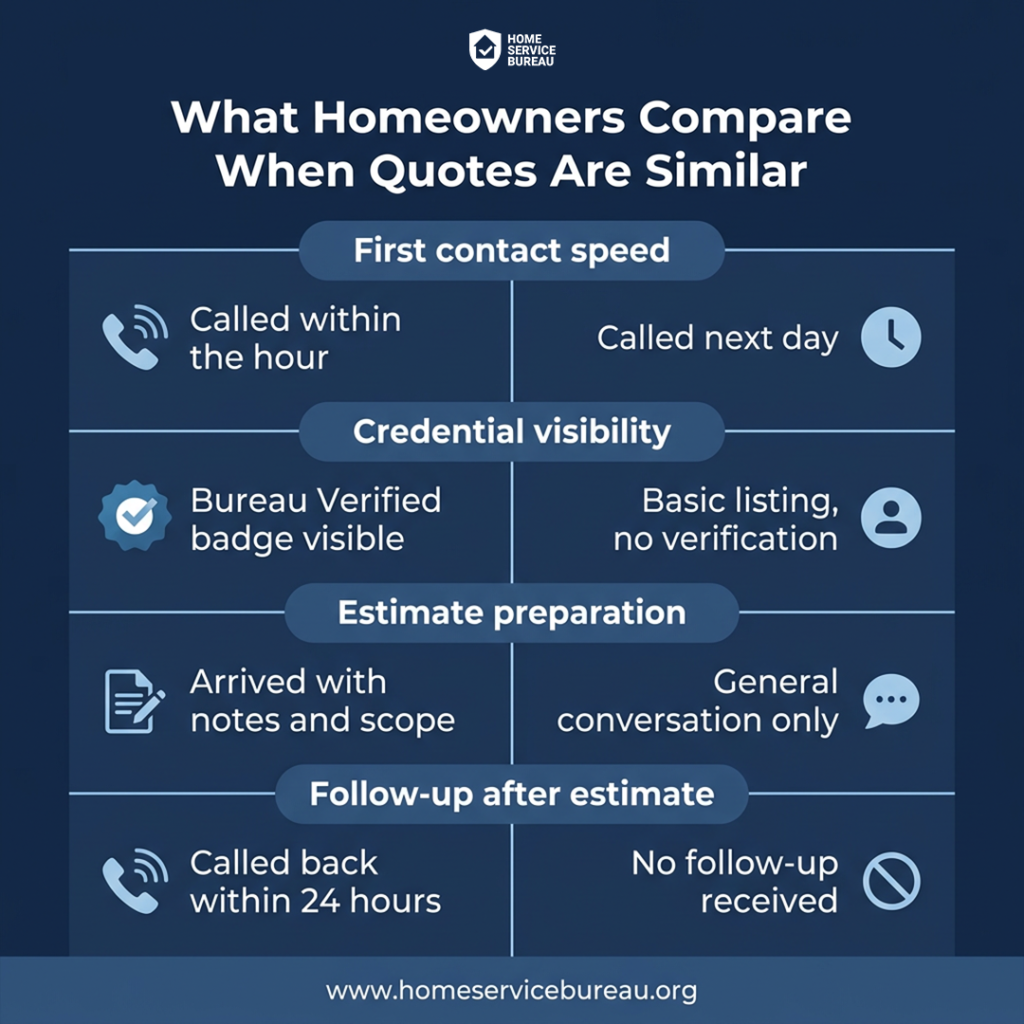
What Homeowners Compare When Quotes Are Similar?
Price stops being the deciding factor once two quotes land within a narrow band. At that point the homeowner is no longer comparing numbers. They are comparing risk.
They compare first contact speed: did this contractor call within the hour, or did they call the next day?
Next, they compare credential visibility: is there a verified badge on this listing, or just a basic profile with a phone number?
They compare estimate preparation did this person arrive with notes and a scope in hand, or did they walk in and start a general conversation?
They compare follow-up after the estimate did anyone call back within 24 hours, or did the quote arrive and then silence?
None of those four comparisons involve the work itself. All four happen before a single tool comes out of the truck. This is the uncomfortable part of Canadian home services estimate conversion: the homeowner has largely decided before they understand what you are actually going to build.
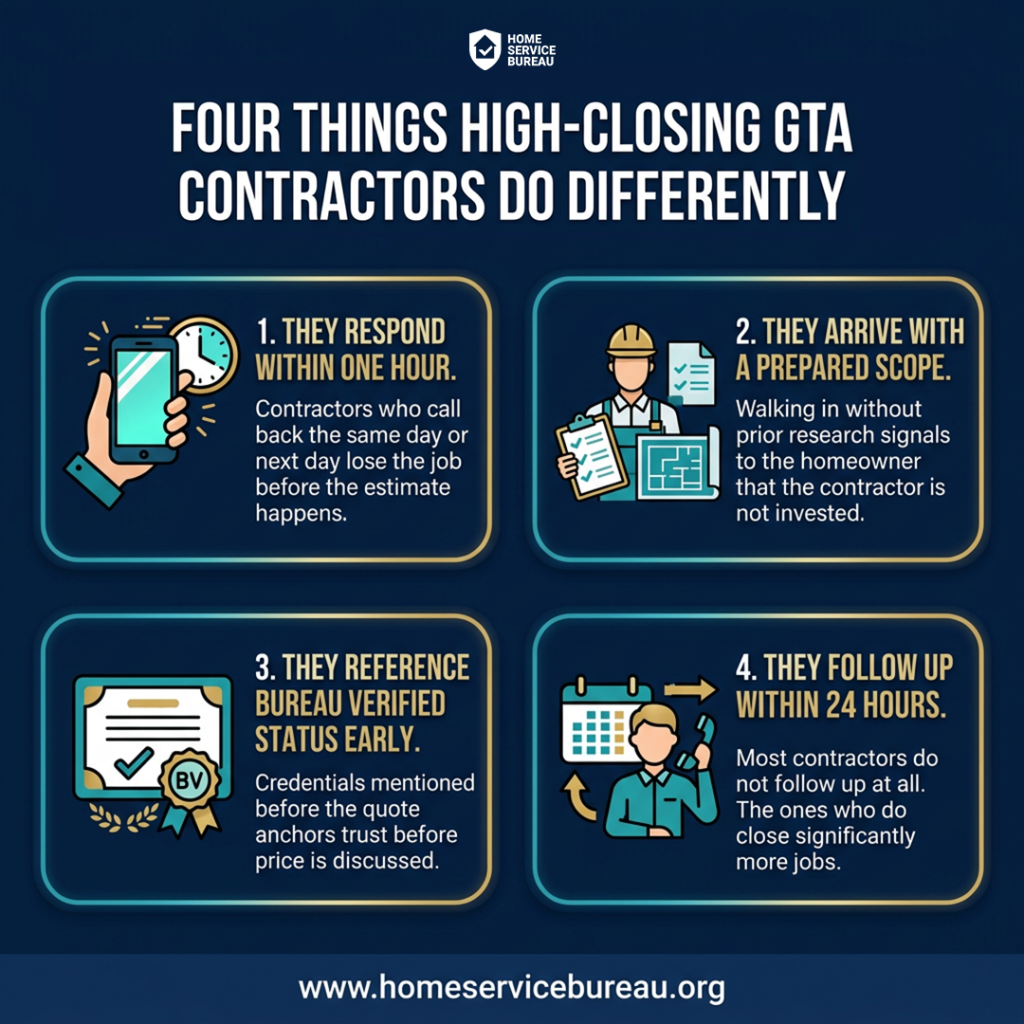
Four Things High-Closing GTA Contractors Do Differently
Contractors who consistently win the job on shared platforms behave in four ways that separate them from everyone else in the same search results.
1. They respond within one hour
Contractors who call back the same evening, or the next morning, lose the job before the estimate ever happens. The homeowner has already spoken to someone else, already formed an impression, already started mentally arranging their week around a different name. Speed is not politeness. Speed is positioning.
2. They arrive with a prepared scope
Walking into a home without prior research signals that the contractor is not invested. The homeowner notices immediately. A contractor who has reviewed the address, looked at the property type, and arrived with a written scope communicates competence before saying anything about competence. This is one of the cheapest contractor close rate improvement GTA levers available, and one of the least used.
3. They reference verified status early
Credentials mentioned before the quote anchor trust before price enters the conversation. Once price is on the table, credentials sound defensive. Before price, they sound like context. Licensed contractors in Ontario close rate performance improves measurably when licensing and verification come up in the first five minutes rather than the last five.
4. They follow up within 24 hours
Most contractors never follow up at all. They submit the quote and wait. The ones who call or text within 24 hours close significantly more jobs, not because the follow-up persuades anyone, but because it demonstrates the exact reliability the homeowner is trying to predict.
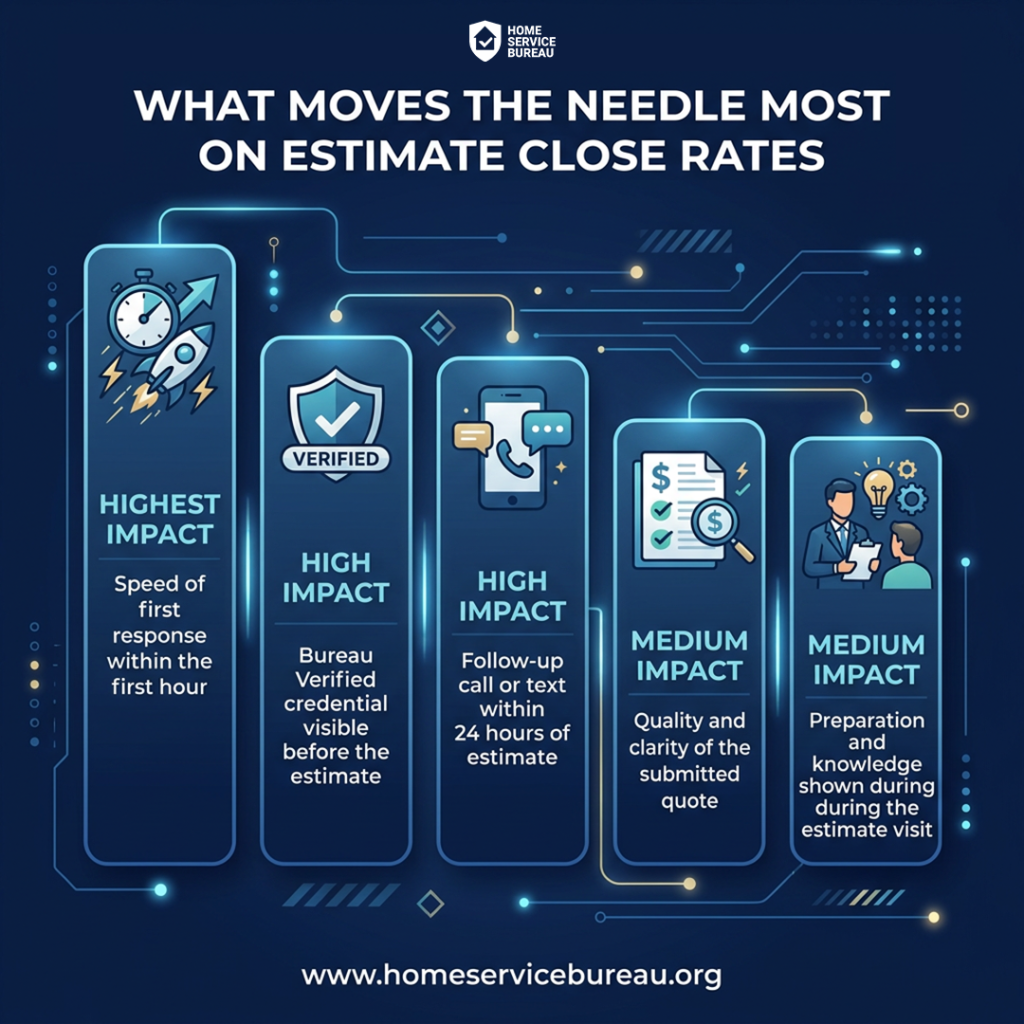
What Moves the Needle Most on Estimate Close Rates
Not all four behaviours carry equal weight.
Highest impact: speed of first response within the first hour. Nothing else compensates for losing this one.
High impact: a visible verification credential before the estimate takes place.
High impact: a follow-up call or text within 24 hours of the estimate.
Medium impact: the quality and clarity of the submitted quote itself.
Medium impact: the preparation and knowledge demonstrated during the estimate visit.
Contractors instinctively invest in the bottom of that list. They refine their quote template. Then, they rehearse their in-home presentation. They spend almost nothing on response time infrastructure or credential visibility, which sit at the top.
That inversion explains most of the GTA contractors close rate spread across identical listings.
How to Win More Estimates as a Contractor in Ontario
Fixing the gap does not require new software, a rebrand, or a marketing budget.
Set a rule that every inbound lead receives contact within 60 minutes during working hours. Route after-hours enquiries to an automated acknowledgment with a committed callback window.
Make verification visible on every profile, every quote document, and every email signature. Do not wait for the homeowner to ask whether you are licensed.
Build a five-minute pre-visit research routine. Property type, age, likely constraints, one prepared question.
Schedule the 24-hour follow-up at the moment you leave the driveway, not when you remember.
Contractors who want to win more estimates contractor Ontario wide should treat these four as a system, not a checklist. The compounding effect matters more than any single item.
Bottom Line
The platform is not the variable. The contractor is.
The GTA contractors close rate difference same platform produces is a behaviour gap disguised as a marketing problem. Contractors who close consistently answer faster, arrive prepared, display credentials early, and follow up without being prompted.
The Home Service Bureau exists to close the credential half of that gap. Bureau Verified status gives homeowners a visible, independent signal at the exact moment they are comparing two contractors and cannot tell them apart. It removes the risk calculation that quietly decides most jobs.
Contractors serious about contractor close rate improvement GTA wide can start at HSB.
Frequently Asked Questions
Why do two contractors on the same platform close at different rates?
Because the platform controls visibility, not behaviour. Response speed, credential display, preparation, and follow-up all sit with the contractor.
How quickly should a contractor respond to a new estimate request?
Within one hour during business hours. Beyond that window, the homeowner has usually engaged someone else.
Does pricing decide most home service jobs in the GTA?
Only when quotes differ significantly. Within a narrow price band, homeowners select on perceived reliability instead.
How much does verification actually affect close rates?
Verification ranks just below response speed in observed impact. It reduces perceived risk before price is discussed.
When should a contractor mention licensing?
Early before the quote. Credentials raised after pricing sound defensive rather than reassuring.
Is follow-up worth the effort if the homeowner did not respond?
Yes. Most contractors never follow up. The act itself demonstrates the reliability the homeowner is trying to assess.
Can a small contractor outperform a larger one on the same platform?
Regularly. Small operators respond faster and follow up personally. Size does not improve either behaviour.
How long before these changes show results?
Response time changes tend to show first. Credential and follow-up effects accumulate more gradually.