
For years, most contractor platforms in Canada measured success by one number: how many contractors they could list. Homeowners paid the price for that model. They scrolled long lists, compared unverified profiles and carried the full risk of every hiring decision.
That approach started breaking down in 2024. The Canadian home services platform verification shift 2024 marked the point where platforms began reviewing credentials before listing a contractor, not after a complaint. Two years later, homeowners in the Greater Toronto Area expect verification as a baseline, and the platforms that still run on volume look increasingly out of step.
This article explains why the volume model failed, what has changed since 2024 and what verification looks like on a modern platform in 2026.
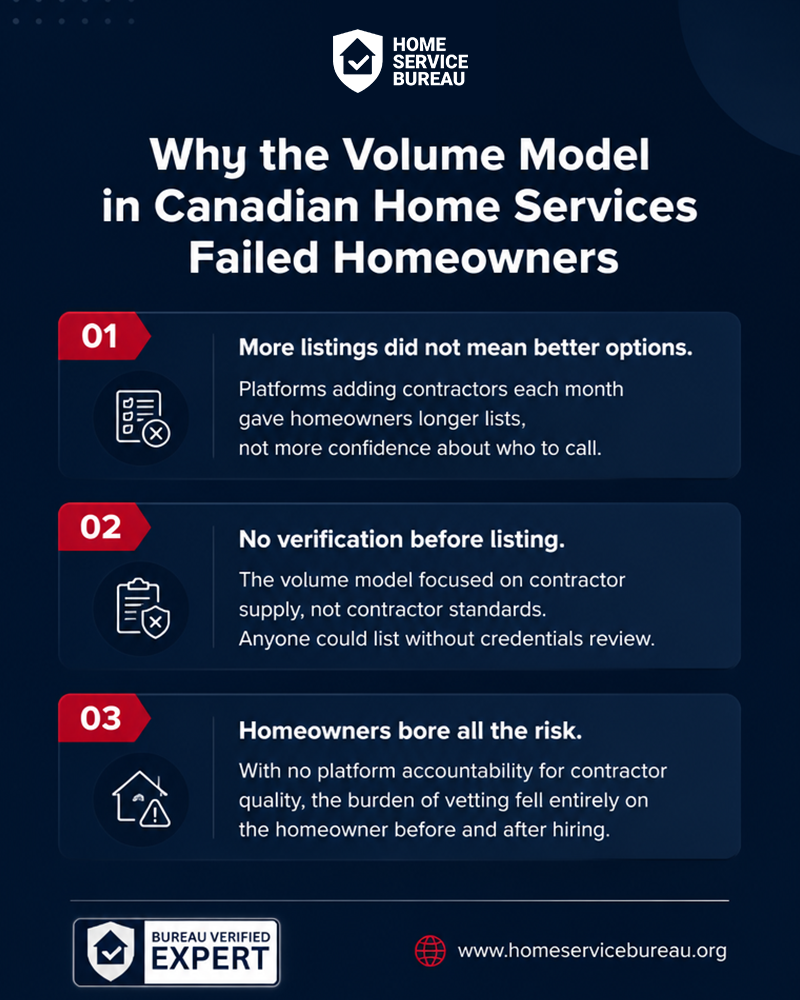
Why the Volume Model in Canadian Home Services Failed Homeowners
The volume model rested on a simple assumption: more contractors mean more choice, and more choice means better outcomes. That assumption did not hold.
More listings did not mean better options
Platforms added contractors every month, but that growth served the platform, not the homeowner. A longer list gave homeowners more profiles to read, more quotes to chase and more uncertainty about who to call. Choice without verification creates work, not confidence.
No verification before listing
Under the volume model, platforms focused on contractor supply rather than contractor standards. Anyone could create a listing without a credentials review. Licensing, insurance and trade qualifications sat outside the signup process, so a listed contractor and a qualified contractor were not always the same thing.
Homeowners bore all the risk
With no platform accountability for contractor quality, the burden of vetting fell entirely on the homeowner. They checked licences, requested insurance certificates and hoped the reviews were genuine. If a job went wrong, the platform pointed to its terms of service and moved on.
This is the environment that produced the contractor platform trust shift GTA homeowners now describe. Trust in open lists eroded because the lists never promised anything beyond a name and a phone number.
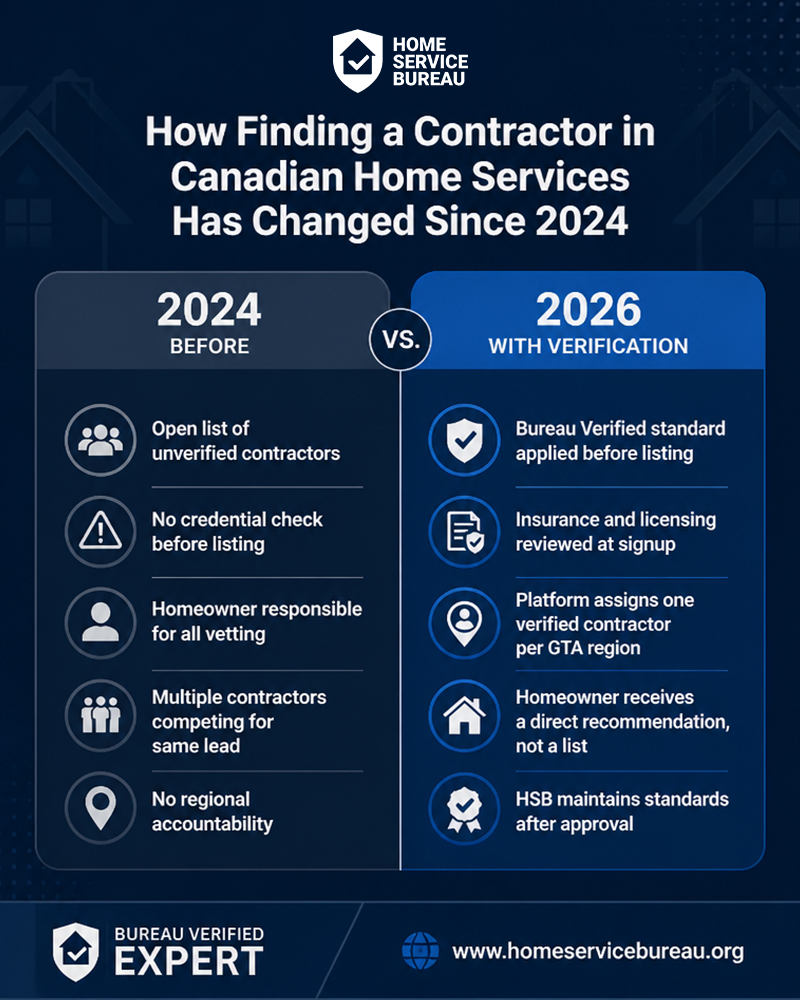
How Finding a Contractor in Canadian Home Services Has Changed Since 2024
The change since 2024 is easiest to see side by side.
Before 2024, the typical platform offered:
- An open list of unverified contractors
- No credential check before listing
- Homeowner responsibility for all vetting
- Multiple contractors competing for the same lead
- No regional accountability
By 2026, a verification-first platform offers:
- A verification standard applied before listing
- Insurance and licensing reviewed at signup
- One verified contractor assigned per GTA region
- A direct recommendation instead of a list
- Standards maintained after approval
Each of these changes addresses a specific failure of the volume model. Credential review at signup removes the guesswork. Regional assignment removes the crowd of contractors chasing one lead. Ongoing standards remove the “approved once, ignored forever” problem.
The GTA contractors verified platform shift also changed how contractors experience these platforms. Instead of paying to compete against a dozen others for a shared lead, a verified contractor holds a defined territory and receives homeowner requests directly. Better contractors have a reason to join, which raises the quality of the whole pool.
For homeowners, the practical result is a shorter path. They describe the job, the platform matches them with the verified contractor for their area and they receive one recommendation they can act on. The comparison work that used to take an evening now happens before the contractor ever appears in front of them.
What the Verification Shift in Canadian Home Services Looks Like in 2026
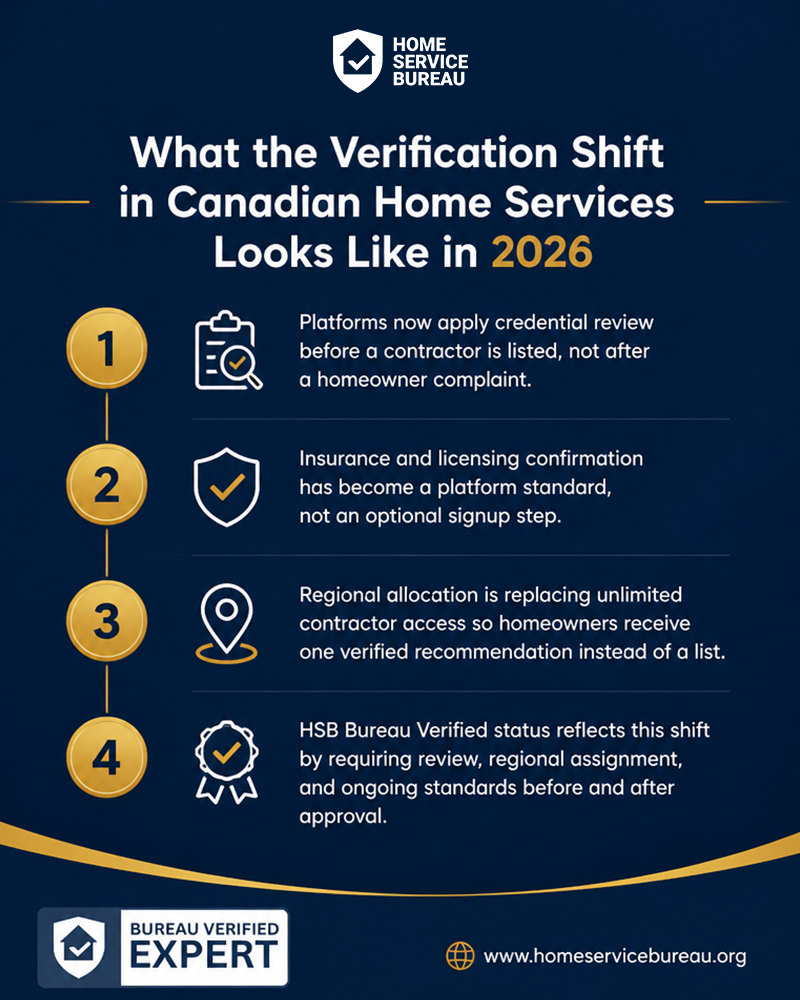
Verification is no longer a marketing badge added after the fact. On a serious platform, it now shapes the entire process.
Credential review before listing
Platforms that follow the verification model review credentials before a contractor goes live. The review happens at the start, not after a homeowner complaint. This single change moves accountability from the homeowner to the platform.
Insurance and licensing as a platform standard
The licensed contractors in Ontario platform standard now means a contractor confirms valid licensing and active insurance as a condition of listing. It is not an optional field on a signup form. If the documentation is missing, the listing does not go live.
Regional allocation instead of unlimited access
Regional allocation replaces unlimited contractor access. Rather than showing every contractor within driving distance, the platform assigns one verified contractor per region. Homeowners receive a single recommendation, and that contractor knows the request came to them alone.
Standards that continue after approval
Approval is the beginning of the relationship, not the end. A verification-first platform holds contractors to ongoing standards, so the badge a homeowner sees today reflects a current status rather than a review from years ago.
Bureau Verified status reflects all four of these elements. It requires review, regional assignment and ongoing standards before and after approval. The Bureau Verified platform growth across the GTA since 2024 tracks directly with the wider move away from open lists.
What This Means for Homeowners in 2026
The homeowner verification expectation Canada has shifted permanently. Homeowners no longer ask whether a platform has many contractors. They ask whether the platform checked them.
That expectation is reasonable, and it puts pressure on the right party. A platform that lists a contractor should be able to say what it reviewed and when. A platform that cannot answer that question is still running the volume model, whatever its homepage claims.
When you evaluate a contractor platform today, look for three things: verification before listing, one recommendation per region and standards that continue after approval. If any of the three is missing, you are still vetting yourself.
Disclaimer
The shift from volume to verification has changed what a contractor platform owes its users. Long lists and unchecked profiles no longer meet the standard homeowners expect in 2026.
Home Service Bureau built its model around that standard. Every contractor holding Bureau Verified status completed a credential review before listing, received a defined GTA region and continues to meet platform requirements after approval. Homeowners receive one verified recommendation, not a list to sort through.
If you are hiring for your home in the GTA, start with a platform that did the vetting before you arrived. Visit www.homeservicebureau.org to find your Bureau Verified Expert.
Frequently Asked Questions
What was the Canadian home services platform verification shift 2024?
It refers to the point where contractor platforms began reviewing licensing and insurance before listing a contractor, replacing open directories with verified recommendations and moving vetting responsibility from homeowners to the platform itself.
Why did the volume model fail homeowners?
The volume model grew contractor lists without checking credentials. Homeowners received longer lists, not better options, and carried all the risk of vetting, hiring and resolving problems when a job went wrong.
What does verification before listing actually check?
A verification-first platform confirms valid trade licensing, active liability insurance and business legitimacy before the contractor appears. The review happens at signup rather than after a homeowner reports a problem with the work.
How does regional allocation help homeowners?
Regional allocation assigns one verified contractor to each area. Homeowners receive a single direct recommendation instead of a list, and the contractor responds to a request that no other contractor is chasing.
Is insurance and licensing confirmation now standard on platforms?
On verification-first platforms, yes. Licensing and insurance confirmation is a condition of listing, not an optional field. Platforms still running the volume model may list contractors without reviewing either document.
What does Bureau Verified status mean?
Bureau Verified status means a contractor passed credential review, received a defined regional assignment and continues to meet platform standards after approval. It represents a current status, not a one-time check.
How has the GTA contractor experience changed since 2024?
Verified contractors now hold a protected territory and receive homeowner requests directly. They no longer pay to compete against many others for a shared lead, which attracts higher-quality contractors to the platform.
How can homeowners tell if a platform still uses the volume model?
Ask what the platform reviewed and when. If it cannot describe a pre-listing credential check, offers a long list instead of one recommendation, and has no ongoing standards, it still runs on volume.