


Running a home services business without a clear picture of next month’s income creates constant stress. Job volume swings, lead costs fluctuate, and planning for staff, equipment, or growth becomes guesswork. This is why more trade professionals are focused on building Canadian home services with contractor predictable monthly revenue through a structured, regional approach to leads rather than relying on unpredictable, pay-per-lead platforms.
This article breaks down the variables that actually determine monthly income, why pay-per-lead pricing models create instability, and how licensed contractors can calculate and plan revenue with far more confidence.
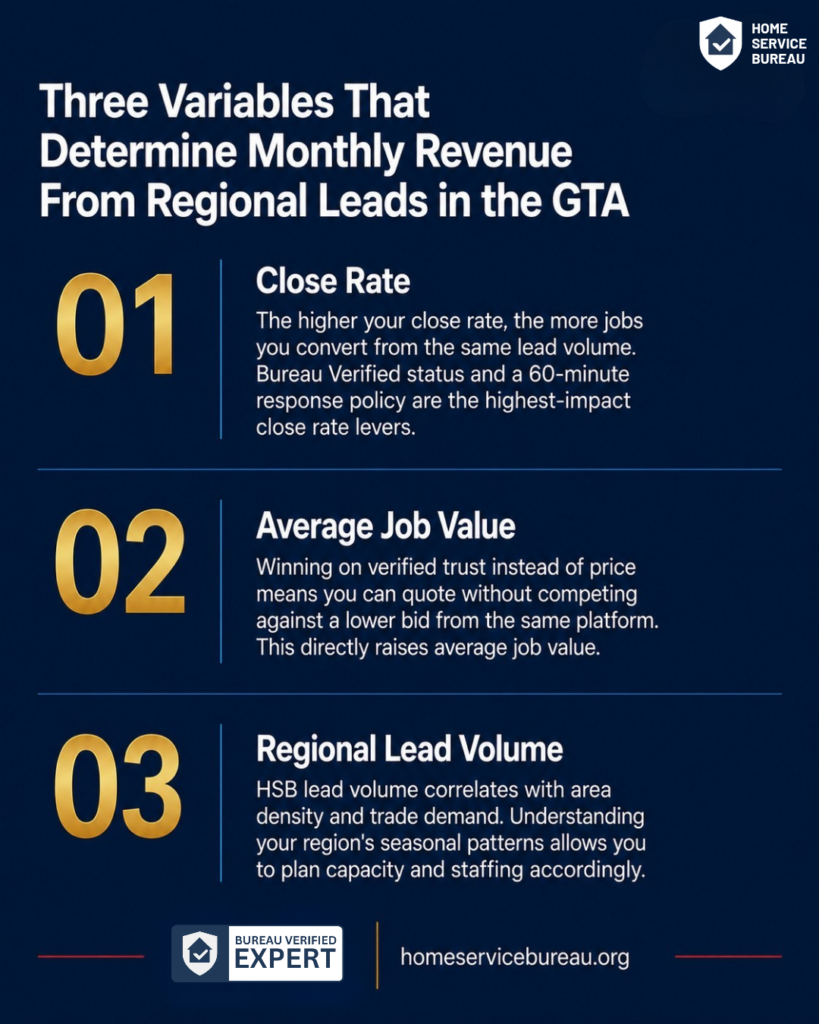
Three Variables That Determine Monthly Revenue From Regional Leads
Before a contractor can build predictable income, they need to understand exactly what drives it. Three variables control GTA contractors monthly lead revenue, and each one can be measured, tracked, and improved over time.
Close Rate
Close rate determines how many jobs a contractor converts from the same volume of leads. A higher close rate means more revenue without spending more on marketing or lead generation. Verified trust status and a fast, disciplined response policy remain the highest-impact levers for improving close rate, since homeowners respond more readily to contractors who appear credible and act quickly.
Average Job Value
Winning work based on verified trust rather than the lowest price allows a contractor to quote confidently without competing against a lower bid pulled from the same shared platform. This shift directly raises average job value, because pricing decisions are based on the quality of the work rather than a race to undercut competitors bidding on identical leads.
Regional Lead Volume
Lead volume correlates closely with area density and seasonal trade demand. Contractors who understand how their specific region behaves throughout the year can plan staffing, scheduling, and capacity well in advance instead of reacting to sudden spikes or slow periods after they happen.
Together, these three variables form the foundation for regional leads monthly income contractor planning. Improve any one of them, and monthly revenue becomes more stable and more predictable.
Why Monthly Revenue Is Unpredictable on Pay Per Lead
Many contractors assume that paying for more leads automatically produces more revenue. In practice, pay-per-lead pricing structures introduce several sources of instability that make monthly income difficult to forecast.
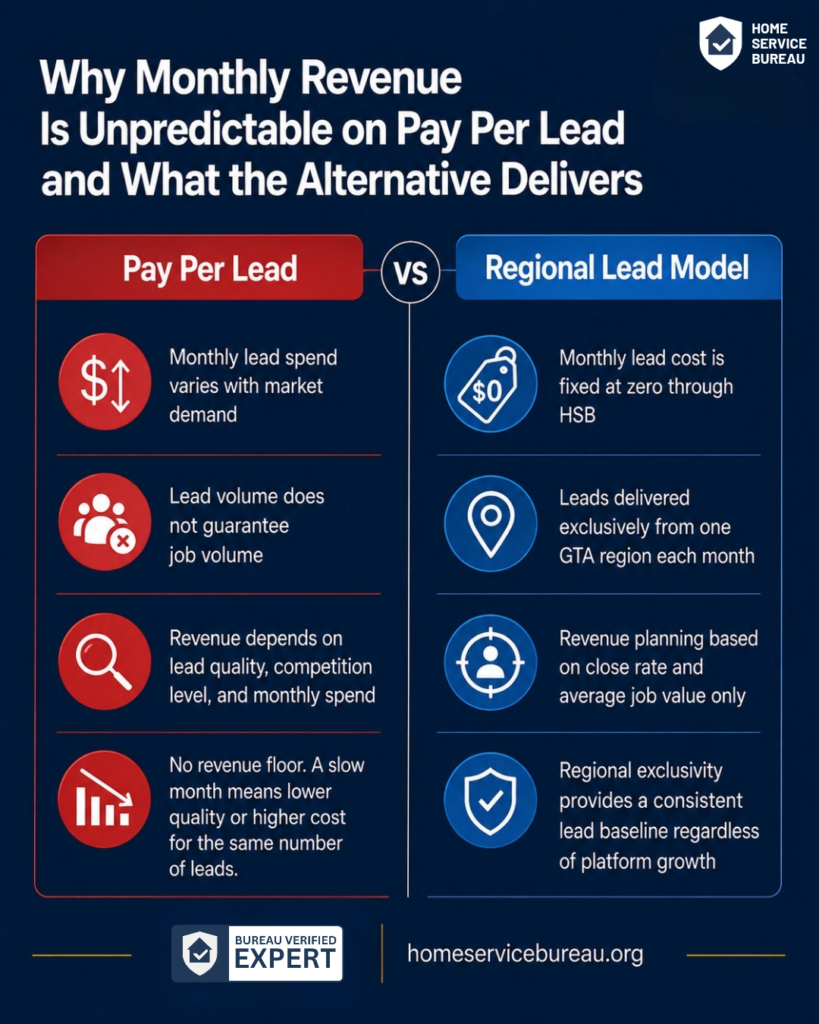
Monthly lead spend under a pay-per-lead model varies with market demand, meaning costs rise during busy seasons exactly when competition for the same leads increases. Lead volume also does not guarantee job volume, since a higher number of leads does not automatically translate into more booked work. Revenue under this model depends on lead quality, the level of competition bidding on the same leads, and how much a contractor is willing to spend that month. There is no revenue floor, so a slower month often means the contractor faces a choice between lower-quality leads or a higher cost for the same number of leads received.
A regional lead model addresses each of these problems directly. Monthly lead cost is fixed at zero, since leads are delivered without a per-lead charge. Leads are delivered exclusively from one GTA region each month, removing the unpredictability caused by shared bidding. Revenue planning becomes based solely on close rate and average job value, two variables the contractor can actually influence. Regional exclusivity also provides a consistent lead baseline regardless of how much the overall platform grows, which protects contractors from dilution as more businesses join.
This structural difference is central to understanding HSB contractor monthly revenue, since removing per-lead cost and shared competition changes the entire revenue equation.
How Licensed Contractors in Ontario Can Project Monthly Revenue With Regional Leads
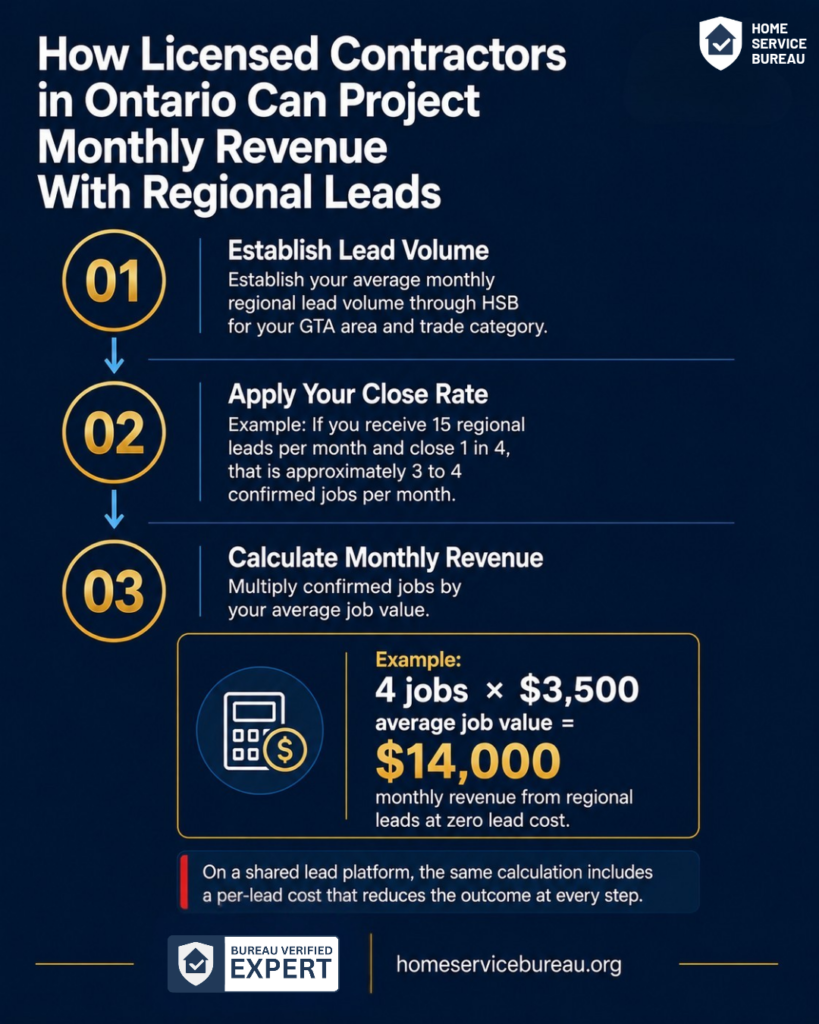
Once a contractor understands the variables that drive income, projecting revenue becomes a straightforward three-step process rather than a guessing game. This approach supports licensed contractors in Ontario lead predictability by turning an uncertain process into a repeatable calculation.
Step one: Establish lead volume. A contractor first identifies their average monthly regional lead volume for their specific GTA area and trade category. This baseline number becomes the starting point for every future projection.
Step two: Apply the close rate. The established lead volume is multiplied by the contractor’s actual close rate, producing an estimated number of confirmed jobs per month. Tracking close rate consistently over several months makes this projection increasingly accurate.
Step three: Calculate monthly revenue. The number of confirmed jobs is multiplied by the average job value to produce a projected monthly revenue figure. Because lead cost is fixed at zero under a regional model, this revenue figure represents the full financial benefit of the lead volume rather than a number reduced by ongoing per-lead charges.
On a shared lead platform, this same calculation includes a per-lead cost that reduces the outcome at every step, which is exactly why revenue planning becomes so much harder to trust under that structure. A regional model removes that variable entirely, giving contractors a cleaner, more reliable basis for forecasting.
Building Predictable Contractor Income in Ontario and the GTA
Achieving predictable contractor income Ontario GTA businesses can plan around requires more than just access to leads. It requires a system that removes the guesswork tied to shared bidding, variable pricing, and inconsistent lead quality.
Contractors who commit to tracking their own close rate and average job value gain a clear understanding of their business performance month over month. Combined with a fixed, zero-cost regional lead structure, this tracking allows contractors to set realistic revenue targets, plan hiring decisions with confidence, and avoid the financial stress that comes from relying on a platform where costs and competition shift unpredictably.
Verified trust status plays a supporting role throughout this entire process. Homeowners are more likely to engage quickly and commit to a booking when they see credible verification before the first conversation even happens. This higher engagement supports a stronger close rate, which feeds directly back into more stable monthly revenue.

Bottom Line
Predictable income is achievable for Canadian home services contractors, but it requires a shift away from pay-per-lead pricing models that introduce cost volatility and shared competition. By focusing on close rate, average job value, and consistent regional lead volume, contractors gain the ability to forecast revenue with real confidence rather than relying on guesswork.
Home Service Bureau (HSB) supports this shift by delivering leads exclusively within a contractor’s own GTA region, with monthly lead cost fixed at zero and verified trust status built into every listing. This structure gives licensed contractors the tools to plan revenue, manage capacity, and grow their business on a foundation they can actually predict. Visit homeservicebureau.org to learn how HSB helps contractors across the GTA build stable, forecastable monthly income through regional leads.
Frequently Asked Questions
1. What does predictable monthly revenue mean for a home services contractor?
It means being able to reasonably forecast income based on known factors like close rate, job value, and lead volume, rather than depending on unpredictable per-lead costs and shifting competition each month.
2. How does close rate affect predictable contractor income?
A higher close rate means more jobs are book from the same lead volume, directly increasing monthly revenue without additional marketing spend or added lead acquisition costs.
3. Why is pay-per-lead pricing considered unpredictable?
Costs rise with demand, lead quality varies, and job volume is never guarantee, meaning contractors can spend more during busy periods without a proportional increase in book work.
4. What makes a regional lead model different from shared lead platforms?
Leads are deliver exclusively within one region at zero per-lead cost, removing share bidding and giving contractors a consistent, predictable baseline for revenue planning each month.
5. How can a contractor calculate projected monthly revenue?
Establish average monthly lead volume, apply the actual close rate to estimate confirmed jobs, then multiply confirmed jobs by average job value to reach a projected revenue figure.
6. Does verified trust status really impact monthly revenue?
Yes. Verified status increases homeowner engagement and confidence before the first contact, which supports a stronger close rate and contributes to more stable monthly income over time.
7. How does regional lead volume support revenue planning?
Understanding seasonal demand within a specific region allows contractors to anticipate busy and slow periods, plan staffing accordingly, and avoid revenue gaps caused by reactive scheduling.
8. Why does average job value matter as much as lead volume?
Higher average job value means each booked job contributes more revenue, so improving pricing confidence through trust rather than competing on price directly strengthens monthly income.