

Homeowners across the Greater Toronto Area submit project requests when their interest peaks, not when it is convenient for a contractor to call back. This single fact explains why the GTA contractors 60 minute response rate has become one of the most important performance metrics in the home services industry. Contractors who reply within the first hour consistently book more estimates, close more jobs, and build stronger reputations than contractors who let leads sit.
This article breaks down what actually happens to a homeowner lead over time, what GTA contractors need to have ready before they respond, and why licensed contractors in Ontario response time close rate figures keep pointing to the same conclusion: speed wins.
Why the First 60 Minutes Determine the Outcome
A homeowner lead is not a static piece of data. It is a person with an active problem, a leaking roof, a broken furnace, or a renovation they want to start soon. That person’s attention and urgency change by the minute.
When a contractor calls within the first half hour, the homeowner is still mentally present in the moment they submitted the request. They expect the phone to ring. They are ready to talk details, ask questions, and schedule a visit. This is why industry data consistently shows the fastest responders capture the highest share of booked appointments.
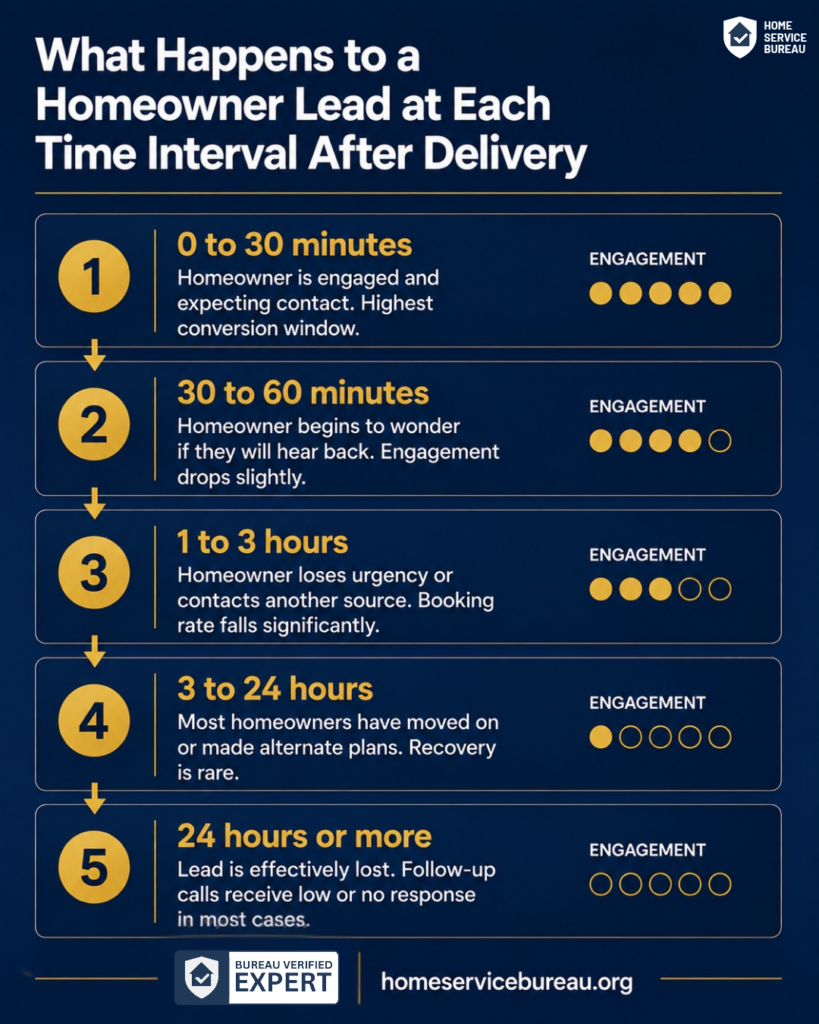
As time passes, engagement drops in a predictable pattern:
- Within 30 minutes, the homeowner is fully engaged and expecting contact, representing the highest conversion window available to any contractor.
- Between 30 and 60 minutes, the homeowner starts to wonder if anyone will call, and engagement begins to soften.
- Between 1 and 3 hours, urgency fades or the homeowner reaches out to another provider, causing booking rates to fall sharply.
- Between 3 and 24 hours, most homeowners have already made alternate plans, and recovering their interest becomes rare.
- After 24 hours, the lead is effectively lost, and follow-up calls receive little or no response in most cases.
This timeline is the foundation of the contractor first response win rate GTA conversation. Every hour of delay chips away at the odds of turning a lead into a paying customer, which is why fast responders consistently outperform slower competitors on the same lead volume.
What Fast Response Actually Looks Like
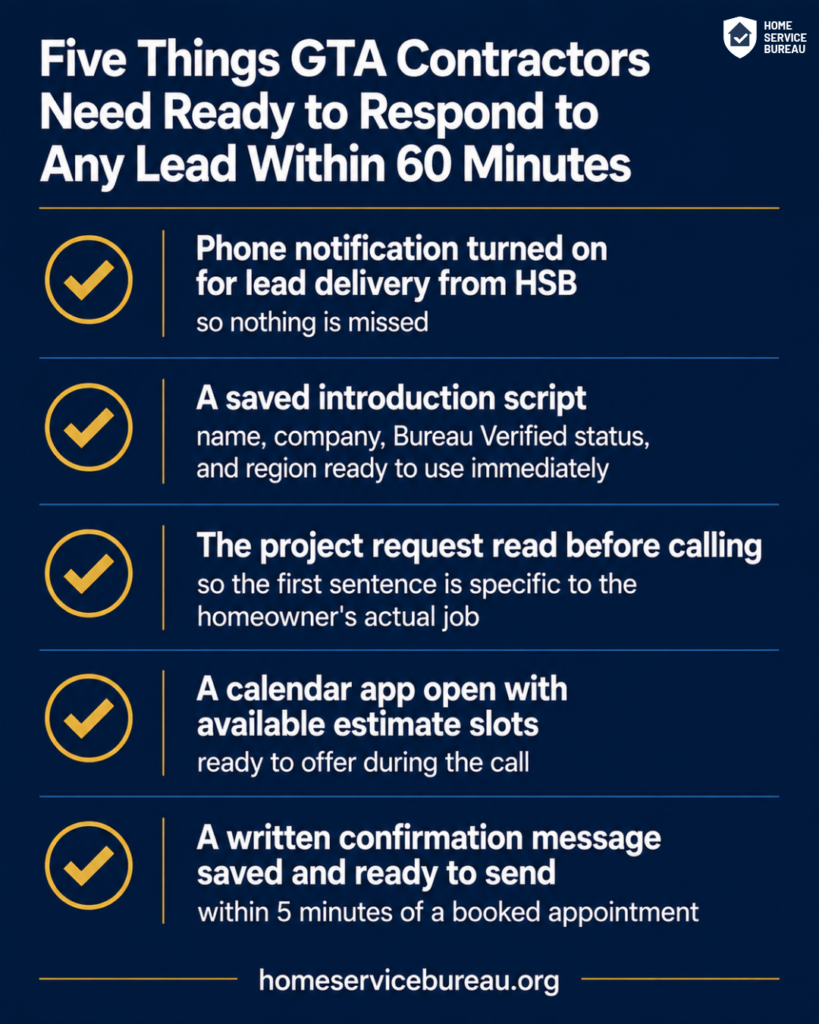
Contractors who consistently respond within 60 minutes are not simply lucky or better at sales. They prepare their process in advance so that when a lead arrives, they can act immediately rather than scrambling to organize information mid-call. GTA contractors who want to respond fast contractor Ontario style need five things ready at all times.
Phone Notifications Turned On for Lead Delivery
A contractor cannot respond quickly to a lead they have not seen. Enabling instant phone notifications for every new lead removes the biggest cause of delay: simply not knowing a homeowner has submitted a request. Checking email once every few hours is not compatible with a 60 minute response goal.
A Saved Introduction Script
Every successful call starts the same way: a clear, confident introduction that states the contractor’s name, company, verification status, and service region. Having this script memorized or saved removes hesitation and awkward pauses, which matters because homeowners judge professionalism within the first few seconds of a call.
The Project Request Read Before Calling
Homeowners notice immediately when a contractor has not read their request. Reviewing the project details before dialing allows the first sentence of the call to reference the homeowner’s actual job rather than a generic greeting. This small step dramatically increases trust and keeps the homeowner on the line longer.
A Calendar App Open With Available Estimate Slots
Speed matters just as much after the introduction as before it. A contractor who can immediately offer two or three specific appointment times converts far more often than one who says they will “check and get back to you.” Having a calendar open and ready to book removes friction at the exact moment the homeowner is deciding whether to commit.
A Written Confirmation Message Ready to Send
Booking an appointment verbally is only half the job. Sending a written confirmation within five minutes of the call reinforces the appointment in the homeowner’s mind and reduces no-show rates. This step also reflects well on the contractor’s professionalism, which supports long-term reputation and repeat referrals.
Same Lead, Different Response Time: What Changes
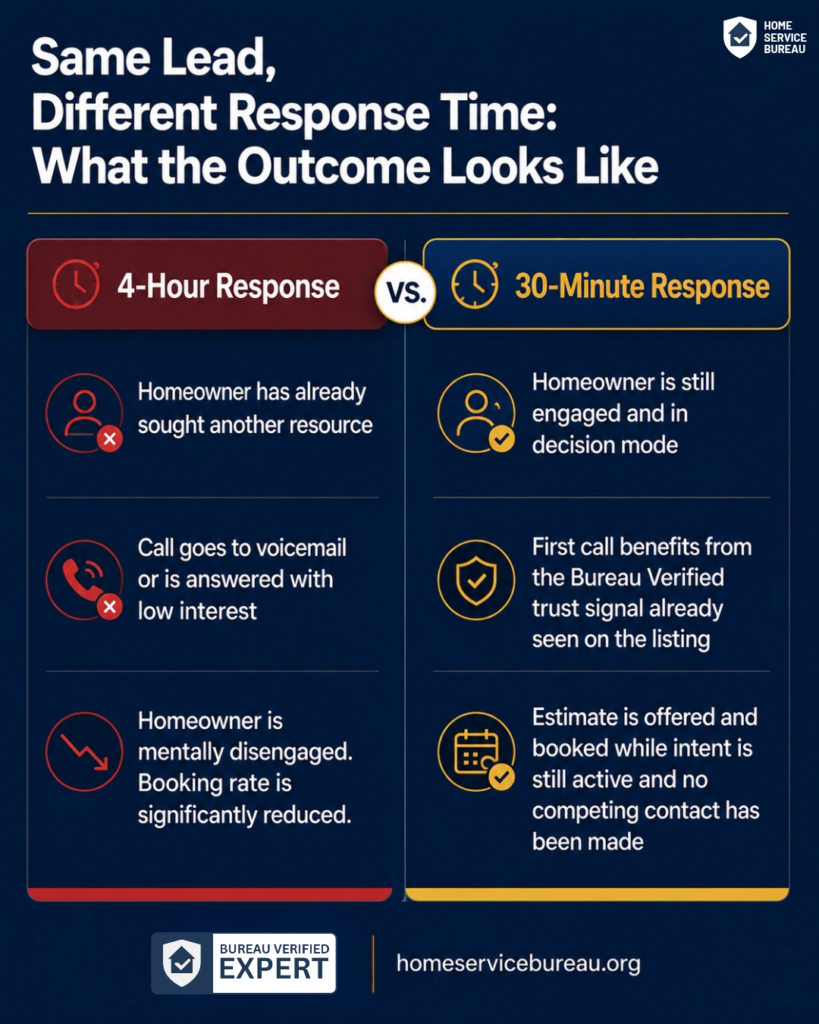
Comparing a four-hour response against a 30-minute response on the exact same lead makes the impact of speed obvious.
With a four-hour delay, the homeowner has often already sought another resource by the time the contractor calls. The call itself may go to voicemail or get answer with noticeably low interest. By this point, the homeowner is mentally disengage from the original request, and the booking rate for that lead drops significantly.
With a 30-minute response, the outcome looks completely different. The homeowner is still engaged and actively in decision mode. The first call benefits from any trust signals the homeowner already saw, such as a verified contractor badge, before the phone even rang. Because intent is still active and no competing contractor has reached the homeowner yet, the estimate gets offered and booked in the same conversation.
This comparison is the clearest illustration of why Canadian home services lead response speed is not a minor operational detail. It is a direct driver of revenue.
How HSB Lead Response Time GTA Data Supports This Pattern
Data tracked through platforms like Home Service Bureau reinforces everything above. HSB lead response time GTA patterns show that contractors who reply within the first hour book appointments at meaningfully higher rates than those who wait longer, regardless of the trade, the season, or the size of the job. This is not a coincidence limit to one market. It reflects basic human behavior: people want confirmation that their problem is seriously, and the first business to provide that confirmation usually wins the opportunity.
For contractors evaluating their own performance, the response time metric is one of the simplest and most actionable numbers to track. It requires no complicated reporting, only a commitment to answering the phone or making the callback as soon as a lead arrives.
Building a Culture of Speed
Improving response time is rarely about hiring more staff. It is about building a habit and a repeatable process. Contractors who treat every new lead notification as urgent, who keep their introduction and confirmation messages ready, and who protect calendar availability for fast booking consistently outperform competitors who treat lead follow-up as a task to handle “when there’s time.”
The GTA contractors 60 minute response rate is ultimately a reflection of discipline. The tools required are simple. The advantage they create is significant.

Bottom Line
Response speed is one of the few variables in the home services business that a contractor fully controls. Job pricing fluctuates, seasonal demand shifts, and competition changes, but the decision to call a homeowner back within the first 60 minutes rests entirely with the contractor. The data is consistent: faster response leads to higher engagement, stronger trust, and more booked jobs.
Contractors who want to strengthen their close rate and build a reputation for reliability should treat every lead as time-sensitive from the moment it arrives. Working with a trust verification and lead platform like Home Service Bureau (HSB) gives contractors a head start, since homeowners already see the Bureau Verified trust signal before the first call is even made. That early trust, combined with a fast response, is what turns a simple lead into a booked job. Visit homeservicebureau.org to learn how HSB helps licensed contractors across the GTA respond faster, book more estimates, and grow their business with verified leads.
Frequently Asked Questions
1. What is consider a good response time for contractor leads in the GTA?
A response within 30 to 60 minutes is consider ideal. Homeowners remain engaged during this window, and booking rates stay high because the request is still fresh in their mind.
2. Why does the GTA contractors 60 minute response rate matter so much?
It directly affects booking rates. Homeowners lose urgency quickly, so responding within an hour keeps the contractor in front of an active, decision-ready customer instead of a cold lead.
3. How does response time affect the licensed contractors in Ontario response time close rate?
Faster response times consistently correlate with higher close rates. Licensed contractors who reply quickly capture homeowners before they contact competitors, improving overall conversion.
4. What happens if a contractor waits several hours to respond?
Engagement drops sharply after three hours. Many homeowners have already contacted another provider or moved on, making the booking rate significantly lower for delayed responses.
5. What tools help contractors improve their first response win rate?
Instant lead notifications, a prepared introduction script, an open calendar for booking, and a ready-to-send confirmation message all help contractors respond faster and more confidently.
6. Does a verified contractor badge really influence homeowner response rates?
Yes. A trust signal seen before the call, such as a verification badge, makes homeowners more receptive during the first conversation, supporting a stronger contractor first response win rate GTA.
7. How can contractors track their own lead response performance?
Contractors can review timestamps between lead delivery and first contact using their lead platform’s dashboard, similar to how HSB lead response time GTA data is tracked and reported.
8. Is a 60 minute response realistic for busy contractors?
Yes, with preparation. Turning on notifications, keeping scripts ready, and blocking calendar time for callbacks make a 60 minute response achievable even for contractors managing multiple jobs daily.