
Ontario homeowners invest heavily in renovations, roofing, HVAC upgrades, and structural repairs every year. Yet many of them discover the same painful truth only after the deposit clears: the contractor never held valid coverage, never issued a written scope, and never intended to finish the job. You can avoid wrong contractor hire Ontario situations entirely, but only when you verify credentials before the first conversation ends rather than after the first payment leaves your account.
This guide walks you through the warning signs, the real financial exposure, and the exact verification steps that protect your property and your budget.
Why Contractor Verification Matters More Than the Quote
Homeowners naturally compare prices first. Experienced project managers compare credentials first, then price. A quote tells you what someone plans to charge. A Certificate of Insurance, a written scope, and a verifiable credential tell you whether that person can legally and safely complete the work on your property.
Ontario regulates several trades directly, and municipalities enforce permit requirements independently. When you skip licensed contractors in Ontario vetting, you accept liability that a qualified professional would otherwise carry. That single oversight explains most renovation disputes across the province.
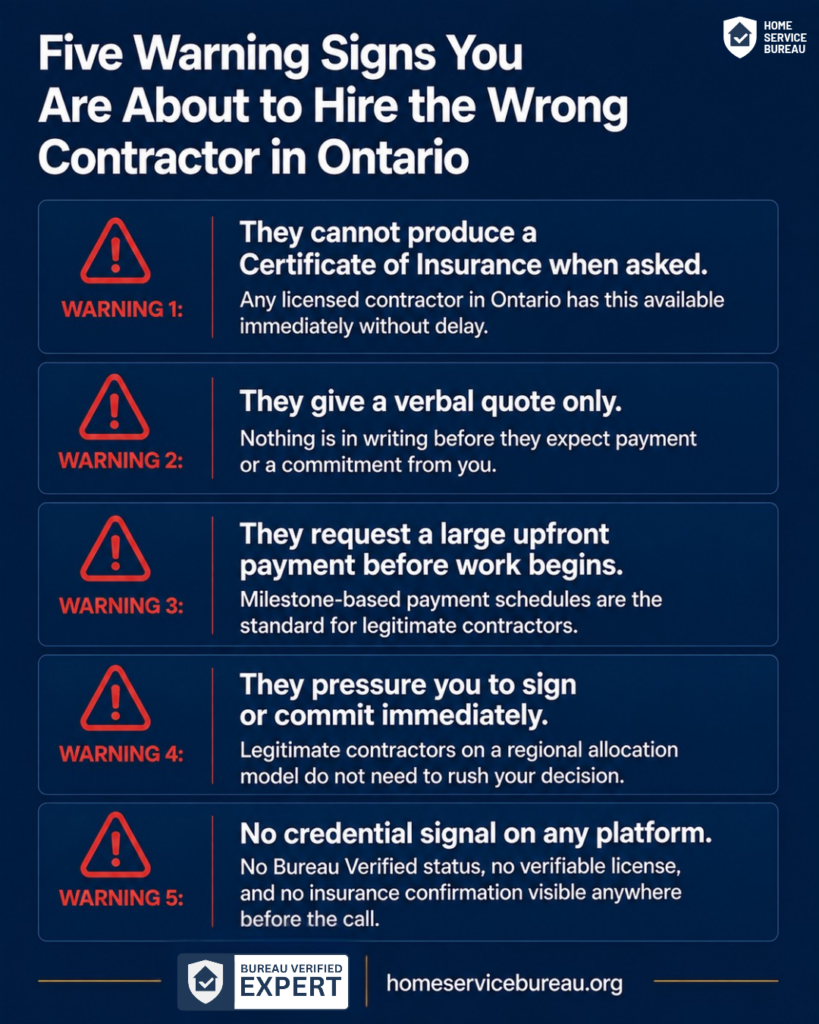
Five Warning Signs You Are About to Hire the Wrong Contractor in Ontario
Trust the signals you observe during the first two interactions. Canadian home services contractor red flags appear early, and they rarely improve later.
Warning 1: They cannot produce a Certificate of Insurance when asked. Any legitimate contractor keeps this document accessible and forwards it within minutes. Delays, excuses, and promises to “send it later” signal a coverage gap.
Warning 2: They give a verbal quote only. Nothing appears in writing before they expect payment or a commitment from you. Verbal pricing protects the contractor, never the homeowner.
Warning 3: They request a large upfront payment before work begins. Milestone-based payment schedules represent the standard across the industry. A demand for half the project value before anyone picks up a tool deserves immediate scrutiny.
Warning 4: They pressure you to sign or commit immediately. Legitimate contractors manage a steady regional workload and do not need to rush your decision. Urgency tactics exist to prevent you from verifying anything.
Warning 5: No credential signal appears on any platform. You find no verified status, no traceable licence, and no insurance confirmation anywhere before the call.
Two or more of these signals together justify walking away, regardless of how competitive the price looks.
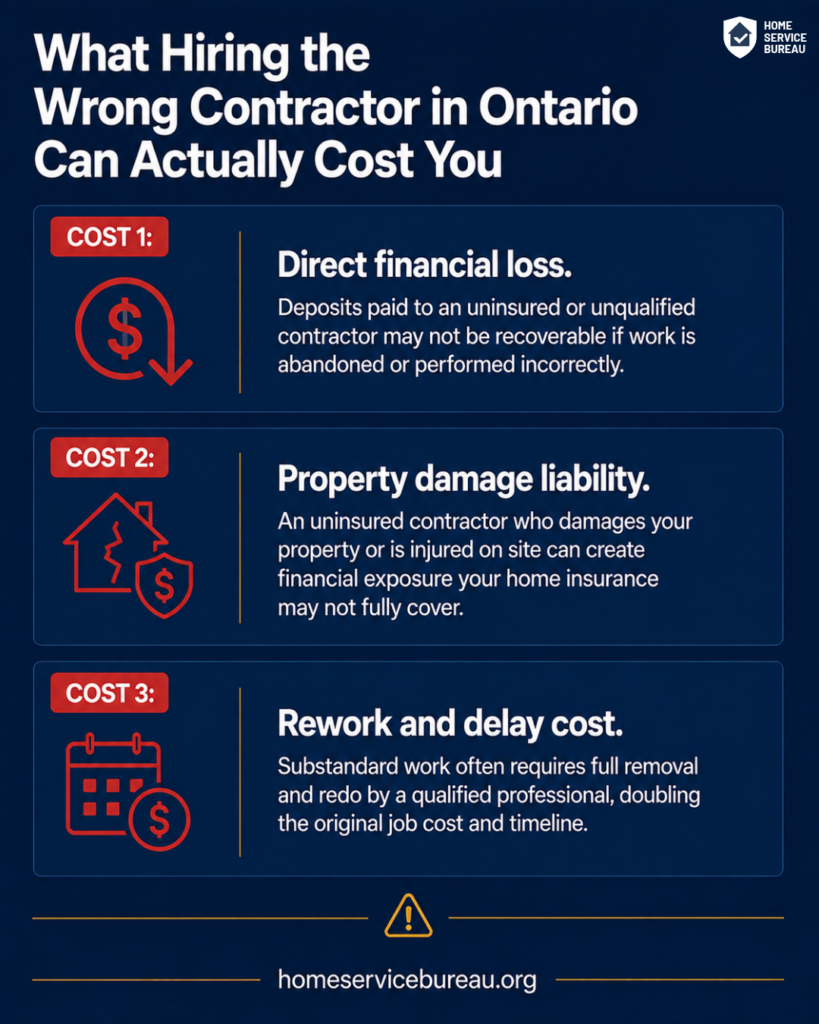
What Hiring the Wrong Contractor in Ontario Can Actually Cost You
Homeowners underestimate the downstream cost of a bad hire because they measure only the deposit they lose. The full exposure runs far deeper.
Cost 1: Direct financial loss. Deposits paid to an uninsured or unqualified contractor may never return to you if the crew abandons the site or performs the work incorrectly. Recovery through small claims consumes months and often produces nothing.
Cost 2: Property damage liability. An uninsured contractor who damages your home or suffers an injury on site creates financial exposure your home insurance policy may not fully absorb. That single gap can exceed the entire project budget.
Cost 3: Rework and delay cost. Substandard work usually requires full removal and a complete redo by a qualified professional. You pay twice for the same result and wait twice as long to use your space.
Understanding these three costs changes how seriously you treat the verification stage.
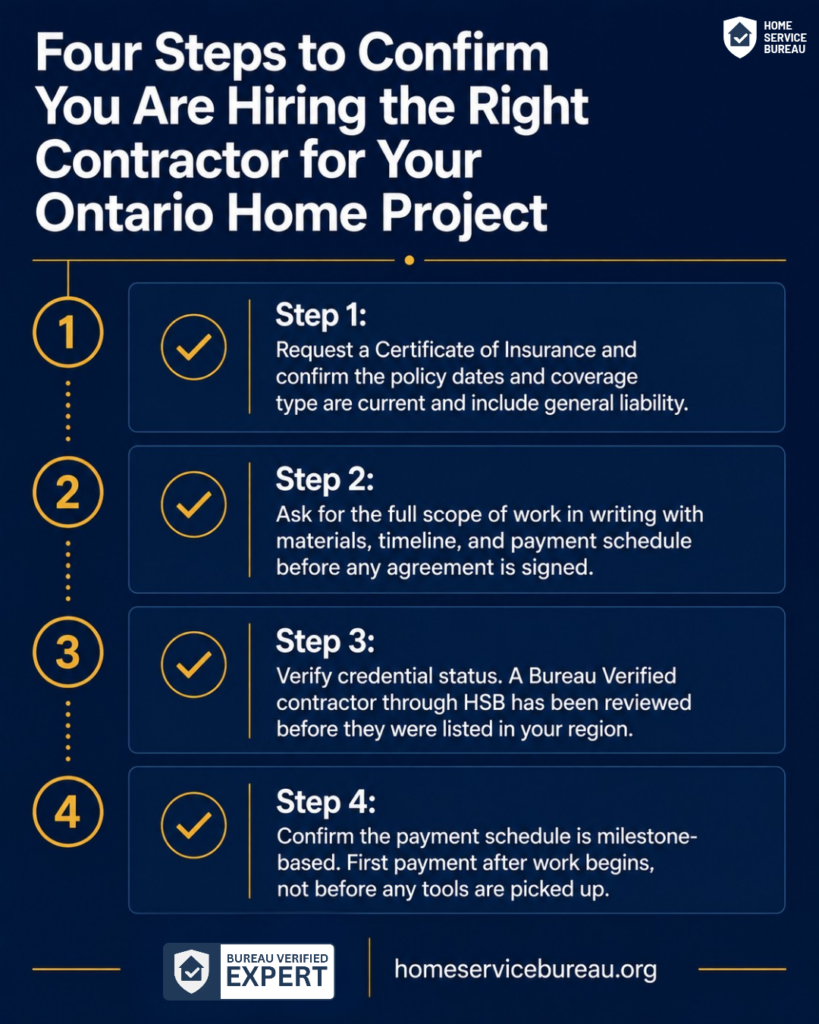
Four Steps to Confirm You Are Hiring the Right Contractor for Your Ontario Home Project
Follow this sequence in order. It takes under an hour and eliminates most risk. Anyone asking how to vet contractor Ontario professionals properly should treat these four steps as non-negotiable.
Step 1: Request a Certificate of Insurance. Confirm the policy dates and coverage type remain current and include general liability. Read the effective and expiry dates yourself rather than accepting a summary.
Step 2: Ask for the full scope of work in writing. The document should list materials, timeline, and payment schedule before anyone signs an agreement. A detailed scope prevents the change-order disputes that derail projects mid-build.
Step 3: Verify credential status. A contractor reviewed and approved before appearing in your region carries a meaningful advantage over an unverified name from a search result. Independent review confirms what a website claims.
Step 4: Confirm the payment schedule is milestone-based. Another step on how to vet contractor Ontario is structure your first payment after work begins, not before any tools arrive on site. Milestones keep both parties accountable through completion.
Common Homeowner Contractor Selection Mistakes GTA Residents Repeat
Certain patterns appear constantly across the region. Recognising them helps you sidestep the most frequent homeowner contractor selection mistakes GTA households make each season.
Homeowners choose the lowest quote without asking why it sits far below the other three. They accept a business card as proof of legitimacy. They allow work to begin without a permit when the municipality clearly requires one. Further, they pay in cash for a discount and forfeit every paper trail that would support a future claim.
GTA contractors homeowner mistakes also include hiring based purely on availability. A contractor who can start tomorrow may simply have no other work booked, and that fact alone deserves a question rather than relief.
Ask direct questions. Request documents. Wait for answers. Professionals respect that process because they pass it routinely.

Hire With Verification, Not Hope
Every homeowner deserves confidence before signing a contract. You do not need industry experience to protect yourself. You need current insurance confirmation, a written scope, verified credentials, and a milestone payment structure.
Home Service Bureau exists for exactly this reason. HSB reviews contractors before listing them in your region, so a Bureau Verified Expert has already passed the credential checks most homeowners never get to run themselves. Instead of guessing which name on a search page deserves your trust, you start from a shortlist that has already cleared independent review.
Verify first. Sign second. Visit homeservicebureau.org to find a Bureau Verified Expert in your area and start your project with certainty rather than hope.
Frequently Asked Questions
1. How do I confirm a contractor holds valid insurance in Ontario?
Request the Certificate of Insurance directly and review the policy dates and coverage type yourself. Contact the listed insurer if anything appears unclear, outdated, or inconsistent with the contractor’s stated business name.
2. Does every home project in Ontario require a permit?
No, but structural, electrical, plumbing, and many exterior projects do. Contact your local municipal building department before work starts, because permit responsibility ultimately rests with the property owner, not the contractor.
3. What deposit amount looks reasonable?
Reasonable deposits cover initial materials rather than a large share of total project value. Structure remaining payments around completed milestones so both parties stay accountable throughout the build from start to finish.
4. Should I always accept the lowest quote?
No. Compare scope, materials, timeline, and credentials alongside price. A quote significantly below the others usually excludes something important, or reflects a contractor who cuts corners to win work.
5. What should a written scope of work include?
Include materials, specifications, project timeline, milestone payment schedule, cleanup responsibilities, and warranty terms. Clear documentation prevents disputes and gives you enforceable reference points if the project drifts off course.
6. How many quotes should I gather?
Collect three quotes from verified contractors. Fewer than three limits your comparison, while significantly more wastes time. Focus on comparing credentials and scope quality rather than price alone.
7. What should I do if a contractor abandons my project?
Document everything immediately with photos, written communication, and payment records. Contact your municipality, review your consumer protection options, and hire a verified professional to assess and complete the remaining work.
8. Can I verify a contractor before I contact them?
Yes. Check credential status, insurance confirmation, and regional listing before you call. Pre-call verification saves time and removes unqualified names from your shortlist immediately, protecting your schedule and budget.