


Most contractors measure success by the job they just completed. The invoice is paid. The project is done. They move on to the next lead and start the acquisition process again.
However, the contractors who build the most sustainable businesses in the GTA do not treat every job as a finished transaction. They treat every completed job as the beginning of a relationship, one that produces repeat projects, referrals, and compounding revenue without the cost of acquiring a new client each time.
The gap between a one-time lead and a Canadian home services long-term client is not wide. It is not bridged by discounts or loyalty programmes. It is bridged by five specific actions taken consistently after every job actions that most contractors skip entirely because the job is done and the next lead is waiting.
In this blog, licensed contractors in Ontario lead to long-term client conversion strategies broken down step by step. You will learn the revenue math behind client retention, the four-touchpoint annual calendar that keeps relationships active, and the system that turns a single project into a multi-year client relationship that costs nothing to maintain.
Why Long-Term Clients Are Worth More Than New Leads
Before covering the how, every contractor needs to understand the why because the financial case for GTA contractors client retention is more compelling than most contractors realise until they calculate it directly.
A one-time lead produces one project. At an average job value of $8,000, they generate $8,000 in revenue, one referral on average, and a $0 acquisition cost from that referral. The relationship then ends.
A long-term client produces three projects over five years at the same average value $24,000 in total revenue. They generate two referrals across that period. Every project after the first costs $0 to acquire because the relationship already exists.
The second project costs nothing to acquire. Every referral after that is free.
This is the revenue math behind single lead to repeat client contractor Ontario conversion. The difference between treating a client as a transaction and treating them as a relationship is not just goodwill; it is $16,000 in additional revenue per client over five years, generated without spending a dollar on lead acquisition.
For a contractor who converts ten one-time leads into long-term clients over the course of a year, this compounds into a pipeline that eventually sustains itself and eventually grows without any additional marketing spend.

5 Actions That Turn a First Lead Into a Long-Term Client
The contractor client relationship GTA is built or lost in the period immediately following project completion. Most contractors lose it not through poor work, but through the absence of the five actions that transform a satisfied client into a long-term one.
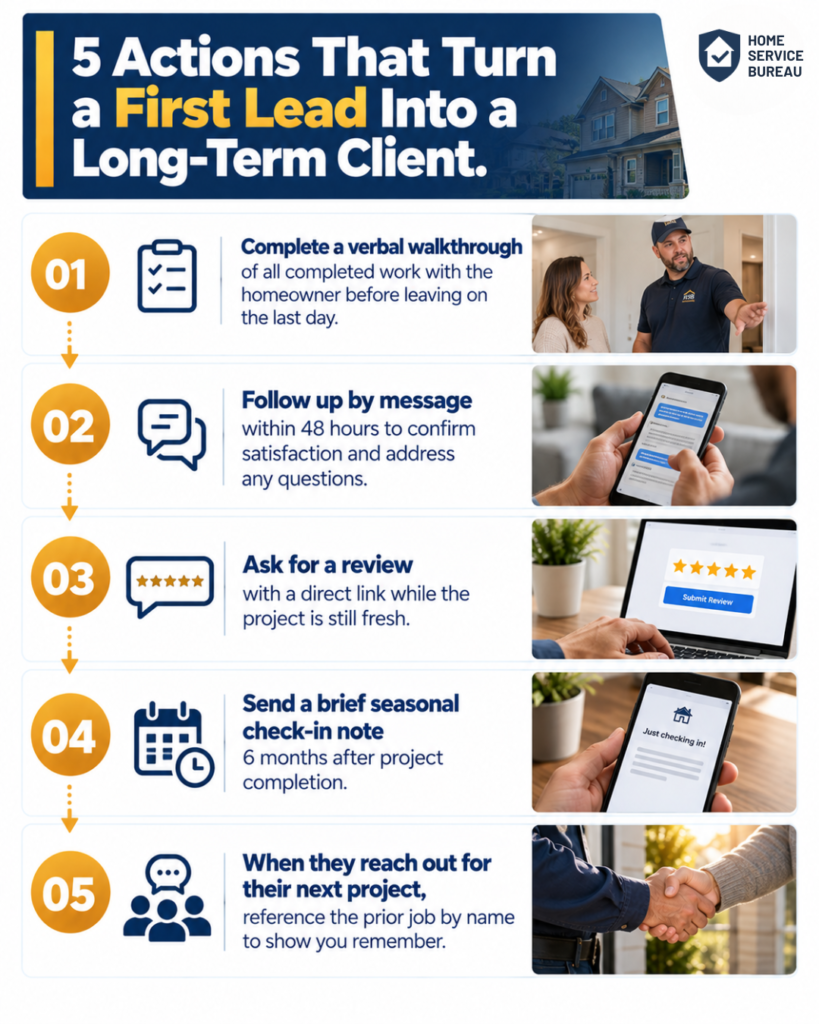
Action 1 Complete a verbal walkthrough of all completed work before leaving on the last day
Walk the homeowner through every element of the completed project on the final day. Point out what was done, why it was done that way, and what to watch for in the weeks ahead. This walkthrough does three things simultaneously: it confirms the homeowner’s satisfaction, it demonstrates the contractor’s professionalism, and it creates a natural opening for the follow-up that comes next.
Action 2 Follow up by message within 48 hours to confirm satisfaction and address any questions
Send a brief, personal message within 48 hours of completing the job. Ask whether everything is working as expected and whether any questions have come up since the walkthrough. Most clients will confirm they are satisfied. A small percentage will raise a minor concern and addressing that concern within 48 hours transforms it into a loyalty-building moment rather than a dissatisfaction that quietly costs the contractor a future referral.
Action 3 Ask for a review with a direct link while the project is still fresh
The best time to request a review is within the first week of completion when the experience is vivid, the satisfaction is high, and the homeowner has not yet moved on to the next thing on their list. Send a direct link to the review platform. Remove every step between the client’s intention to leave a review and the review being published. Most clients who intend to leave a review and face friction simply do not.
Action 4 Send a brief seasonal check-in note six months after project completion
Six months after the job, send a short message two or three sentences checking in and mentioning a relevant seasonal maintenance point. This is not a sales message. It is a professional touch that reminds the client the contractor exists, cares about the property they worked on, and is available when the next need arises. Most contractors never do this. The ones who do are the ones clients call when the next project comes up.
Action 5 When they reach out for their next project, reference the prior job to show you remember
When a returning client contacts the contractor for a new project, reference the previous job specifically. Mention what was done, when, and how it is holding up. This single act demonstrating that the contractor remembers the relationship, not just the invoice differentiates a returning professional from a contractor the homeowner would need to re-evaluate from scratch.
Long-Term Client vs One-Time Lead: The Revenue Math
The Canadian home services long-term client revenue comparison is not theoretical. It is a direct financial calculation that every contractor can apply to their own numbers.
| One-Time Lead | Long-Term Client (5 Years) | |
| Projects | 1 job | 3 projects |
| Revenue | $8,000 | $24,000 |
| Referrals generated | 1 | 2 |
| Acquisition cost | $0 from referral | $0 across all projects |
The second project costs nothing to acquire. The third project costs nothing to acquire. Both referrals cost nothing to acquire. The entire $24,000 in revenue over five years flows from a single initial lead converted into a long-term relationship through five consistent post-project actions.
A contractor who manages this conversion across ten clients per year builds a self-sustaining pipeline. After three to four years, a significant portion of new project enquiries arrive from existing clients and their referrals reducing dependence on paid lead generation entirely.
HSB lead to client retention Ontario contractors who combine regional lead exclusivity with a deliberate client retention system build businesses that compound in value at both ends: new leads arrive without per-lead cost, and existing clients return without acquisition cost.

Your 4-Touchpoint Annual Client Calendar
The GTA contractors client retention system does not require complex technology or significant time investment. It requires four structured touchpoints applied consistently across every completed project.
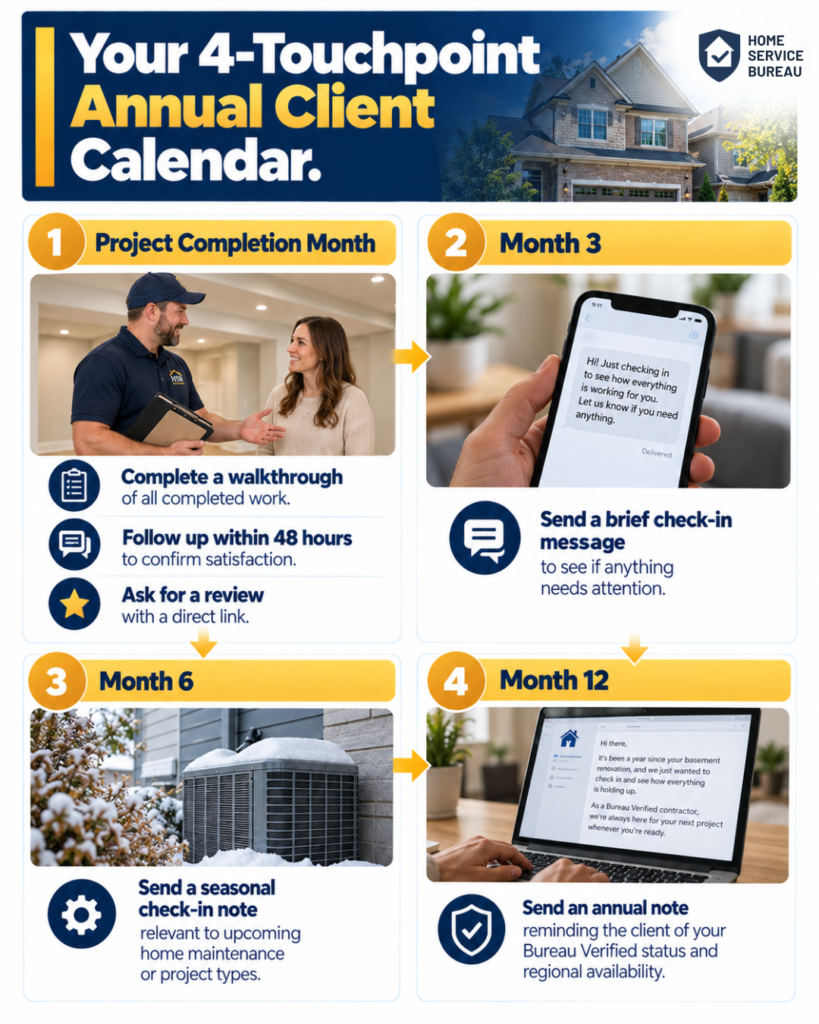
Touchpoint 1 Project Completion Month Complete the verbal walkthrough. Follow up within 48 hours. Request a review with a direct link. These three actions happen within the first week of every completed project and they form the foundation of every client relationship that follows.
Touchpoint 2 Month 3 Send a brief check-in message to confirm everything is working as expected and ask whether anything needs attention. Keep it short two sentences is enough. The goal is presence, not promotion.
Touchpoint 3 Month 6 Send a seasonal check-in note relevant to upcoming home maintenance or project types. Reference the completed project briefly and mention a seasonal consideration relevant to the client’s property. This message positions the contractor as a proactive professional rather than a reactive service provider.
Touchpoint 4 Month 12 Send an annual note reminding the client of Bureau Verified status and regional availability. This message reinforces the contractor’s verified credentials, confirms continued local operation, and plants the seed for the next project at exactly the moment one year post-completion when many homeowners begin thinking about their next home improvement.
Four touchpoints. One per quarter. Applied consistently across every client. The result is a client base that stays warm, refers actively, and returns without requiring re-acquisition.
Conclusion: The Most Valuable Lead Is the One Already in Your Client List
Every licensed contractors in Ontario lead to long-term client conversion starts with a decision to treat the completed job as a beginning rather than an ending.
GTA contractors client retention does not require expensive technology, complex systems, or significant time investment. It requires five post-project actions, four annual touchpoints, and the consistent habit of treating every satisfied client as a relationship worth maintaining.
The revenue math is clear. The single lead to repeat client contractor Ontario model produces three times the revenue per client over five years at zero additional acquisition cost. The referrals it generates compound that advantage further.
Home Service Bureau (HSB) supports this model at every stage. HSB lead to client retention Ontario contractors build businesses that compound in value from both ends: new leads from regional allocation, and returning clients from a retention system that costs nothing to run.
Visit homeservicebureau.ca to check your region and apply for Bureau Verified status today.
FAQs
Q1: How long does it take to turn a one-time client into a long-term relationship?
A: The foundation is set in the first week after project completion. The walkthrough, 48-hour follow-up, and review request establish the pattern. The relationship deepens through the four-touchpoint annual calendar applied consistently across months three, six, and twelve.
Q2: How often should a GTA contractor contact past clients after project completion?
A: Four structured touchpoints annually at completion, month three, month six, and month twelve maintain consistent presence without overcontacting. Brief, relevant, value-focused messages at each touchpoint keep the relationship active without creating disruption.
Q3: Does requesting a review damage the client relationship if they had a less than perfect experience?
A: No if the 48-hour follow-up addressed any concerns first. A contractor who resolves a minor issue promptly and then requests a review is more likely to receive a positive response than one who avoids the conversation and never asks.
Q4: What is the most effective way to ask a past client for a referral?
A: Reference the completed project specifically and ask directly whether they know anyone facing a similar project. A specific, contextual referral request consistently outperforms a generic ask. Most clients who are satisfied refer willingly when asked clearly.
Q5: How does Bureau Verified status support long-term client retention?
A: Bureau Verified status gives existing clients confidence that the contractor maintains professional standards after the initial job. Referencing it in the annual touchpoint message reinforces ongoing credibility and distinguishes the contractor from unverified alternatives the client may encounter elsewhere.
Q6: What should a seasonal check-in message include to be effective?
A: Two to three sentences maximum. Reference the completed project briefly, mention one relevant seasonal maintenance point, and confirm availability for the next project. The goal is professional presence not a sales pitch. Brevity and relevance drive response rates.
Q7: How many long-term clients does a GTA contractor need to reduce dependence on paid lead generation?
A: It varies by trade and average job value. However, most contractors find that twenty to thirty active long-term client relationships generating two to three projects each over five years produce enough referral volume to sustain a significant portion of new project enquiries without additional lead spend.
Q8: Does the HSB platform support long-term client relationship building as well as new lead generation?
A: Yes. HSB’s regional exclusivity ensures that leads from a contractor’s area arrive consistently. The Bureau Verified credential that clients see on the platform reinforces credibility across every interaction including when existing clients return to confirm the contractor’s ongoing verified status before recommending them to someone new.