

A renovation should improve your home, not drain your savings. Yet every year, homeowners across the province sign agreements they barely read and regret it later. Learning the contractor red flags Ontario homeowner communities talk about most gives you a real advantage before any work begins.
Our team at Home Service Bureau (HSB) reviews contractor practices every day. We see the same patterns repeat, and most are easy to catch if you know where to look. This guide walks you through seven warning signs, shows you what good practice looks like, and tells you exactly what to do when something feels wrong.
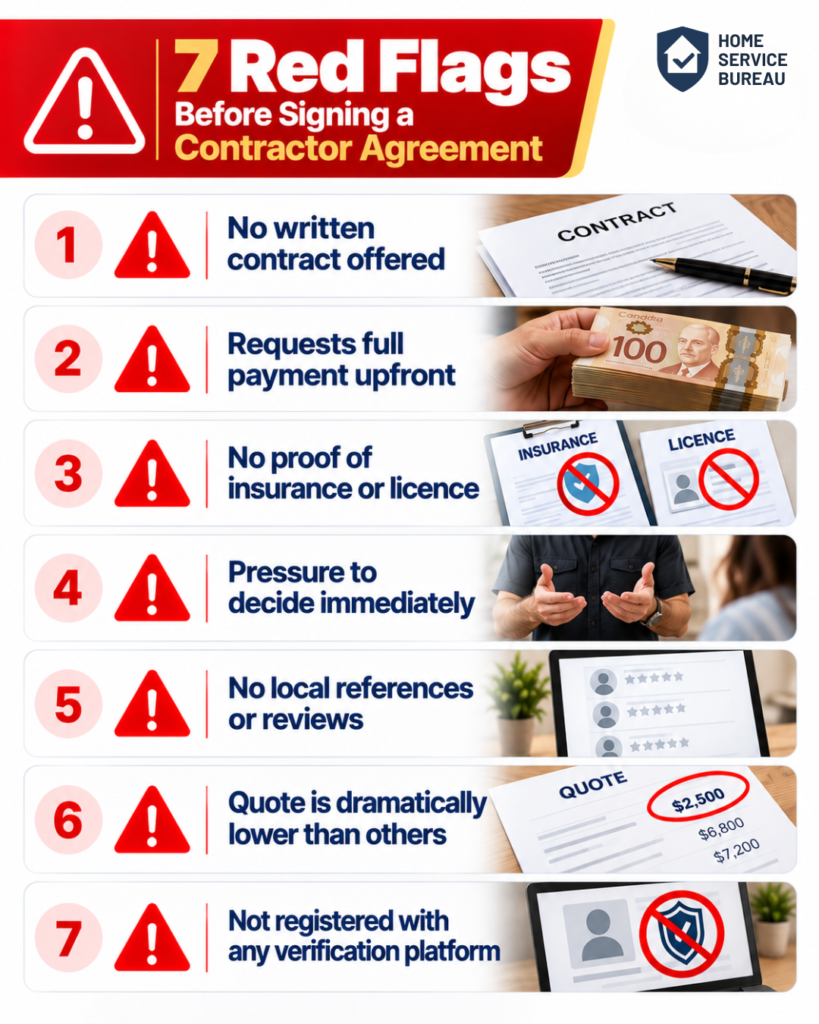
7 Red Flags Before Signing a Contractor Agreement
Each of these contractor agreement red flags Ontario homeowners encounter can cost you time, money, and peace of mind. Review them carefully before you pick up a pen.
1. No Written Contract Offered
A verbal promise protects no one. A professional contractor puts the scope of work, price, timeline, and warranty in writing. If someone avoids a written agreement or offers a vague one-page note, treat that as one of the clearest bad contractor warning signs GTA homeowners can spot. Without a detailed document, you cannot prove what the contractor promised, and you cannot enforce it.
2. Requests Full Payment Upfront
Honest contractors need some money to start a project, but they never need everything on day one. A request for the full amount in advance, especially in cash, ranks among the most common contractor scam red flags Canada wide. Once you hand over the money, you lose your leverage. Insist on a staged payment plan tied to finished milestones.
3. No Proof of Insurance or Licence
Every serious contractor can show proof of liability coverage, workplace insurance, and any licence their trade requires. If they dodge the question or promise to “send it later,” walk away. An uninsured worker who gets hurt on your property can create serious financial and legal trouble for you. Always verify these documents yourself instead of trusting a verbal claim.
4. Pressure to Decide Immediately
Watch out for phrases like “this price expires today” or “I have a cancellation, but only if you sign now.” Artificial urgency is a classic home improvement scam sign Ontario residents report. A good contractor respects your need to review the paperwork, compare options, and ask questions. Pressure exists to stop you from thinking clearly.
5. No Local References or Reviews
Established professionals build a track record in their community. If a contractor cannot give you local references, past project details, or verifiable reviews, you have no way to judge their quality. Be extra careful with reviews that look generic or suspiciously perfect. Call the references, and ask direct questions about deadlines, communication, and cleanup.
6. Quote Is Dramatically Lower Than Others
Everyone likes a bargain, but a quote far below the rest should make you suspicious. Low-ball pricing often signals cheap materials, skipped permits, hidden add-ons, or a plan to demand more money halfway through. Gather at least three itemized quotes and compare them line by line. An outlier deserves questions, not excitement.
7. Not Registered with Any Verification Platform
Today, trusted contractors have no reason to hide. Many join verification platforms that check credentials, insurance, and customer feedback. A contractor who refuses any independent verification forces you to take their word for everything. That gamble rarely pays off.
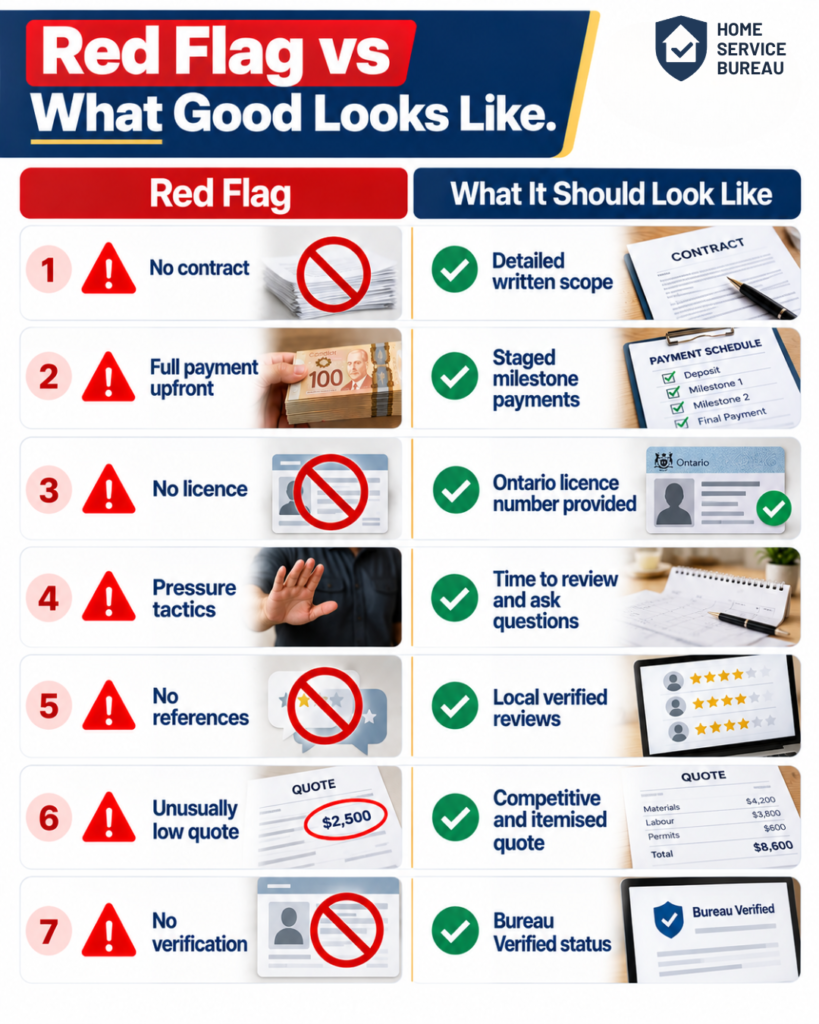
Red Flag vs What Good Looks Like
Spotting trouble gets easier when you know the healthy alternative. Use this quick comparison as a checklist during every meeting:
- No contract → A detailed written scope that covers every task, material, and deadline.
- Full payment upfront → Staged milestone payments, with a small deposit and a final payment after completion.
- No licence → A provincial licence number you can verify yourself.
- Pressure tactics → Plenty of time to review, compare, and ask questions.
- No references → Local, verified reviews you can check independently.
- Unusually low quote → A competitive, itemized quote that breaks down materials, labour, and permits.
- No verification → Verified status through a trusted platform.
This approach shows you how to avoid bad contractor GTA homeowners often run into. When a contractor meets every item on the right side of the list, you can move forward with far more confidence.
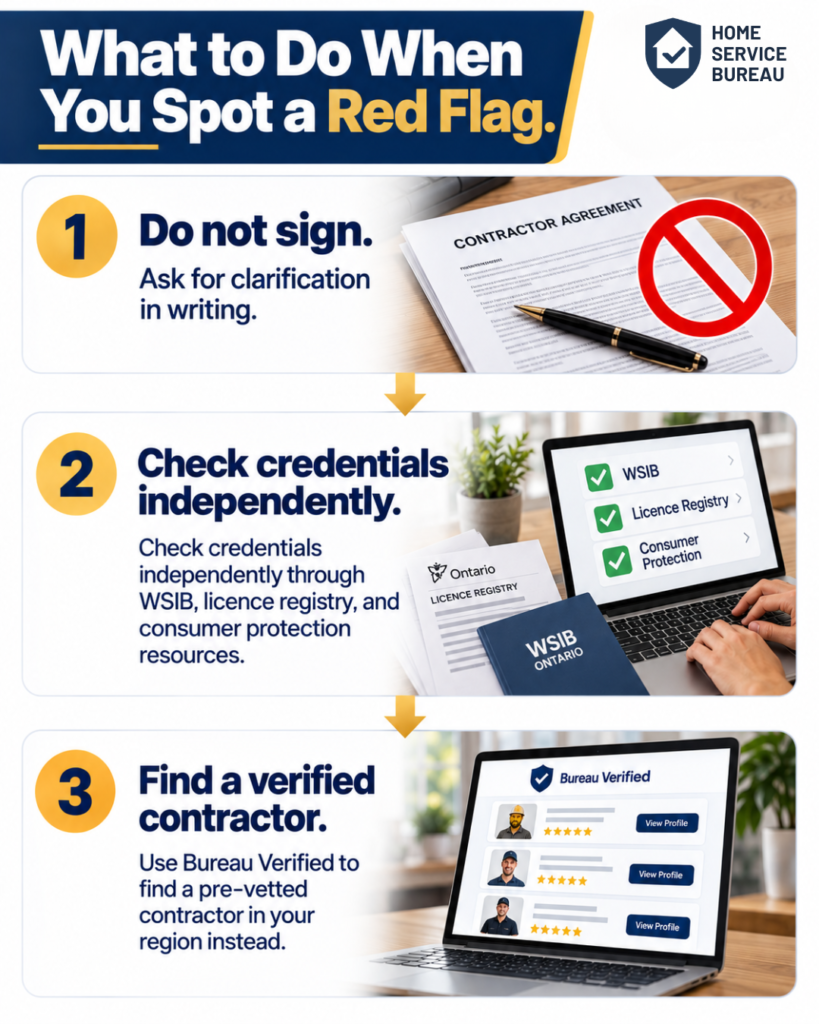
What to Do When You Spot a Red Flag
Noticing a warning sign does not mean you must panic. It means you must slow down and act deliberately. Follow these three steps.
Step 1: Do Not Sign
Put the pen down. Ask the contractor to clarify the concern in writing, whether it involves unclear wording, a missing detail, or a payment term that feels off. A trustworthy professional will answer clearly and without irritation. Evasive or angry replies tell you everything you need to know.
Step 2: Check Credentials Independently
Never rely on documents the contractor hands you without checking them. Contact the provincial workplace insurance board, search the relevant licence registry, and review consumer protection resources. This takes less than an hour and can save you months of stress and thousands of dollars.
Step 3: Find a Verified Contractor
If the red flags pile up, move on. Use a trusted platform to find a pre-vetted contractor in your region instead. Verified listings remove much of the guesswork, because someone has already checked the credentials for you.
Why Taking These Steps Protects Your Home
A renovation is one of the biggest financial decisions you will make as a homeowner. Careful research, written agreements, and independent verification protect that investment. Experienced homeowners and industry professionals agree on one rule: if something feels uncomfortable before the contract, it will feel worse during the project. Trust your instincts, and back them up with proof.

Bottom Line
Every homeowner can learn to spot the contractor red flags Ontario homeowner communities warn about, and every homeowner deserves a fair, transparent agreement. Read the contract closely, verify every credential, compare multiple quotes, and never let anyone rush you into a signature.
You do not have to do this alone. Home Service Bureau connects Ontario homeowners with pre-vetted professionals through its Bureau Verified listings. Each contractor profile shows verified credentials and local reviews, so you can compare your options with confidence. Visit Home Service Bureau today, find a verified contractor in your region, and start your next project with peace of mind.
Frequently Asked Questions
1. What is the biggest contractor red flag in Ontario?
The biggest warning sign is a missing written contract. Without a signed document that lists scope, price, and timelines, you have no protection if the work stalls, costs rise, or the quality falls far short.
2. How much deposit is reasonable for a renovation?
Ask for a small deposit tied to a payment schedule. Reputable contractors request staged payments linked to completed milestones. Never agree to pay the full amount upfront, because you lose leverage once payment is complete.
3. How do I verify a contractor’s licence?
Ask for the licence number, then check it through the relevant provincial or municipal registry. Confirm the contractor also carries workplace insurance and liability coverage. Request proof in writing before you sign anything at all.
4. Is an unusually low quote always a scam?
Not always, but treat it with caution. Compare at least three itemized quotes. A price far below the rest often signals cut corners, hidden charges, or a contractor who plans to demand more money mid-project.
5. Why do pressure tactics matter?
Pressure tactics stop you from reviewing terms and comparing options. Honest contractors give you time to read the agreement, ask questions, and consult others. Anyone who rushes your decision likely hides something you would question.
6. What should a contractor agreement include?
A solid written agreement lists the detailed scope of work, total agreed price, payment schedule, start and final completion dates, materials, warranty terms, permit responsibility, and a clear process for handling changes and any disputes.
7. What should I do if I already signed a bad agreement?
Document everything, including photos and receipts. Pause all further payments and contact the contractor to resolve issues. If that fails, contact provincial consumer protection resources or seek legal advice about your cancellation and remedy options.
8. How does Home Service Bureau help homeowners?
Home Service Bureau helps homeowners find pre-vetted contractors through its Bureau Verified listings. Each profile shows verified credentials and local reviews, so you can compare trusted professionals side by side and hire with greater confidence.