

Homeowners frequently assume that each contractor-matching service works in exactly the same way regardless of the location it operates in. The assumption gets blown out of the water when you examine Canadian homes services and US leading platforms against one another. The two markets developed from different regulatory systems, distinct licensing bodies, and differing homeowner expectations. As such, the platforms designed for each market appear and behave differently.
This blog explains the regulatory, structural, and operational distinctions in Canadian systems and American counterparts. It the reasons why they affect homeowners as well as contractors.
Home Service Bureau Canada vs Angi: A Direct Comparison
An effective way to observe these distinctions in action is to look at comparing home service bureau Canada vs Angi which is among the top recognized US leads generation systems.
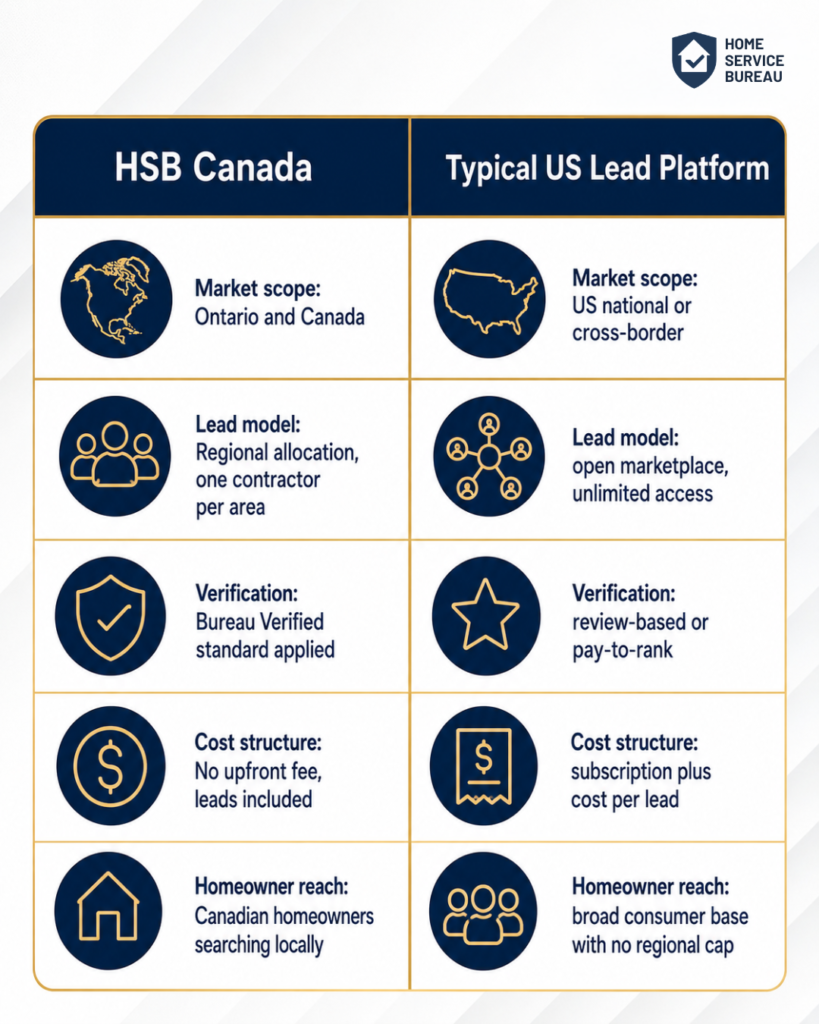
- Market coverage A Canadian-focused bureau usually focuses on Ontario and the wider Canadian market, whereas platforms such as Angi is operating on the US global or cross-border scale.
- lead model Regional allocation of one contractor per region looks quite different from an open marketplace in which any number of providers can use this lead.
- Verification Standard that is bureau-certified linked to insurance and credentials differs from a review-based system or pay-to-rank model, in which visibility can be bought.
- Cost structure: A model with no upfront fee and leads included contrasts with a subscription-plus-cost-per-lead structure that charges contractors on an ongoing basis.
- Reach of homeowners: Canadian homeowners searching locally are a smaller geographically defined audience as compared to a larger population of consumers with no regional limit.
This doesn’t make any system superior to another. It’s just the fact that each platform was created for the particular market it serves. A model for a national marketplace developed specifically for the US will not necessarily translate to a provincially-regulated and distributed regionally similar to Canada’s.
Canadian Home Services Structure: Built Around Provincial Rules
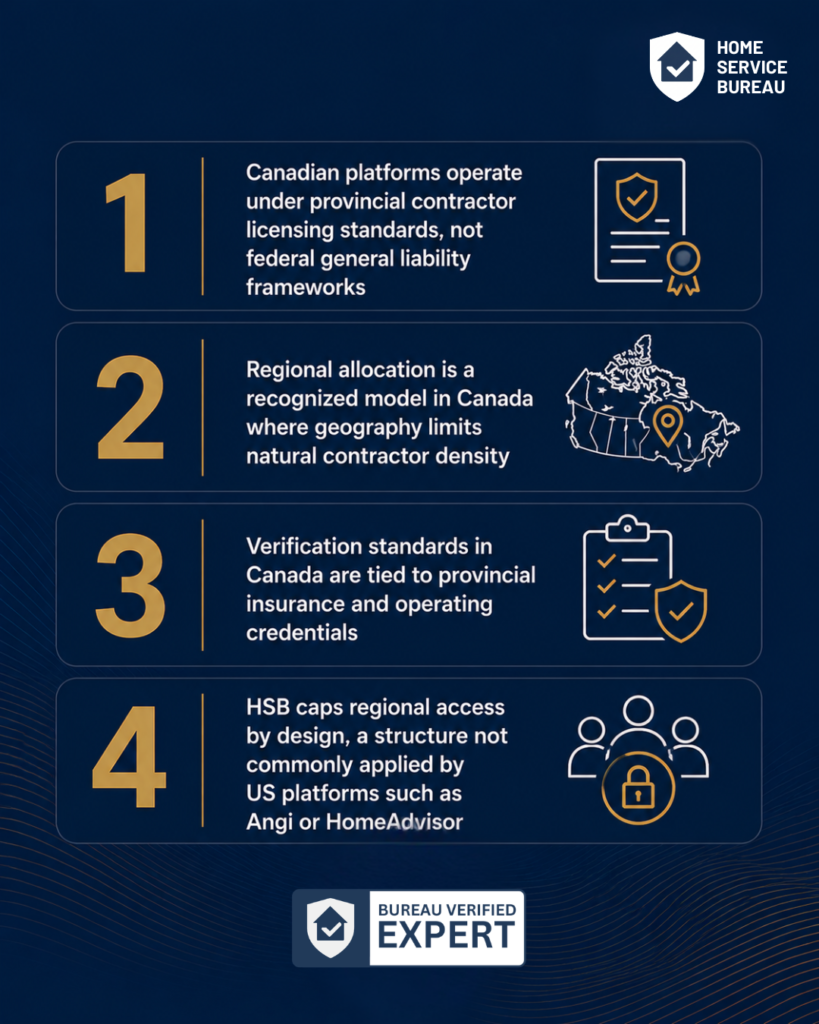
The Canadian home services structure begins with a basic reality: Canada doesn’t regulate contractors at the federal level. Each province has its own requirements for licensing including insurance minimums, as well as trade certifications. An electrician licensed in Ontario is on a different procedure than an electrician located in British Columbia or Alberta.
This patchwork in Ontario forces Canadian platforms to construct their verification processes around regional regulations instead of a single national standard. A platform that operates within Ontario must ensure that the contractor has valid Ontario license and is in compliance with insurance requirements that are specific to the province. This is quite different from a general liability framework where there is a common national framework that applies across the board. Canadian platforms generally operate multiple compliance frameworks under one roof, with one system for each province they service.
This structure is also a factor in the way platforms develop. The process of expanding into a new region isn’t just a matter of turning a knob; it requires learning a brand new licensing rules and establishing the verification process around the rules. It’s a significantly slow, deliberate expansion strategy than the one the majority of US platforms use.
Licensed Contractors in Ontario Platform Canada Model
Ontario provides a clear illustration of how this works out in real life. Ontario’s licensed contractors in Ontario platform Canada model connects verification specifically to operating credentials, and not to subscription tiers or reviews. The contractor is verified if they have an insurance and license that is valid for the work they do and not simply just because they’ve bought a badge or earned an arbitrary star rating.
This approach is part of a larger idea that is prevalent in the Canadian market that trust is built upon documents and certificates and not on popularity scores. This is a longer process to verify however it provides an even more solid foundation for homeowners who need to be sure that the person entering their home is properly train and insured to do the task at hand.
GTA Contractors Canada Difference: Regional Allocation in Action
It is no more apparent as in the GTA contractors Canada difference in comparison to the way US platforms function. GTA contractors Canada is a distinct model from US platforms. Greater Toronto Area is one of the largest homes-service markets in the nation and Canadian platforms typically utilize a regional-based allocation model to connect homeowners to a small number of contractors within a particular area, rather than opening up the floodgates for every registered service.
Why is this important? Regional allocation is based on a geography-based fact that contractor density is extremely different across Canada. A model developed specifically for the GTA will not work exactly the same way for smaller towns three hours to the north. Therefore, platforms build their allocation systems in accordance with actual demand and population patterns, rather than treating the entire country as one market.
This is a well-known and practical model in Canada which limits the number of contractors competing in the same lead pool within the same location. This is a choice for structural reasons that is not accidental and stands against platforms that offer all the access they want to any company who is willing to invest in exposure.
Canada Contractor Lead Market: A Smaller, Tighter Ecosystem
The Canada contractor lead market is merely lower than the US market in terms of both population size and in terms of the number of platforms in use. The smaller size of the market alters the dynamic of competition. A smaller number of contractors are competing for each lead, yet each lead is also carrying more weight since there are less platforms to find new customers.
This more tightly knit ecosystem is pushing Canadian platforms towards an organized approach. Instead of maximising leads, many platforms are focus on the quality of leads and long-term contract relationships within certain regions. It’s a distinct business strategy in contrast to the volume-driven model which prevails in larger markets that are more fragmented.
Why These Differences Matter for Homeowners
The understanding of Canadian homes services vs US leading platforms isn’t just a purely technical exercise. It impacts what homeowners can anticipate when looking for contractors.
In Canada Verified badges is a good indicator of actual insurance and licensing compliance that is in accordance with provincial regulations. In a marke based on reviews the high score could indicate a good reputation in marketing or a high volume of reviews instead of credentials verification. Homeowners who are aware of this distinction will be able to make informed choices about which indicators are actually a sign of reliability.
The regional allocation means that homeowners living in areas like the GTA might have a more restricted, curated list of contractors rather than a plethora of all registered providers across the nation. For homeowners in many areas, having fewer, well-vetted choices are more valuable than an unlimited number of bogus ones.

Final Thoughts
The distinctions among Canadian homes services vs US leading platforms result from regulations geography, regulation, and their philosophy. The provincial licensing rules in Canada, model of regional allocation, as well as credential-base verification offer a framework that is design to operate in a smaller and more tightly control market. US platforms, which operate in a bigger and more scattered market, are leaning toward marketplace access that is open and reviews-driven visibility.
For homeowners looking for a contractor that you can be confident in, or a contractor searching for a platform which accurately represents the real landscape of Canada’s regulation, Home Service Bureau (HSB) offers a specific model specifically designed to serve this particular market. Take a look at HSB today to discover the ways a Canadian-first method of home services can benefit you.
Frequently Asked Questions
1. What is the reason Canadian platforms depend on provincial licensing?
Canada doesn’t regulate contractor licensing at the federal level. Each province has their own standards, and platforms develop verification processes based on provincial laws rather than a uniform national framework.
2. What is the meaning of regional allocation for homeowners living in the GTA?
The regional allocation limits the number of contractors who receive leads within a specific region. Homeowners usually are connected to a limit, more target selection of contractors instead of an open market with unlimit choices.
3. Is a verified contractor with a bureau more trustworthy than a highly-rated one using a review-based platform?
The standards for verification differ. The badges of a bureau-verified company usually reflect the validity of insurance and licensing and a rating based on reviews provides feedback from customers and is dependent on review or marketing volumes, not just the credentials.
4. What are the different ways that Canadian platforms charge their contractors in a different way from US platforms?
A lot of Canadian platforms offer a no-upfront fee model, with leads included; however, most US platforms have the cost-per-lead model with a subscription. Cost models vary depending on the platform so make sure to check the specifics prior to making a decision to sign for.
5. Is an open market model similar to the US model implemented in Canada possible?
However it’s necessary to take into account the provincial licensing regulations in Canada and the differing contractor numbers across different regions. A universal model of a national marketplace isn’t a perfect fit for Canada’s geographic and regulatory realities.