

Most contractors dread objections. When a homeowner says the price is too high, another contractor quoted less, or they need to think about it, the instinct is to defend, discount, or disengage.
However, the contractors who consistently win estimates despite objections do something different. They recognise objections for what they actually are: a sign that the homeowner is still engaged, still considering, and still reachable. An objection is not a rejection. It is an unanswered question wearing a defensive face.
GTA contractors handle homeowner objections most effectively when they treat every objection as an opportunity to provide clarity, demonstrate credibility, and move the conversation forward rather than a signal to retreat or reduce the quote.
In this blog, you will learn how to respond to the five most common Canadian home services contractor objections, how to reframe objections as buying signals, and how to build the conversational confidence that consistently converts hesitant homeowners into committed clients.
Why Objections Are a Sign of Interest Not a Sign of Rejection
Before covering specific responses, every contractor needs to understand one foundational principle: homeowners who object are homeowners who care.
A homeowner who has no interest in your service does not raise objections. They say they will call you back and they do not. Then, they give a polite excuse and end the conversation. They do not push back on your price, question your timeline, or ask about another quote they received.
Licensed contractors in Ontario objection handling starts with this reframe. Every objection signal means:
It means they care. Homeowners ask questions when they are seriously considering the project. An objection confirms active consideration not disengagement.
It gives you a chance to educate. You can clarify concerns and highlight the value of your expertise in a way that no marketing material does. The objection creates the opening.
It builds trust. A thoughtful, calm, factual response to an objection demonstrates professionalism and credibility more powerfully than any credential on a website. Homeowners remember how contractors behave when challenged.
It brings you closer to a yes. Every objection you handle well removes a barrier between the homeowner and a committed decision. Skilled objection handling does not feel like selling it feels like the conversation the homeowner needed to have before they could say yes.
Contractor objection sales Ontario success therefore begins with mindset approaching each objection as a request for more information rather than a closing door.

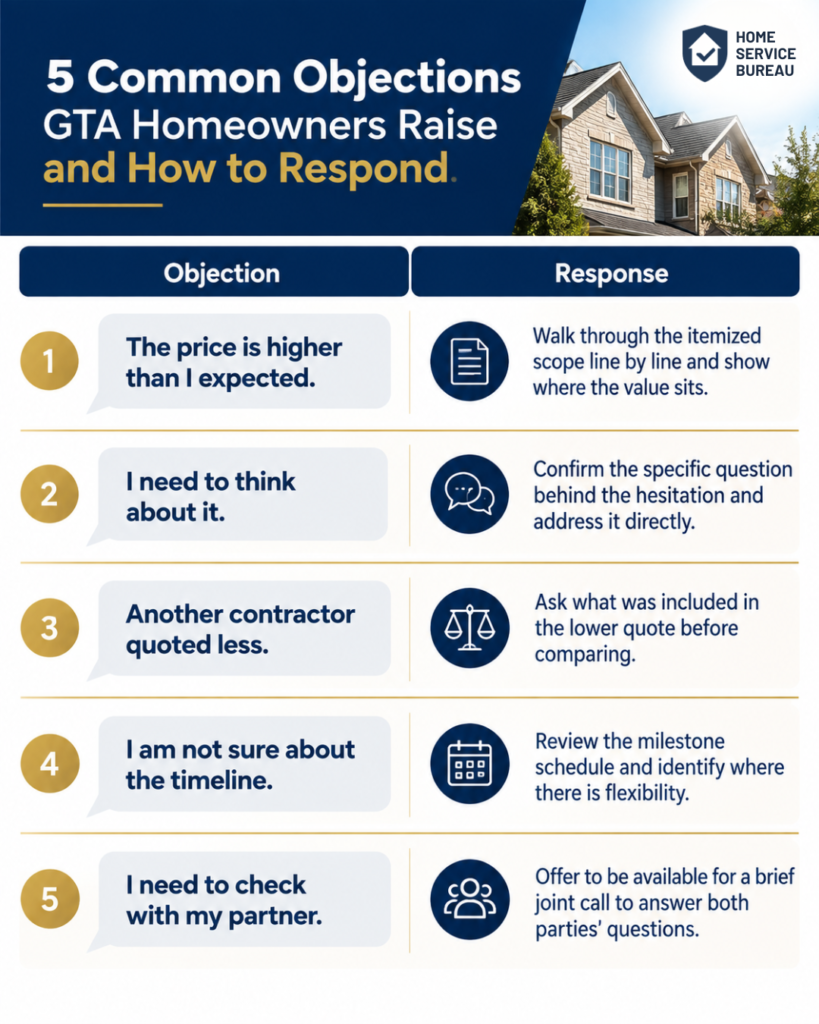
5 Common Objections GTA Homeowners Raise and How to Respond
The homeowner objection response GTA contractors need covers five objections that appear consistently across every trade, every project size, and every neighbourhood in the Greater Toronto Area.
Objection 1 “The price is higher than I expected.”
Why homeowners say it: They compared your quote to a mental estimate they formed without knowing what the job involves. The expectation and the reality do not match and the gap feels uncomfortable.
How to respond: Walk through the itemised scope line by line and show where the value sits. Do not defend the total number in isolation. Show what the total covers materials, labour, timeline, warranty, insurance, and credentials and let the homeowner see that the price reflects the scope, not an arbitrary margin. Most homeowners who raise this objection have never seen a properly itemised quote before. Showing them one resolves it.
Objection 2 “I need to think about it.”
Why homeowners say it: This objection almost never means the homeowner needs time. It almost always means there is a specific question, concern, or hesitation they have not yet voiced. “I need to think about it” is a polite exit from a conversation the homeowner is not yet ready to conclude.
How to respond: Confirm the specific question behind the hesitation and address it directly. Ask: “Is there a specific part of the project or the quote you want to revisit?” Most homeowners will identify the real concern when asked directly and addressing that concern moves the conversation forward far more effectively than waiting for a callback that may never come.
Objection 3 “Another contractor quoted less.”
Why homeowners say it: They received a lower number from another source and want to understand the gap before committing to the higher quote. This is a rational request but it is often handled poorly by contractors who respond defensively rather than analytically.
How to respond: Ask what the lower quote included before comparing. In most cases, the lower quote either excludes line items that your quote covers, reflects a narrower scope of work, or does not account for licensed, insured delivery. Canadian home services contractor objections on price almost always dissolve when the homeowner compares what is actually included in each quote, not just the headline number.
Objection 4 “I am not sure about the timeline.”
Why homeowners say it: The proposed timeline conflicts with their personal schedule, an upcoming event, or a dependency they have not yet disclosed. Timeline uncertainty is almost always a logistics question not a rejection of the work itself.
How to respond: Review the milestone schedule together and identify where there is flexibility. Most timelines have fixed elements and adjustable ones. Showing the homeowner where the project can flex and where it cannot, and why converts timeline uncertainty into a confirmed start date rather than an indefinite delay.
Objection 5 “I need to check with my partner.”
Why homeowners say it: A decision-maker who was not part of the conversation has not yet heard the contractor’s case. The homeowner is not stalling; they are correctly identifying that a joint decision requires both parties.
How to respond: Offer to be available for a brief joint call that answers both parties’ questions. This removes the information gap that the second decision-maker holds and prevents the project from being killed by a concern that could easily be resolved with five minutes of direct conversation.
How to Turn Objections Into Opportunities With Confidence
GTA contractors handle homeowner objections most consistently when they apply a structured conversational approach, one that produces confident, calm, value-focused responses rather than reactive or defensive ones.
Five principles define this approach.
Listen first. Understand the real concern before responding. Contractors who respond to the surface statement rather than the underlying concern almost always miss the point and the opportunity. Pause. Ask a clarifying question. Confirm what you heard before you answer.
Stay calm. A confident, respectful response builds trust at exactly the moment the homeowner is evaluating how the contractor behaves under pressure. Homeowners who challenge a quote and receive a composed, factual response feel more confident not less about the contractor they are speaking with.
Provide clarity. Address the concern with facts and a clear explanation. Emotion does not resolve objections. Specific information does. Walk through the relevant detail the scope, the credential, the material specification, the timeline rationale and let the facts carry the conversation.
Focus on value. Reinforce the long-term benefits, not just the immediate cost. A homeowner evaluating a roofing quote is not only buying a roof they are buying weather protection, energy efficiency, insurance compliance, and peace of mind for the next fifteen years. Framing the conversation around long-term value consistently reduces price sensitivity.
Move forward. Turn the conversation into the next step. Every successful objection response ends with a clear, specific proposed action a joint call, a revised timeline review, a scope walkthrough. Do not leave an objection response open-ended. Close the gap with a defined next step the homeowner can say yes to immediately.
Licensed contractors in Ontario objection handling that follows these five principles produces measurably better conversion rates not because the contractor uses pressure tactics, but because they give homeowners the information and the confidence they need to make a committed decision.

Why Bureau Verified Contractors Handle Objections From a Stronger Position
Homeowner objection response GTA conversations start differently for Bureau Verified contractors because the credential that HSB applies before listing changes the baseline of every interaction.
A Bureau Verified contractor who faces a price objection does not need to establish that they are insured, legitimate, and regionally authorised in response to the objection. They established all of that before the homeowner raised any concern. The Bureau Verified credential answers the most common underlying questions “can I trust this person?” and “are they properly qualified?” before the homeowner asks them.
This baseline advantage shifts the entire objection handling dynamic. The contractor does not spend the conversation defending their legitimacy. They spend it clarifying value, reviewing scope, and addressing the specific practical concern the homeowner actually holds. That is a much more efficient and much more effective sales conversation.
Win estimate despite objections contractor Ontario outcomes improve when the contractor’s credibility is pre-confirmed because the homeowner enters the objection from a position of trust rather than unresolved doubt.

Conclusion: Objections Are the Conversation Before the Commitment
Every objection a homeowner raises is a conversation that needs to happen before they can commit. GTA contractors handle homeowner objections most effectively when they treat each one as an opening not an obstacle.
Licensed contractors in Ontario objection handling that is calm, specific, value-focused, and structured consistently outperforms reactive or defensive responses on price, timeline, competitor comparisons, and every other concern a homeowner raises during the estimate process.
The contractors who win estimates despite objections are not the ones with the lowest quotes. They are the ones who give homeowners the clearest, most confident, most factual path to a decision they feel good about.
Home Service Bureau (HSB) supports Bureau Verified contractors with the credential foundation that makes every sales conversation start from a stronger position. When your insurance, identity, and regional eligibility are pre-confirmed by an independent body, the objections you face are practical not fundamental and practical objections are always resolvable.
If you want to hold a Bureau Verified position in your region and carry the credential that changes how homeowners receive every conversation you have, your area may still be available. Visit homeservicebureau.ca to check your region and apply today.
FAQs
Q1: What is the most common objection GTA homeowners raise during a contractor estimate?
A: Price objections are the most frequent. However, they almost always reflect scope uncertainty rather than genuine budget limitation. Walking through the itemised quote line by line resolves most price objections without reducing the quote.
Q2: Should a contractor lower their price when a homeowner mentions a cheaper competitor?
A: Not before asking what the competitor’s quote includes. Lower quotes typically reflect narrower scope, excluded insurance, or missing line items. Comparing scope before comparing price usually reveals that the quotes are not equivalent.
Q3: How should a GTA contractor respond to “I need to think about it”?
A: Ask directly what specific concern sits behind the hesitation. Most homeowners identify the real question when asked. Addressing that question directly moves the conversation forward more effectively than waiting for a callback.
Q4: How does Bureau Verified status help contractors handle objections more effectively?
A: It pre-confirms the contractor’s insurance, identity, and regional credentials removing the most common underlying concerns before the homeowner raises them. Objections then focus on practical project details rather than contractor legitimacy questions.
Q5: How many times should a contractor follow up after a homeowner says they need to think about it?
A: Follow up once within 24 to 48 hours with a specific, value-focused message that addresses any concern raised in the original conversation. After that, one final follow-up at a week is appropriate. Beyond this, the lead requires a different nurture approach.
Q6: Is it appropriate for a contractor to offer a joint call when a homeowner says they need to check with their partner?
A: Yes and it is highly effective. Offering a brief joint call removes the information gap between both decision-makers and prevents projects from stalling because a second party heard the proposal secondhand rather than directly.
Q7: How does a contractor handle timeline objections without offering discounts?
A: Review the milestone schedule together and identify adjustable elements. Most timelines contain fixed and flexible components. Showing the homeowner exactly where flexibility exists converts timeline uncertainty into a confirmed start date without any financial concession.
Q8: What is the biggest mistake contractors make when handling objections?
A: Responding defensively rather than curiously. Contractors who treat objections as attacks respond with justification rather than information which rarely resolves the underlying concern. Asking a clarifying question before responding almost always produces a better outcome.