


A per-lead invoice looks simple on paper, but it rarely tells the full story. Most contractors track the fee they pay for each inquiry and stop there, without factoring in close rates, wasted follow-ups, or the trust gap a homeowner feels before an estimate is even presented. Understanding GTA contractors pay per lead real cost requires looking past the sticker price and calculating what each closed job actually costs once every variable is accounted for.
This article walks through how to run that calculation properly, why verification changes the numbers before a quote is even delivered, and how a regional model compares once the math is laid out side by side.
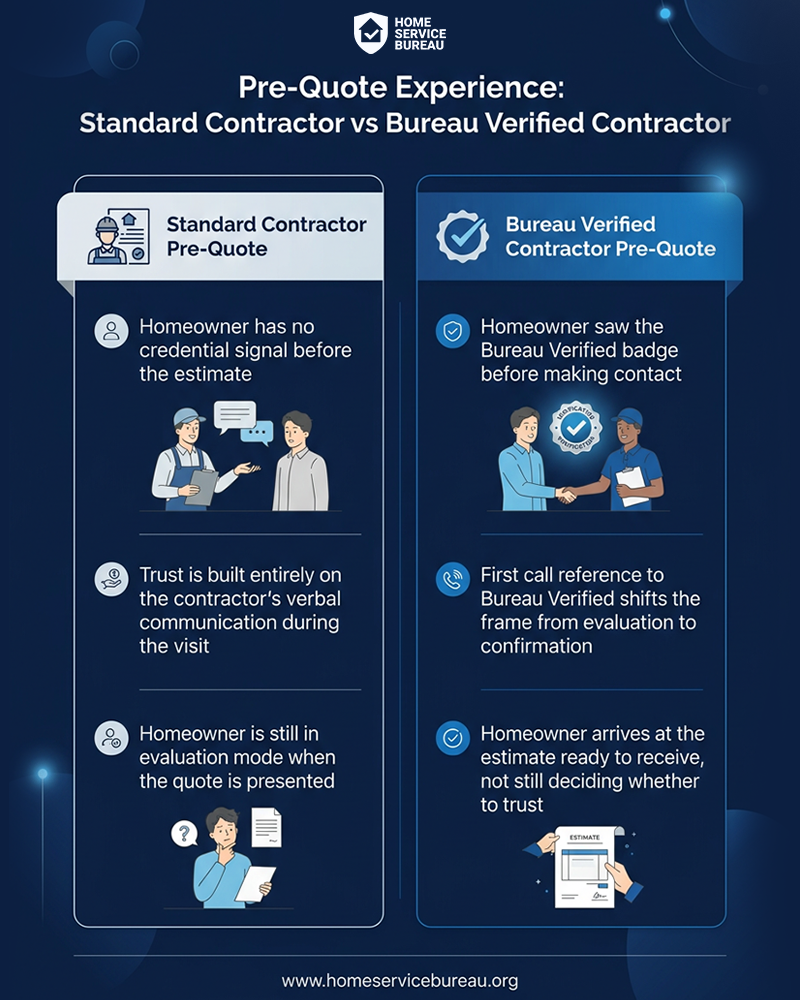
Pre-Quote Experience: Standard Contractor vs Bureau Verified Contractor
Before any cost calculation makes sense, it helps to understand what happens before the quote is even presented. Because this stage quietly affects close rates and, by extension, real cost per job.
Under a standard contractor pre-quote experience, the homeowner has no credential signal before the estimate. Trust gets built entirely on the contractor’s verbal communication during the visit, with nothing backing it up beforehand. By the time the quote is presented, the homeowner is often still in evaluation mode. Mentally weighing whether this contractor is even legitimate rather than focusing on the actual scope of work.
A Bureau Verified contractor pre-quote experience looks different from the first point of contact. The homeowner sees the Bureau Verified badge before making contact, which shifts the entire frame of the conversation. The first call reference to Bureau Verified status moves the homeowner from evaluation to confirmation before the visit even happens. By the time the estimate is presented, the homeowner arrives ready to receive it, not still deciding whether to trust the person standing in front of them.
This distinction matters directly for licensed contractors in Ontario lead cost calculation, because a homeowner who’s already past the trust question. That converts at a noticeably higher rate than one who’s still deciding whether the contractor is credible.
How to Activate the Bureau Verified Advantage on Every GTA Lead
Verification only improves close rates if it’s actually used at every touchpoint. There’s a four-step sequence that keeps the credential visible from first contact through final quote.
Step one, the contractor call. Mention Bureau Verified status in the voicemail or within the first 30 seconds of the initial call. This sets the tone before any other detail of the conversation begins.
Step two, send a confirmation. After booking, send a confirmation text that includes Bureau Verified status. This reinforces the credential in writing, giving the homeowner something to reference before the visit.
Step three, arrive prepared. Show up at the estimate with the Bureau Verified credential visible on documentation or a shirt badge. Visual confirmation on-site closes the loop between what was said on the phone and what the homeowner sees in person.
Step four, reference it again at the quote. When presenting the digital quote, reference Bureau Verified status once more as the reason the standard is higher than an unverified competitor. This final mention reinforces value right at the decision point.
Following this sequence consistently is part of what drives the improved close rates reflected in any accurate contractor lead spend Ontario analysis. Since a credential mentioned once and then dropped rarely carries the same weight as one reinforced at every stage.

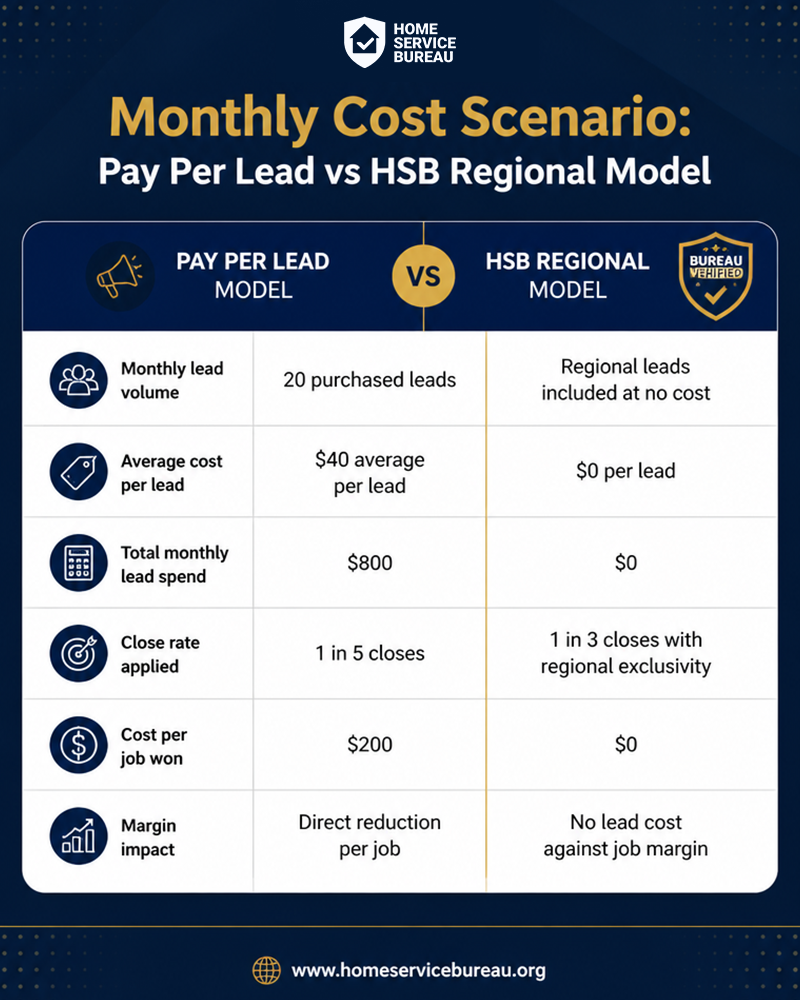
Monthly Cost Scenario: Pay Per Lead vs HSB Regional Model
Numbers make the real cost comparison clear. Consider a monthly scenario built around twenty purchased leads.
Under the pay-per-lead model, a contractor buys twenty leads a month at an average cost of $40 per lead, bringing total monthly lead spend to $800. Applying a close rate of one in five, the contractor lands four jobs from those twenty leads. That puts the cost per job won at $200, a figure that comes directly out of margin on every single project regardless of size.
Under the HSB regional model, regional leads are included at no cost, meaning $0 per lead and $0 total monthly lead spend. With regional exclusivity in place and no competing contractors fielding the same inquiry, the close rate applied in this scenario rises to one in three. Cost per job won lands at $0, with no lead cost cutting into job margin at any point in the process.
This is the core of the HSB vs lead cost GTA comparison: it isn’t just that one model charges a fee and the other doesn’t. It’s that removing the fee alongside improving exclusivity and trust compounds into a meaningfully different cost structure per job won, not just per lead purchased.
Why Real Cost Calculation Matters More Than Lead Price Alone
Looking only at the price tag on a lead misses the larger picture. A $40 lead that closes at a low rate can end up costing far more per job than a $60 lead that closes reliably, simply because the denominator in the calculation is jobs won, not leads purchased. This is the foundation of any legitimate Canadian home services lead ROI analysis: cost per lead is only half the equation, and close rate is the variable that determines whether a lead spend actually pays for itself.
A proper pay per lead cost breakdown contractor teams should run monthly includes total spend, number of leads purchased, close rate. And cost per job won, calculated together rather than in isolation. Skipping any one of these variables produces a number that looks reassuring on a spreadsheet. But doesn’t reflect what’s actually happening to margin at the end of the month.

Ending Words
Calculating the real cost of a pay-per-lead model means going beyond the per-lead price tag and factoring in close rate. Trust at first contact, and cost per job won. Once those variables are combined, a model that looked affordable on paper can turn out to be a significant drain on margin. While a model with no per-lead fee and stronger exclusivity can come out meaningfully ahead.
Home Service Bureau’s regional allocation model removes lead cost from the equation entirely, pairs it with Bureau Verified credentials that build trust before the first quote is presented, and gives contractors regional exclusivity that improves close rates rather than diluting them across competitors. Contractors ready to see what their region’s real cost comparison looks like can explore how Home Service Bureau’s regional model works for their area.
Frequently Asked Questions
1. What does real cost per lead actually mean?
Real cost per lead accounts for total monthly spend divided by jobs won, not just the price charged per inquiry. It reflects how much a contractor truly pays for each completed project, factoring in close rate.
2. How does close rate affect the real cost calculation?
A lower close rate raises the real cost per job even if the per-lead price stays the same. Fewer conversions from the same spend means each closed job absorbs a larger share of total lead cost.
3. Why does verification improve close rates?
Verification builds trust before the estimate is presented, moving the homeowner from evaluation to confirmation. Homeowners who already trust the contractor’s credentials are more likely to proceed with the quote presented.
4. What is cost per job won?
Cost per job won is total monthly lead spend divided by the number of jobs closed. It’s a more accurate measure of lead spend efficiency than cost per lead alone, since it reflects actual revenue-generating outcomes.
5. Does regional exclusivity change the cost calculation?
Yes. Exclusive regional leads face no direct competition from other contractors on the same inquiry, which tends to raise close rates and lower cost per job won compared to shared, competitive lead models.
6. How much can lead spend affect monthly margin?
In a typical scenario, $800 in monthly lead spend across twenty leads can translate to $200 per job. That is won at a low close rate, directly reducing margin on every project regardless of job size.
7. Is a $0 per-lead model always better than a paid one?
Removing lead cost helps, but the real advantage comes from combining no cost with better close rates and exclusivity. A $0 model with poor conversion still needs volume, while exclusivity improves both cost and conversion.
8. How often should contractors run this cost calculation?
Reviewing lead spend, close rate, and cost per job won monthly helps contractors catch inefficiencies early. And compare models accurately, rather than relying on assumptions about which lead source performs better.