

You hired a trade, paid a deposit, and cleared the space. Then the crew stopped showing up. Half the kitchen sits unfinished, calls go to voicemail, and nobody can tell you when the job resumes. This situation frustrates thousands of households every year, and it follows a predictable pattern. The good news is that you hold more leverage than you think. When a contractor does not complete work, Ontario homeowner protections, documentation habits, and provincial oversight bodies all work in your favour provided you act in the right order.
This guide walks through exactly what to do, what to collect, and where to escalate.
First, Define What “Not Completed as Agreed” Actually Means
Before you escalate anything, separate delay from default. A two-week slip caused by a permit backlog differs sharply from a crew that abandons the site after collecting seventy percent of the contract value.
Ask yourself three questions. Did the work stop entirely, or did it slow down? Does the finished portion match the agreed specification, or did the materials and methods change without your approval? Has the contractor communicated a revised completion date in writing?
Incomplete work usually falls into one of four buckets: outright abandonment, partial completion with no return date, substituted materials or reduced scope, or workmanship that fails inspection. Each bucket leads to a different resolution path, so name the problem precisely. Vague complaints rarely produce results. Specific, documented claims almost always do.
Verified vs Unverified: When Something Goes Wrong
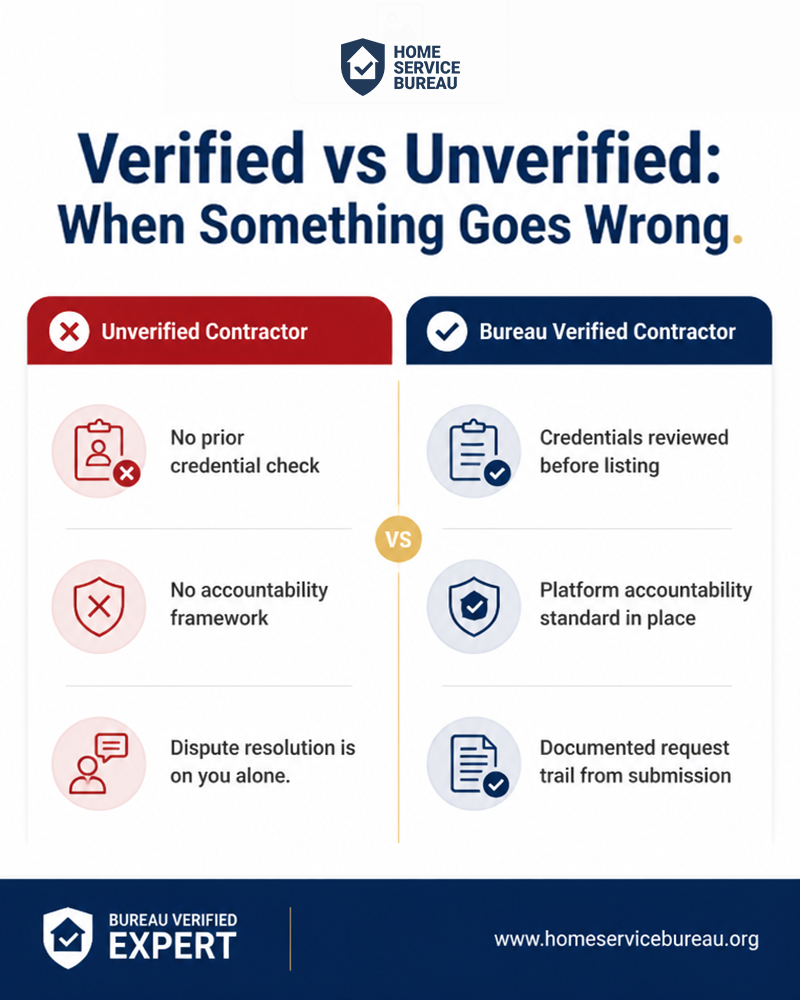
The difference between a verified and an unverified trade becomes obvious the moment a project stalls.
An unverified contractor arrives with no prior credential check. Nobody confirmed their licensing, insurance, or business registration before they stood in your driveway. No accountability framework sits behind them. When the relationship breaks down, dispute resolution falls entirely on you your time, your research, your persistence.
A Bureau Verified contractor works differently. Credentials get reviewed before the listing goes live. A platform accountability standard already applies to their conduct. A documented request trail exists from the moment of submission, which means a third party can see what was promised and when.
That distinction matters enormously for licensed contractors in Ontario dispute resolution. Verification does not guarantee a perfect project no system does. What it does provide is a paper trail, a standard to measure performance against, and a body that has already vetted the basics. Contractor accountability Ontario depends on that groundwork being laid before the first invoice, not after the dispute begins.
Agreement Checklist: Protect Yourself Before Work Starts
Most disputes over GTA contractors incomplete work trace back to a thin or verbal agreement. Ontario’s consumer protection rules require written contracts for most home renovation work above a modest threshold, and a detailed agreement remains your single strongest asset.
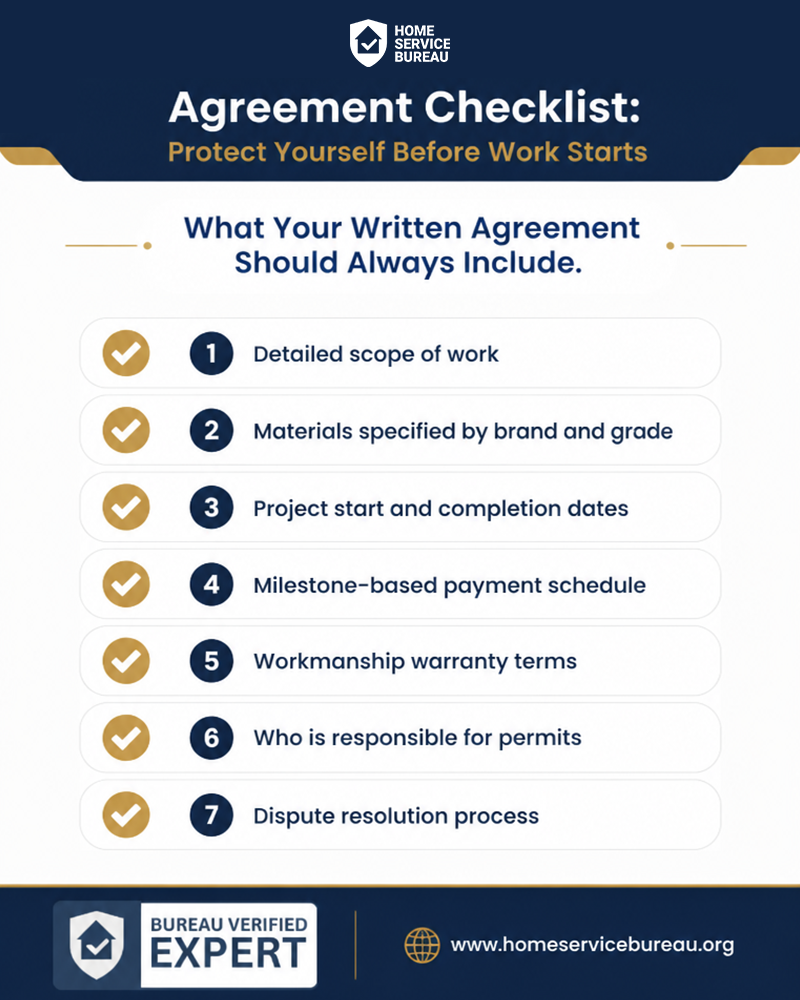
Your written agreement should always include:
- Detailed scope of work every task, room, and deliverable named explicitly
- Materials specified by brand and grade never “or equivalent” without your written approval
- Project start and completion dates with a clause covering justified delays
- Milestone-based payment schedule payments tied to verified progress, never to the calendar alone
- Workmanship warranty terms duration, coverage, and the process for claims
- Who is responsible for permits including inspection scheduling and fees
- Dispute resolution process mediation, arbitration, or the courts, agreed in advance
Hold back a meaningful final payment until the work passes inspection and you have signed off. Contractors who resist milestone payments or refuse to specify materials are telling you something important. Listen.
5 Steps When Work Is Not Completed as Agreed
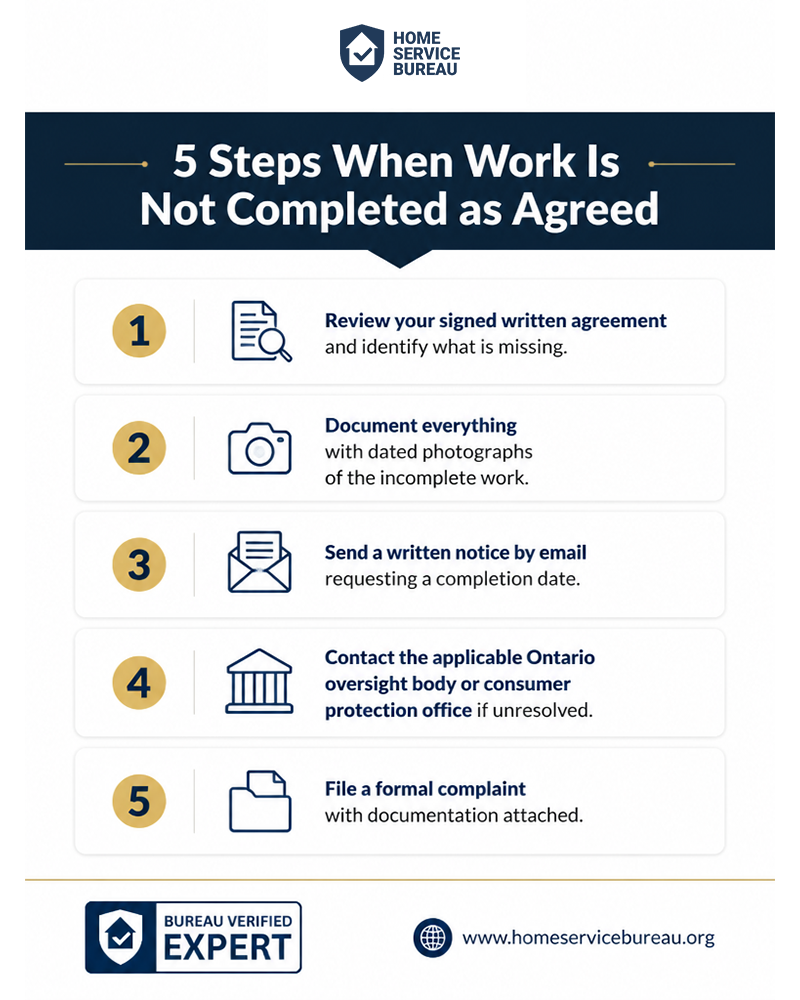
Once a project has genuinely stalled, follow this sequence. Skipping steps weakens your position later.
Step 1: Review your signed written agreement and identify what is missing. Print it. Highlight each deliverable that remains outstanding. Build a simple two-column list promised versus delivered.
Step 2: Document everything with dated photographs of the incomplete work. Photograph every room, every unfinished surface, every delivered and undelivered material. Keep the metadata intact. Save invoices, e-transfer confirmations, text messages, and change orders in one folder.
Step 3: Send a written notice by email requesting a completion date. Email creates a timestamped record that phone calls never will. State the outstanding items factually, request a firm completion date, and set a reasonable deadline for a reply. Keep the tone professional. This email becomes evidence.
Step 4: Contact the applicable Ontario oversight body or consumer protection office if unresolved. The right body depends on the trade. Electrical work falls under the Electrical Safety Authority. Fuel and gas work falls under the TSSA. New home builders answer to the Home Construction Regulatory Authority, with warranty claims handled through Tarion. Permit and code issues go to your municipal building department. General consumer complaints go to Consumer Protection Ontario.
Step 5: File a formal complaint with documentation attached. A complaint supported by a contract, dated photographs, and an email trail carries far more weight than a narrative account. This is where homeowner recourse contractor GTA cases succeed or stall.
Escalating Further: Legal Options in Ontario
If the oversight route does not resolve matters, Ontario’s Small Claims Court handles disputes up to $35,000 and does not require a lawyer. Prepare your contract, payment records, photographs, correspondence, and critically a written quote from another trade showing the cost to complete the outstanding work. That quote establishes your damages.
Watch for construction liens as well. A contractor or supplier may register a lien against your property under the Construction Act, and strict timelines apply. If a lien appears on title, seek legal advice quickly rather than waiting.
For larger claims, or where structural safety is involved, consult a construction lawyer before making further payments or hiring a replacement crew.
Reduce the Risk on Your Next Project
Every Canadian home services homeowner complaint carries a lesson worth applying forward. Verify licensing and WSIB coverage before signing. Request a certificate of insurance directly from the insurer, not from the contractor. Never pay large deposits in cash. Tie money to milestones. Keep all communication in writing, even when a phone call feels easier.
Above all, start with contractors whose credentials someone has already checked.

Bottom Line
A stalled renovation feels personal, but resolving it is a procedural exercise. Define the gap, document it, notify in writing, escalate to the right body, and file formally if needed. Homeowners who follow that sequence recover their position far more often than those who negotiate by phone and hope for the best.
Better still, avoid the situation altogether. Home Service Bureau (HSB) exists precisely for this reason. Every Bureau Verified Expert passes a credential review before listing, operates under a platform accountability standard, and leaves a documented request trail from the first submission onward. That structure protects you before a dispute ever starts and gives you something solid to point to if one does.
Visit www.homeservicebureau.org to find a Bureau Verified Expert in your area, and hire with a record behind you rather than a hope in front of you.
Frequently Asked Questions
1. Can I withhold final payment if the work is incomplete?
Yes. Withhold an amount proportionate to the outstanding work, document your reasoning in writing, and keep the funds available. Never withhold payment silently, as that weakens your position during dispute resolution.
2. How long should I wait before escalating a stalled project?
Send a written notice once work stops for two weeks without explanation. Give a reasonable deadline, usually seven to fourteen days, then escalate to the applicable oversight body if the contractor stays unresponsive.
3. Does Ontario require a written contract for renovation work?
Ontario consumer protection rules require written agreements for most home renovation contracts above a modest value threshold. Always insist on one regardless of size, because verbal agreements become nearly impossible to enforce later.
4. What if the contractor changed materials without telling me?
Unapproved substitution breaches your agreement. Photograph the installed materials, compare them against your written specification, and request either replacement or a written credit. Document the entire exchange through email for evidence.
5. Can I hire another contractor to finish the job?
Yes, but document the incomplete work thoroughly first and obtain a written completion quote. That quote establishes your damages if you later pursue compensation through Small Claims Court or formal dispute resolution.
6. What is a construction lien and should I worry about one?
A construction lien is a legal claim registered against your property by a contractor or supplier seeking payment. Strict timelines apply, so seek legal advice immediately if one appears on title.
7. Does hiring a verified contractor guarantee the work gets completed?
No system guarantees outcomes. Verification confirms credentials before listing and creates a documented accountability trail, which makes disputes considerably easier to resolve and discourages the behaviour that causes abandonment.
8. Where do I file a formal complaint in Ontario?
File with the oversight body governing that trade, such as the Electrical Safety Authority, TSSA, or HCRA. General complaints go to Consumer Protection Ontario. Always attach contracts, photographs, and correspondence.