


Hiring a contractor for a home renovation or repair involves more than finding someone who offers an affordable price. You need to understand what the project includes, whether the contractor has the right credentials, and how their proposed costs compare with other professionals.
This raises an important question for homeowners: how many contractor quotes should I get Ontario before making a hiring decision?
Ontario’s consumer protection guidance recommends getting at least three written estimates from different contractors. This gives homeowners a useful reference point for comparing project costs, materials, labour, and proposed timelines. However, collecting multiple quotes only helps when you know what to look for. The lowest price does not always represent the best value.
This guide explains why three quotes make a practical starting point, how to compare contractor estimates, and which warning signs deserve attention before you sign an agreement.
How Many Contractor Quotes Should You Get in Ontario?
For most home renovation and repair projects, homeowners should aim to collect at least three written estimates.
The Ontario government’s guidance on home renovations recommends obtaining written estimates from at least three contractors. It also advises homeowners to have contractors inspect the property rather than accept estimates over the phone without assessing the work. Ontario’s home renovation guidance.
Three estimates provide a useful comparison without making the selection process unnecessarily complicated. The first establishes a reference price, the second helps identify differences in pricing and project scope, and the third provides another point of comparison.
For more complex projects, homeowners may request additional estimates when the proposals differ significantly or leave important questions unanswered.
The objective behind how many quotes before hiring contractor Canada homeowners should collect is not simply to gather prices. It is to understand the actual value, quality, and scope of the proposed work.
Why Three Quotes Is the Right Number
Getting three contractor estimates gives homeowners a clearer picture of the expected project cost.
The first quote establishes a reference point. It introduces the proposed scope, estimated materials, labour charges, and expected timeline. You can use this information to understand the contractor’s approach to the project.
The second quote reveals differences. Another contractor may recommend different materials, suggest additional work, or structure the payment schedule differently. These differences help you identify details that require clarification.
The third quote helps identify pricing outliers. Comparing three proposals makes it easier to recognise whether one contractor has significantly higher or lower pricing than the others.
However, three quotes do not guarantee a reliable decision. Each contractor must assess the same project requirements for the comparison to remain useful.

Comparing the Price vs Comparing the Value
One of the biggest mistakes homeowners make is focusing entirely on the total price.
A lower estimate may appear attractive, but it could exclude important materials, labour requirements, preparation work, or finishing tasks. Another contractor may charge more because their proposal includes a more detailed scope, better-quality materials, or additional services.
When conducting a contractor quote comparison GTA homeowners should examine the complete proposal rather than selecting the lowest headline figure.
Start by comparing the scope of work. Check whether each contractor has included the same tasks, materials, preparation, installation, and cleanup responsibilities.
Next, review credentials and insurance. Ask for relevant trade licences, proof of liability insurance, and applicable WSIB information. These details help establish whether the contractor meets the requirements for the proposed work.
Payment terms also deserve attention. Review deposit requirements, payment milestones, warranties, and procedures for approving changes during the project.
Finally, examine verified reviews and any applicable third-party verification status. A contractor’s professional record can provide additional information when assessing their suitability.
A meaningful comparison considers what you receive for the quoted amount, not simply how much you pay.

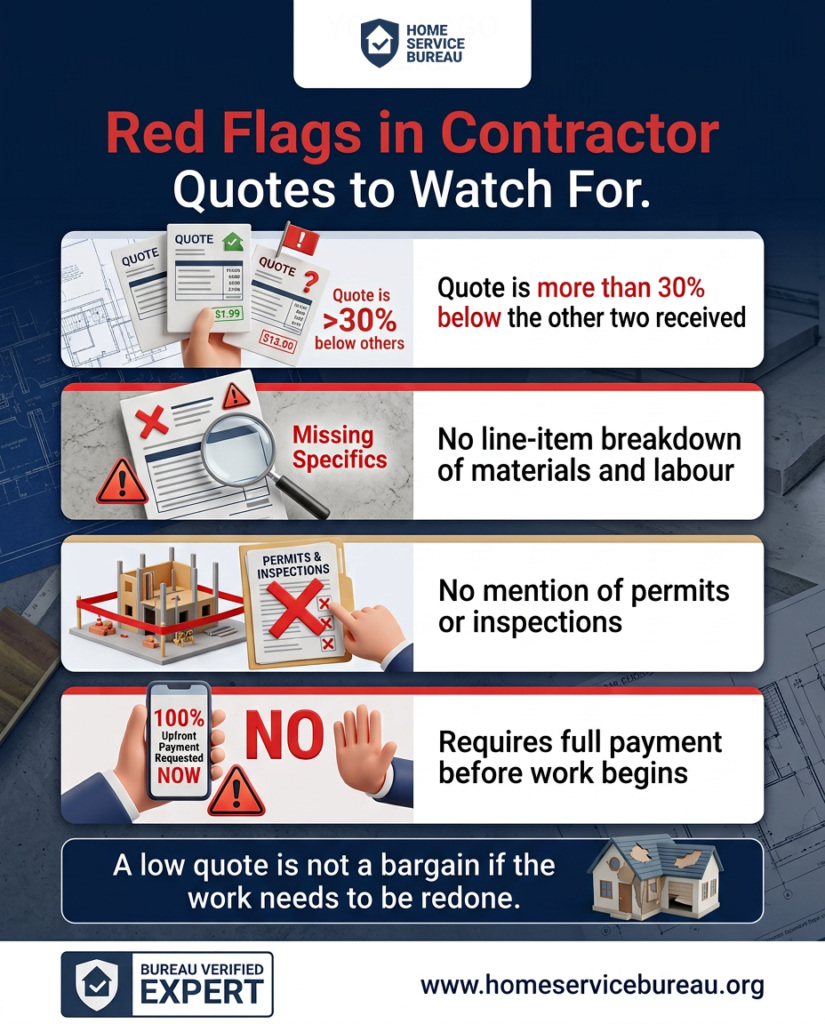
Red Flags in Contractor Quotes to Watch For
Not every estimate provides enough information to support an informed hiring decision. Some proposals contain warning signs that homeowners should investigate before proceeding.
A Quote That Is More Than 30% Below Other Estimates
A significantly lower quote deserves closer examination, particularly when other contractors have assessed the same project and provided similar pricing.
The difference may reflect missing materials, incomplete labour calculations, excluded services, or an incorrect understanding of the project.
A price difference of 30% or more is not an automatic reason to reject a contractor. However, it should prompt you to request a detailed explanation and confirm that the proposal covers the entire project.
Missing Details About Materials and Labour
A quote should explain what the contractor plans to complete and which materials they intend to use.
Be cautious when an estimate provides only a single total without explaining the work involved.
Request an itemised breakdown covering materials, labour, equipment, and other applicable charges. This makes it easier to identify missing tasks and compare proposals accurately.
No Mention of Permits or Inspections
Some renovation projects require municipal building permits or inspections.
Ask whether your project needs approval and clarify who will arrange the necessary permits. Include these responsibilities in the written agreement.
Do not assume that a contractor’s quotation automatically covers permit applications or associated costs.
A Demand for Full Payment Before Work Begins
Be careful when a contractor requests the entire project payment upfront.
Ontario’s consumer guidance recommends keeping down payments to a minimum and advises against paying the full contract amount before the work is complete.
A written payment schedule should connect payments to clearly defined project stages. This gives both parties a better understanding of their financial responsibilities.
How to Compare Contractor Estimates in the GTA
Homeowners comparing contractor estimates GTA homeowner projects require should follow a consistent evaluation process.
First, give every contractor the same project description and requirements. If one contractor receives different information, their estimate may not reflect the same amount of work.
Second, arrange an on-site assessment where appropriate. Contractors need to inspect the property to understand existing conditions, measurements, access requirements, and potential complications.
Third, ask each contractor to provide a written, itemised estimate. Ontario recommends written estimates and explains that homeowners should include the accepted estimate in their contract.
Under Ontario’s Consumer Protection Act, when a consumer contract includes an estimate, the supplier generally cannot charge more than 10% above that estimate unless the consumer agrees to additional or different work through an amended agreement. Review the applicable terms before signing.
Finally, compare references, credentials, communication, and payment conditions alongside pricing.
You can also check the Ontario government’s consumer protection guidance before making your final decision.
How HSB Helps Homeowners Find Verified Contractors
Collecting contractor estimates is only one part of choosing the right professional. Homeowners also need confidence in the businesses they invite to work on their properties.
Home Service Bureau (HSB) offers a Bureau Verified programme that reviews contractor information and supporting credentials.
Its verification framework covers areas such as business identity, applicable licences, insurance documentation, WSIB status, and homeowner reviews. HSB also uses regional allocation to connect homeowner enquiries with contractors in designated service areas.
For homeowners, this provides another reference point when evaluating available professionals. Rather than relying entirely on advertisements or informal recommendations, they can search for contractors with Bureau Verified status and review the available profile information.
However, third-party verification should complement independent checks. Always confirm that relevant licences, insurance, and project-specific requirements remain current.

Bottom Line
So, how many contractor quotes should I get Ontario homeowners planning a renovation should collect? Three written estimates provide a practical starting point for comparing prices, project scope, materials, and contractor suitability.
However, the number of quotes matters less than the quality of your evaluation. Look beyond the total price, investigate unusually low estimates, review credentials, and understand the payment terms before signing an agreement.
Home Service Bureau (HSB) makes contractor research easier through its Bureau Verified programme and structured regional allocation model. Homeowners can use HSB to discover verified professionals and gain additional information when comparing their options.
Before starting your next home improvement project, visit Home Service Bureau to find Bureau Verified contractors. Compare their credentials, review your estimates carefully, and choose a professional who offers the right combination of experience, transparency, and project value.
Frequently Asked Questions
1. How many contractor quotes should I get before hiring in Ontario?
Ontario recommends obtaining at least three written estimates from different contractors. This helps homeowners compare pricing, materials, labour, project scope, and timelines before selecting a suitable professional for their renovation.
2. Is getting three contractor quotes enough for a renovation?
Three quotes usually provide a useful starting point for comparison. However, complex renovations or significantly different estimates may justify additional proposals to clarify project requirements, pricing differences, and contractor qualifications.
3. Should I always choose the cheapest contractor quote?
No. A cheaper estimate may exclude important materials, labour, or services. Compare the complete scope, credentials, insurance, warranties, and payment conditions before deciding which contractor offers the best overall value.
4. What should a contractor’s written estimate include?
A written estimate should describe the project scope, materials, labour, individual costs, and expected timelines. It should also identify exclusions, applicable charges, and other details needed to prepare an accurate contract.
5. What should I do if one contractor quote is significantly lower?
Ask the contractor to explain the price difference and provide an itemised breakdown. Check whether the estimate excludes materials, labour, permits, or essential tasks before considering the proposal further.
6. Can a contractor charge more than the original estimate in Ontario?
When an estimate forms part of a consumer contract, Ontario generally limits charges to 10% above it. Additional or different work may require an agreed amendment to the contract.
7. How can I compare contractor quotes fairly?
Give every contractor identical project requirements and compare written estimates. Review materials, labour, timelines, warranties, credentials, insurance, and payment terms to understand the actual value behind each proposed price.
8. How does HSB help homeowners choose contractors?
HSB helps homeowners research Bureau Verified contractors through its credential review framework, homeowner feedback, and regional allocation process. Homeowners should also independently confirm current licences, insurance, and project-specific requirements.