


Most contractor disputes in Ontario do not start with bad workmanship. They start with an incomplete process before the first tool is picked up.
A homeowner who skips licence verification, accepts a verbal scope, or releases payment without milestone confirmation does not simply take on more risk they remove the protection that the entire hire contractor steps Ontario process is designed to provide. When something goes wrong, the absence of documentation and due diligence is what turns a manageable complaint into an expensive, unresolvable dispute.
This blog gives every GTA homeowner a complete contractor hiring checklist Ontario homeowner guide covering what to verify before work begins, what to monitor during the project, and how to close a project properly to protect your rights, your budget, and your property at every stage.
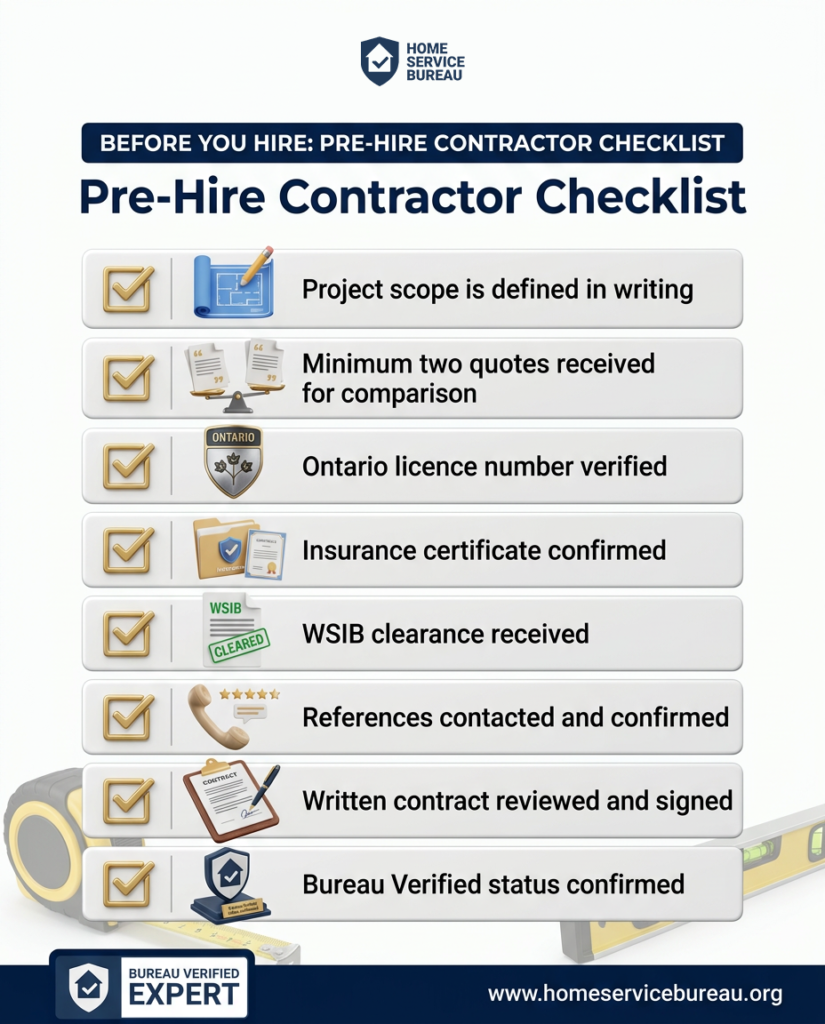
Before You Hire: Pre-Hire Contractor Checklist
The contractor pre-work checklist Canada covers every verification step a homeowner must complete before signing a contract or releasing any payment. Each item on this list exists because its absence has produced a documented, preventable outcome for Ontario homeowners.
Project scope is defined in writing
Before requesting any quotes, the homeowner defines the full project scope in writing. This document describes every element of the work materials, finishes, dimensions, and any exclusions. A written scope protects the homeowner at every subsequent stage, from quote comparison to contract review to dispute resolution. A contractor who quotes without a written scope is pricing something undefined and an undefined scope is an open invitation for cost escalation.
Minimum two quotes received for comparison
The before hiring contractor checklist GTA standard requires a minimum of two written quotes for direct comparison. Quotes must be for the same written scope to be meaningfully comparable. A lower quote that covers a narrower scope is not better value it is a narrower commitment that creates gaps the homeowner will pay to fill later. Never compare quotes based on headline price alone.
Ontario licence number verified
Every licensed trade in Ontario holds a registration number that is independently verifiable. The homeowner confirms this number before any contract is signed. A contractor who cannot or will not provide a verifiable licence number for the relevant trade is not meeting the hire contractor steps Ontario minimum standard regardless of how credible they appear in conversation.
Insurance certificate confirmed
Active liability insurance protects the homeowner if property damage or injury occurs during the project. The homeowner requests a current insurance certificate not a verbal confirmation, not a policy number, not a promise to send it later. A legitimate contractor provides this document immediately on request. Hesitation or delay on this item is a decisive signal about how the rest of the engagement will proceed.
WSIB clearance received
Workplace Safety and Insurance Board clearance confirms that the contractor’s workers are covered for work-related injury while on the homeowner’s property. Without WSIB clearance, a worker injured on site may have grounds to pursue the homeowner directly. This is not an optional step in the contractor hiring checklist Ontario homeowner process; it is a liability protection measure every homeowner must complete.
References contacted and confirmed
References from recent, comparable projects give the homeowner direct insight into how the contractor performs not how they present. The homeowner contacts references and asks specific questions: Was the project completed on time? Did the final cost match the quoted price? Were scope changes handled in writing? Would you hire this contractor again? Generic positive references are less useful than specific, detailed ones.
Written contract reviewed and signed
The contract specifies the full scope of work, the agreed timeline, the milestone-based payment schedule, the warranty terms, and the dispute resolution process. Every element agreed verbally must appear in the written contract before the homeowner signs. If a contractor resists putting any agreed term in writing, that resistance tells the homeowner everything they need to know before a dollar changes hands.
Bureau Verified status confirmed
Bureau Verified status confirms that an independent body has reviewed the contractor’s licence, insurance, and regional eligibility before listing them on the platform. This is the final pre-hire confirmation in a complete contractor pre-work checklist Canada and the one that provides the most structured protection for the entire engagement that follows.
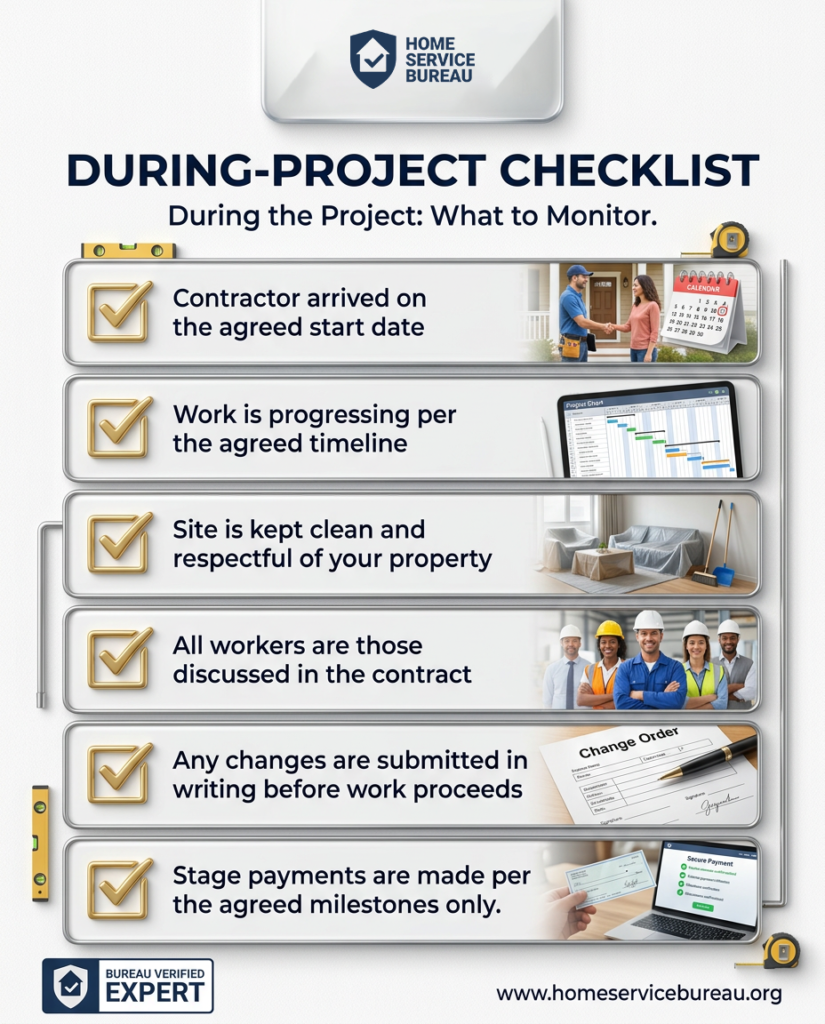
During the Project: What to Monitor
Homeowner contractor preparation GTA does not end at contract signing. Active monitoring throughout the project protects the homeowner against scope drift, payment exposure, and quality deviations that are far easier to address during the project than after it is complete.
Contractor Arrived on the Agreed Start Date
The start date in the contract is a commitment, not a guideline. A contractor who does not arrive on the agreed date without prior written notification has already deviated from the contract. The homeowner notes this, communicates formally in writing, and monitors closely from that point forward.
Work Is Progressing Per the Agreed Timeline
The homeowner checks progress against the contract timeline regularly throughout the project not only at milestone payment points. A project that falls significantly behind schedule in its early stages rarely catches up without direct intervention. Catching timeline deviation early gives the homeowner the opportunity to address it before it compounds.
Site Is Kept Clean and Respectful of Your Property
A professional contractor maintains a clean, organised work site throughout the project. Debris, materials, and tools are managed in a way that respects the homeowner’s property. A consistently messy or disrespectful site is not a cosmetic issue; it is a signal about the contractor’s overall approach to their professional obligations.
All Workers Are Those Discussed in the Contract
The homeowner verifies that every person working on their property is covered by the contractor’s insurance and WSIB clearance. If subcontractors arrive who were not discussed during the pre-hire process, the homeowner asks for confirmation that they are covered before work proceeds. Uninsured workers on a homeowner’s property create direct liability exposure.
Any Changes Are Submitted in Writing Before Work Proceeds
No scope change however minor it appears proceeds without written confirmation of the change and its cost impact before work begins. A verbal agreement about additional work is the most reliable source of invoicing disputes in the homeowner contractor preparation GTA experience. The written change order is not an administrative burden. It is a protection for both parties.
Stage Payments Are Made Per the Agreed Milestones Only
The homeowner releases payment only when the milestone tied to that payment has been demonstrably completed, not when the contractor requests it ahead of schedule. A milestone-based payment schedule protects the homeowner’s financial leverage throughout the project. Releasing payments ahead of milestones removes that leverage entirely.
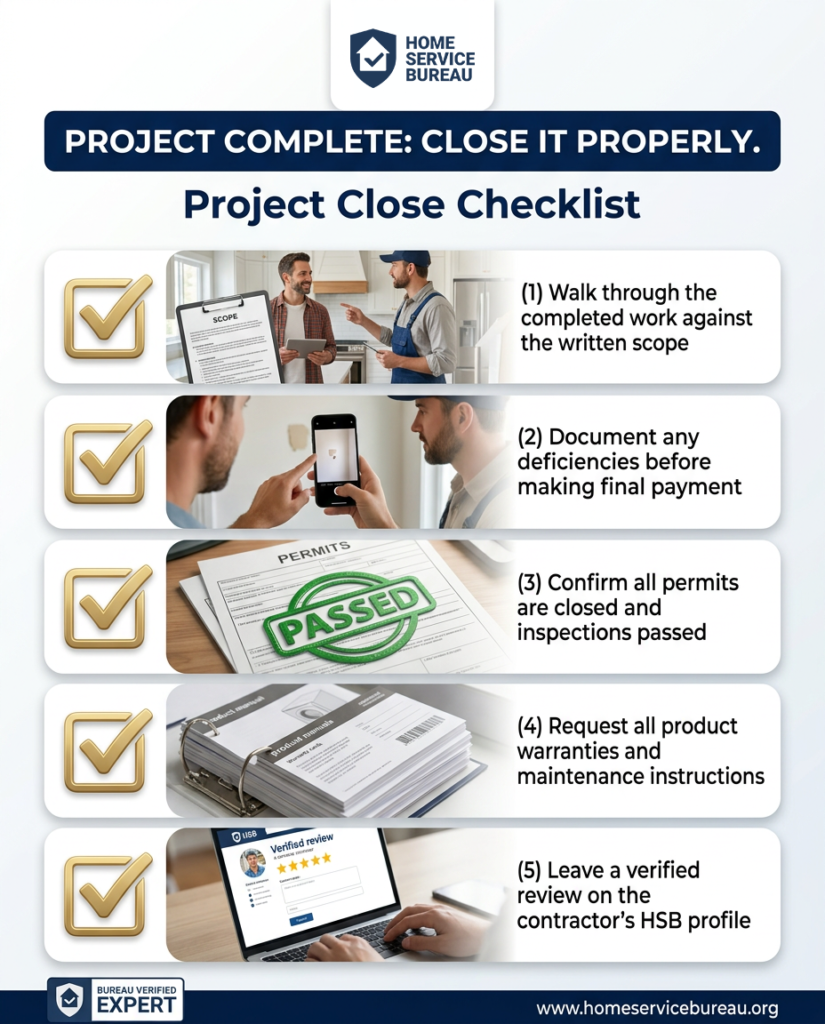
Project Close Checklist: Close It Properly
The project close is where many Ontario homeowners lose protection they held throughout the project by releasing final payment before completing the five steps that protect their position after the contractor has left the site.
(1) Walk through the completed work against the written scope
The homeowner conducts a formal walkthrough of every element of the completed project against the written contract scope. Every line item in the original scope is confirmed as complete before the final payment conversation begins. Items not completed to scope are documented and addressed before sign-off.
(2) Document any deficiencies before making final payment
If any deficiency, incomplete element, or deviation from the written scope exists at the time of walkthrough, the homeowner photographs and documents it before releasing final payment. Final payment is withheld in full or in part until documented deficiencies are remedied. This is the homeowner’s most important financial protection at project close, and it is fully within their rights under Ontario law.
(3) Confirm all permits are closed and inspections passed
Any permit-required work must be formally closed by the relevant municipal authority before the project is considered complete. The homeowner confirms that all permits are closed and all inspections have passed. Open or failed permits create complications at resale and may indicate that work was not completed to the required standard.
(4) Request all product warranties and maintenance instructions
Every material and product installed during the project carries a manufacturer warranty that the homeowner is entitled to hold. The homeowner requests all warranty documentation and maintenance instructions at project close not weeks later when the contractor is unavailable. These documents protect the homeowner’s ability to make warranty claims independently of the contractor if issues arise in the future.
(5) Leave a verified review on the contractor’s HSB profile
A verified review on the contractor’s Bureau Verified platform profile gives future homeowners access to the genuine, firsthand experience of a completed project. Positive reviews strengthen the contractor’s regional reputation and help the platform serve homeowners effectively. If the experience was not positive, an honest review serves the same function: it gives future homeowners the information they need before making their own hiring decision.
The Most Common Mistakes Ontario Homeowners Make When Hiring a Contractor
Even homeowners who follow most of the contractor hiring checklist Ontario homeowner process lose protection by missing a few critical steps. These are the mistakes that matter most.
Accepting a verbal scope instead of a written one. Every element of the project must appear in a signed document before work begins. Verbal agreements disappear the moment a dispute arises.
Choosing the lowest quote without comparing scope. A lower number covering narrower work is not better value it is an incomplete commitment. Always compare quotes against the same written scope.
Releasing large upfront payments before work starts. Milestone-based payments protect your financial leverage throughout the project. A contractor requesting 40% or more upfront before work begins is asking you to absorb risk that belongs to them.
Skipping insurance and WSIB confirmation because the contractor seems trustworthy. Professionalism in conversation and verified credentials are not the same thing. The homeowner contractor preparation GTA process requires documents not impressions.
Allowing scope changes without a written change order. Mid-project verbal agreements produce invoicing disputes just as reliably as pre-hire ones. Every change, however minor, goes in writing before work proceeds.

Conclusion: Every Completed Checklist Item Is a Risk Removed
The difference between a home project that goes smoothly and one that produces a costly dispute is almost always visible in the pre-hire process. Every item on the contractor hiring checklist Ontario homeowner guide exists because its absence has produced a documented, preventable outcome for homeowners across the GTA.
Home Service Bureau (HSB) supports every step of this process. Bureau Verified contractors on the HSB platform have already had their licence, insurance, and regional eligibility independently confirmed meaning the most demanding items on the hire contractor steps Ontario checklist are addressed before the homeowner’s first enquiry. The platform’s regional exclusivity model ensures the contractor assigned to a homeowner’s area is genuinely local, genuinely qualified, and genuinely accountable.
The contractor pre-work checklist Canada standard exists to protect homeowners. HSB is built to deliver contractors who already meet it.Visit homeservicebureau.ca to find a Bureau Verified contractor in your region and start your next project with confidence.
FAQs: Contractor Hiring Checklist for Ontario Homeowners
Q1: Why does a written project scope matter before requesting quotes?
A: A written scope ensures all quotes cover the same work, making comparison meaningful. Without it, contractors price different scopes and the homeowner cannot determine which quote represents genuine value versus a narrower commitment priced to look attractive.
Q2: What is WSIB clearance and why does a GTA homeowner need it?
A: WSIB clearance confirms a contractor’s workers are covered for work-related injuries. Without it, a worker injured on the homeowner’s property may have grounds to pursue the homeowner directly for compensation a liability the contractor pre-work checklist Canada process exists to eliminate.
Q3: How many quotes should an Ontario homeowner get before hiring?
A: The before hiring contractor checklist GTA minimum is two written quotes for the same defined scope. More than three quotes for a residential project typically produces confusion rather than clarity, particularly when scopes are not identical. Quality of documentation matters more than quantity of quotes.
Q4: Can a homeowner withhold payment if milestone work is incomplete?
A: Yes. A milestone-based payment schedule makes payment conditional on completion of the defined milestone. The homeowner is not obligated to release payment ahead of the agreed milestone regardless of the contractor’s request. This is both a contractual right and a practical protection.
Q5: What should a written contract include for an Ontario home project?
A: Full scope of work, agreed timeline, milestone-based payment schedule, materials and finishes specified, warranty terms, dispute resolution process, and signatures from both parties. Every element agreed verbally must appear in writing before the contract is signed.
Q6: Why is Bureau Verified status the final item on the pre-hire checklist?
A: Bureau Verified status confirms that an independent body has reviewed the contractor’s licence, insurance, and regional eligibility which means the earlier checklist items are substantially addressed by the verification process itself. It is the final confirmation that the contractor meets the platform’s professional standard before engagement begins.
Q7: What happens if a contractor brings workers not discussed in the contract?
A: The homeowner asks for immediate written confirmation that the additional workers are covered by the contractor’s insurance and WSIB clearance before work continues. Uninsured workers on a homeowner’s property create direct liability exposure regardless of the contractor’s verbal assurances.
Q8: Is a contractor checklist PDF something a GTA homeowner should keep on file?
A: Yes. A contractor checklist PDF Ontario that documents the completion of every pre-hire, during-project, and project-close step creates a verifiable record of the homeowner’s due diligence. This record strengthens the homeowner’s position in any dispute resolution or insurance claim that arises from the project.