
Every homeowner faces the same decision at some point. Something needs fixing. The question is whether to pick up a tool or pick up the phone.
The honest answer is that some repairs are genuinely safe to handle yourself and some are not. The line between the two is not about confidence, DIY experience, or how many videos you have watched. It is about the nature of the repair, the legal requirements in Ontario, and the consequences if something goes wrong.
Understanding when to call a licensed contractor vs DIY in Ontario is one of the most practically valuable things a homeowner can know. The wrong call in either direction costs money. Handle a job that requires a licensed professional and you risk code violations, voided insurance, and structural or safety hazards. Call a contractor for something you could safely handle yourself and you pay for professional labour you did not need.
This blog gives you a clear, honest framework for making that decision every time based on the actual rules and risks that apply to Canadian home services DIY vs contractor situations in Ontario.
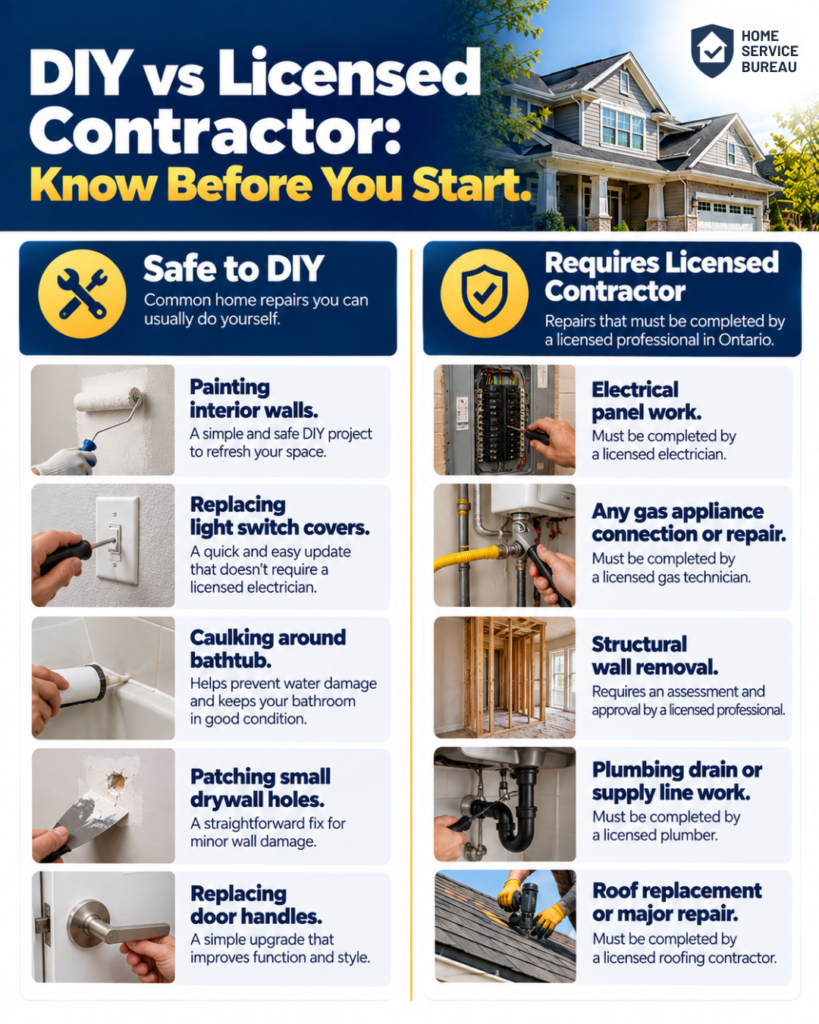
DIY vs Licensed Contractor: Know Before You Start
The most important thing to understand before attempting any home repair in Ontario is that the homeowner DIY or contractor Ontario decision is not always yours to make freely. Some repairs are legally require to be complete by a licensed professional not because the work is complex, but because Ontario law mandates it for safety, insurance, and code compliance reasons.
Safe to DIY covers common home repairs you can usually handle yourself without professional involvement:
- Painting interior walls a straightforward cosmetic update that carries no structural or safety risk
- Replacing light switch covers a surface-level task that does not involve any live wiring
- Caulking around a bathtub a simple maintenance step that prevents water damage over time
- Patching small drywall holes a manageable fix for minor wall damage with no structural implications
- Replacing door handles a basic hardware swap that improves function without any technical risk
Requires a Licensed Contractor covers repairs that Ontario law requires to be completed by a qualify professional:
- Electrical panel work must be completed by a license electrician; no exceptions apply
- Any gas appliance connection or repair must be completed by a licensed gas technician due to carbon monoxide and explosion risk
- Structural wall removal requires assessment and approval by a licensed professional before any work begins
- Plumbing drain or supply line work must be completed by a license plumber to meet code requirements
- Roof replacement or major repair must be complete by a licensed roofing contractor to protect structural integrity and insurance validity
For GTA contractors vs DIY homeowners, this distinction is the foundation of every repair decision. When the work falls on the licensed contractor side of this list, there is no grey area. The repair requires a professional regardless of how straightforward it may appear.
Your 3-Question Decision Framework: DIY or Contractor?
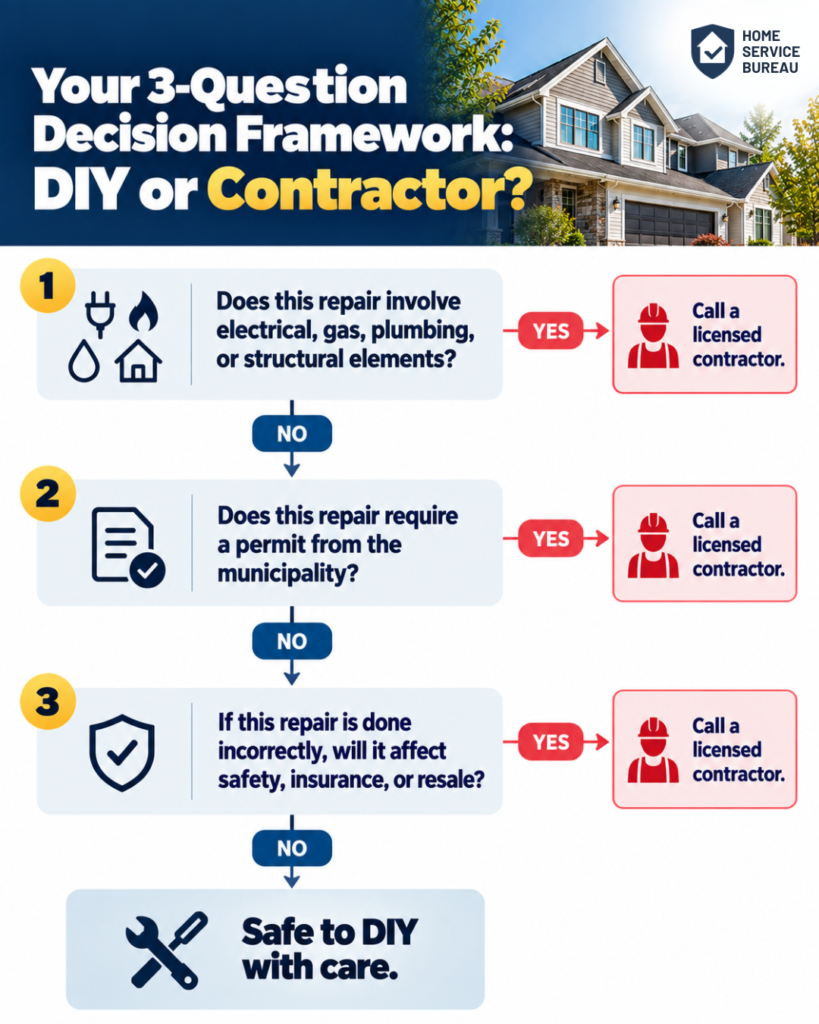
For repairs that do not clearly fall into either category above, a structured three-question framework resolves most homeowner DIY or contractor Ontario decisions quickly and reliably.
Question 1: Does this repair involve electrical, gas, plumbing, or structural elements? If yes call a licensed contractor. These four categories carry the highest risk profile of any home repair type. They involve systems that affect safety, habitability, and insurance coverage. A mistake in any of these areas produces consequences far beyond the cost of hiring a professional from the start. This question alone resolves the majority of call contractor vs self-repair GTA decisions.
If no move to question two.
Question 2: Does this repair require a permit from the municipality? If yes call a licensed contractor. Permit-required work in Ontario must be complete to a specific standard and inspected by a municipal authority before sign-off. Attempting permit-required work without a licensed professional typically results in failed inspections, mandatory remediation at the homeowner’s expense, and complications at the time of resale.
If no move to question three.
Question 3: If this repair is done incorrectly, will it affect safety, insurance, or resale? If yes call a license contractor. Even for work that does not require a permit or involve a licensed trade category directly, the consequence of getting it wrong matters. A repair that affects structural stability, creates a fire or water hazard, or triggers an insurance exclusion carries professional-level risk regardless of how straightforward it appears.
If no to all three the repair is safe to DIY with care.
This framework applies consistently across every licensed contractors in Ontario when to hire decision. It removes guesswork and replaces it with a repeatable process that protects the homeowner at every stage.
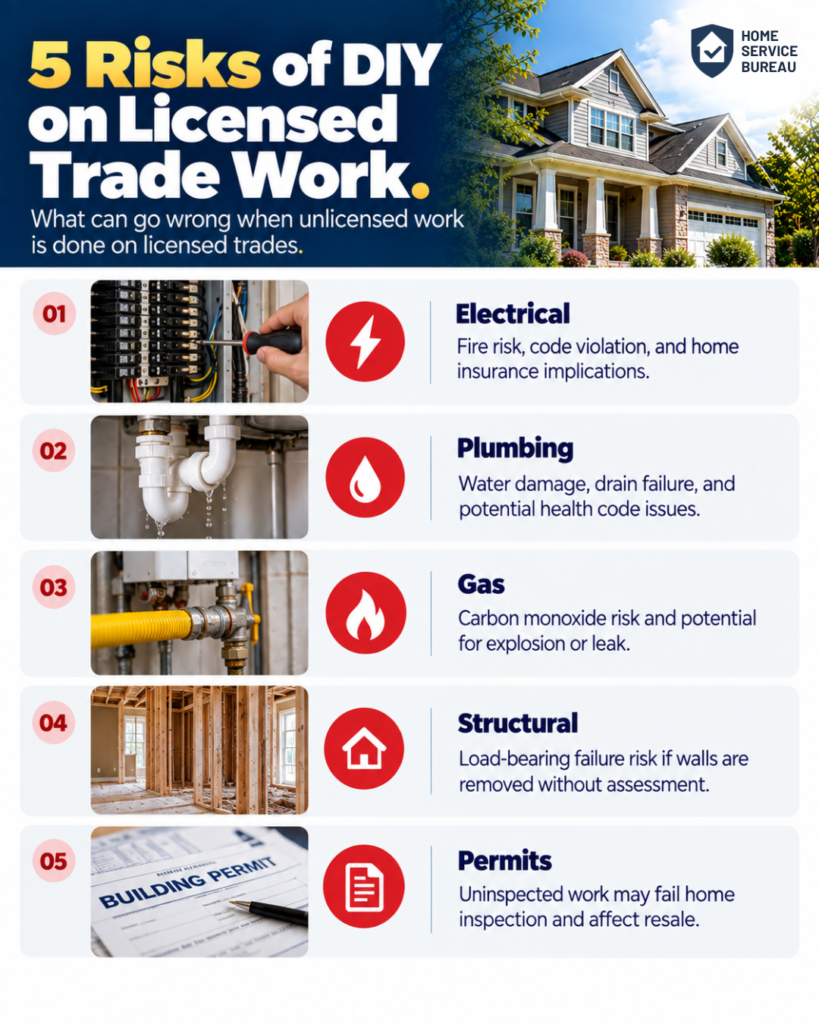
5 Risks of DIY on Licensed Trade Work
Understanding why Canadian home services DIY vs contractor boundaries exist requires looking directly at what goes wrong when homeowners attempt licensed trade work themselves. These are not rare scenarios. They represent the most consistently documented risks across Ontario’s home repair market.
Risk 1 Electrical: Fire risk, code violation, and home insurance implications. Unlicensed electrical work in Ontario creates fire hazards that often do not manifest immediately. A faulty connection inside a wall can smoulder for months before igniting. Beyond the physical risk, electrical work completed without a licensed electrician voids most home insurance policies meaning the homeowner bears the full financial consequence of any damage that results.
Risk 2 Plumbing: Water damage, drain failure, and potential health code issues. Improperly connected plumbing causes water damage that frequently remains invisible until it becomes structural. Drain failures create health code violations. Supply line issues produce water damage that homeowner insurance may not cover if unlicense work is documented as the cause.
Risk 3 Gas: Carbon monoxide risk and potential for explosion or leak. Gas work carries the highest immediate safety risk of any trade category. A faulty gas connection creates carbon monoxide exposure risk that has no visible warning signs. In Ontario, gas appliance connections and repairs are legally restricted to licensed gas technicians the consequence of non-compliance is not a fine. It is a life-safety hazard.
Risk 4 Structural: Load-bearing failure risk if walls are removed without assessment. Removing what appears to be a non-load-bearing wall without professional assessment creates structural failure risk that may not become apparent immediately. Load-bearing systems distribute weight across the entire structure. Altering them without a licensed professional’s assessment produces consequences that are both expensive and dangerous.
Risk 5 Permits: Uninspected work may fail home inspection and affect resale. Work completed without the required permits does not simply disappear. It surfaces at the time of resale, when a home inspection reveals unpermitted modifications. The result is either a mandatory remediation before sale or a price reduction that far exceeds what the original professional work would have cost.
Each of these five risks represents a concrete reason why when to call licensed contractor vs DIY Ontario knowledge protects homeowners financially and physically not just in the moment of the repair, but for the entire life of the property.
When the Decision Is Not Clear-Cut
Most GTA contractors vs DIY homeowner decisions are resolve by the framework above. But some repairs sit in a genuine grey area jobs that appear manageable but carry hidden complexity.
The reliable signal in these cases is the consequence of getting it wrong. A repair that could compromise safety, trigger an insurance clause, or require a permit if done to code is not a DIY job regardless of how straightforward it appears on the surface. When in doubt, a brief consultation with a licensed professional costs far less than remediation after something goes wrong.
Licensed contractors in Ontario when to hire decisions almost always resolve in favour of the professional when the question involves anything behind a wall, under a floor, inside an electrical panel, or connected to a gas or plumbing system.
Conclusion: The Right Call Protects Your Home, Your Budget, and Your Safety
The when to call licensed contractor vs DIY Ontario question does not have a complicated answer once you apply the right framework. Safe-to-DIY jobs are genuinely manageable without professional help. License trade work is legally and practically required to be completed by a qualify professional and attempting it otherwise creates risks that no amount of cost savings justifies.
For GTA contractors vs DIY homeowners, the three-question decision framework resolves most situations clearly: does the repair involve electrical, gas, plumbing, or structural elements? Does it require a permit? Could doing it incorrectly affect safety, insurance, or resale? A yes to any of these means calling a licensed contractor in Ontario when to hire is the right answer.
Home Service Bureau (HSB) exists specifically to make that call easier. Every call contractor vs self-repair GTA situation that resolves in favour of a contractor leads to a professional you can trust not one you have to take on faith. Visit homeservicebureau.ca to find a Bureau Verified contractor in your area today.
FAQs
Q1: Can a homeowner legally do their own electrical work in Ontario?
A: Homeowners can perform minor electrical work on their own home with a permit in Ontario. However, electrical panel work, new circuit installation, and service upgrades legally require a licensed electrician. Attempting these without one voids most home insurance policies.
Q2: What home repairs require a permit in the GTA?
A: Structural alterations, electrical service upgrades, new plumbing rough-ins, HVAC system changes, and roof replacements typically require municipal permits in the GTA. Always confirm with your local municipality before beginning any project that modifies existing systems or structure.
Q3: Does DIY plumbing work void home insurance in Ontario?
A: Unlicensed plumbing work can void home insurance coverage for related damage claims. If water damage results from improperly complete plumbing and the insurer determines unlicense work caused it, the claim may be denied regardless of the policy’s stated coverage terms.
Q4: How do I know if a wall is load-bearing before I remove it?
A: A licensed contractor or structural engineer determines whether a wall is load-bearing through a proper assessment. Visual inspection alone is not reliable. Attempting to remove a wall without professional confirmation creates structural failure risk that a DIY assessment cannot safely eliminate.
Q5: Is roof repair a DIY job in Ontario?
A: Minor cosmetic repairs to a roof replacing a few shingles on a safely accessible low-pitch section may be manageable for a skilled homeowner. However, major repairs, full replacements, and any work affecting flashing, ventilation, or structural decking require a licensed roofing contractor to meet insurance and code standards.
Q6: What happens if unpermitted work is discovered during a home sale?
A: Unpermitted work discovered during a home inspection typically requires either remediation before sale or disclosure that reduces the property’s negotiated value. In some cases, municipalities require the work to be demolish and redone to code at the current homeowner’s expense.
Q7: How does a Bureau Verified contractor differ from an unverified one for DIY-adjacent repairs?
A: A Bureau Verified contractor has had their licence, insurance, and regional eligibility independently confirmed before receiving any homeowner enquiry. For repairs in the grey zone between DIY and licensed work, engaging a Bureau Verified contractor removes the risk that the professional assessing or completing the job lacks proper credentials.
Q8: Can a GTA homeowner handle gas appliance connections themselves?
A: No. In Ontario, gas appliance connections and repairs are legally restrict to license gas technicians regardless of the homeowner’s skill level. This is a safety regulation, not a recommendation. Unlicensed gas work creates carbon monoxide exposure and explosion risk with no legal protection for the homeowner.