


Every homeowner enquiry looks like a potential business opportunity, but not every enquiry deserves the same attention. Contractors across the Greater Toronto Area (GTA) often spend valuable time contacting homeowners who have unclear project requirements, live outside their service areas, or are not ready to move forward.
These conversations take time away from estimating, scheduling, managing ongoing projects, and speaking with homeowners who have genuine service requirements.
Understanding how to qualify homeowner leads GTA contractors receive can help reduce this unnecessary workload. A structured screening process allows contractors to review essential information before making contact and identify enquiries that match their services, availability, and operating regions.
Instead of measuring success by the number of enquiries received, contractors should focus on the quality of those enquiries and their potential to become confirmed projects.
This guide explains how to screen homeowner leads, identify promising opportunities, and make better use of your time through a structured qualification process.
Why Lead Qualification Matters for GTA Contractors
Generating homeowner enquiries is only the beginning of customer acquisition. Contractors still need to determine whether those enquiries match their services and whether the homeowners have realistic expectations.
Without proper screening, contractors may spend hours discussing projects they cannot undertake. Some enquiries involve services outside their expertise, while others require work in locations that make travel and scheduling impractical.
Poor lead quality can also affect quotation efficiency. Preparing estimates requires time, particularly when contractors must review project requirements, calculate materials, and assess labour needs.
A consistent contractor lead qualification Ontario process helps businesses avoid unnecessary work by identifying relevant enquiries before committing resources.
It also improves the homeowner experience. When contractors understand the project before calling, they can ask more useful questions, provide clearer information, and determine the next steps more quickly.
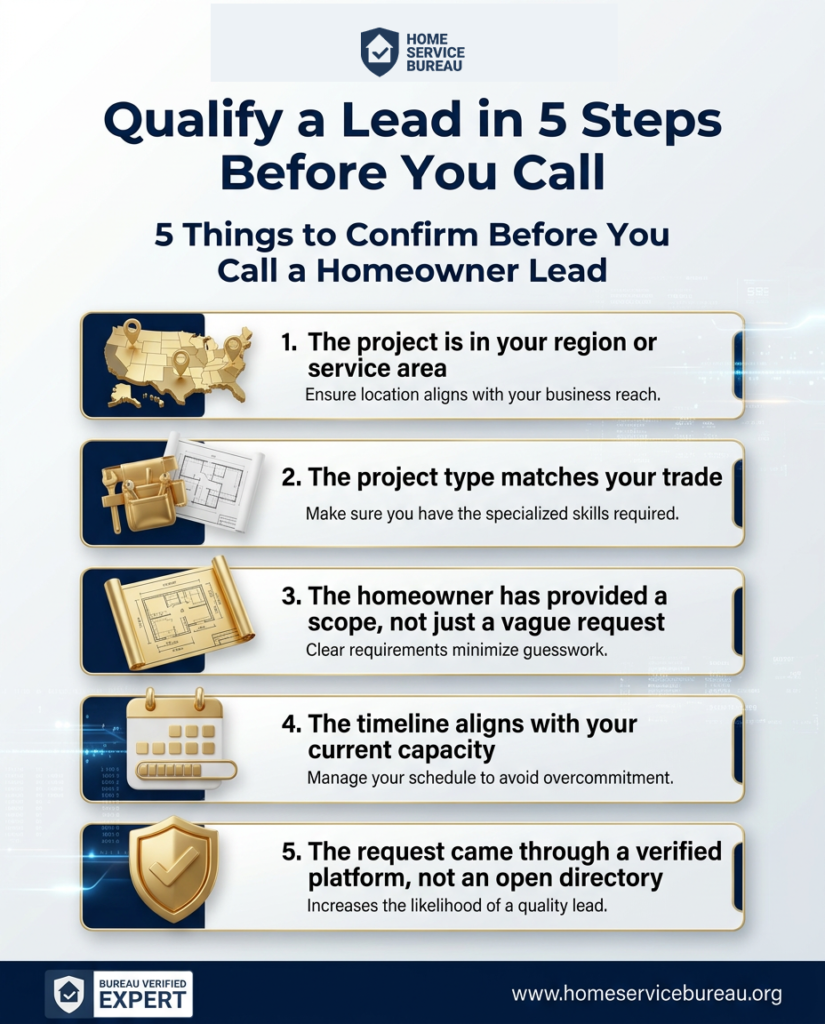
Qualify a Lead in 5 Steps Before You Call
Before contacting a homeowner, review five important details that help determine whether the enquiry deserves immediate attention.
These checks form the foundation of effective homeowner lead screening Canada contractors can incorporate into their daily operations.
1. Confirm the Project Is Within Your Service Area
Location should be one of the first details you review.
A homeowner may have a genuine requirement, but the opportunity may not suit your business if the property falls outside your operating region.
Serving distant locations can increase travel expenses, complicate scheduling, and reduce the time available for existing customers.
Check the property’s location against your defined service boundaries before arranging a consultation. Contractors who work within specific GTA regions should maintain accurate service area information across their websites and lead-generation platforms.
Regional relevance helps ensure that incoming enquiries align with your business capacity.
2. Check Whether the Project Matches Your Trade
Not every home improvement enquiry will match your professional expertise.
Review the requested service and determine whether your business has the skills, qualifications, and resources required to complete the work.
Trade compatibility matters particularly when projects involve regulated activities that require specific credentials or certifications.
Contractors should avoid accepting work outside their professional capabilities. A relevant enquiry should match the services the business actively provides.
This initial check prevents unnecessary conversations and supports better project planning.
3. Review the Homeowner’s Project Scope
A homeowner who provides a detailed description of the required work gives contractors a stronger starting point for evaluating the opportunity.
Review whether the enquiry identifies the type of work, property requirements, and expected outcome.
A vague request does not necessarily indicate a poor lead. However, it requires additional clarification before the contractor can determine whether the project is suitable.
Where possible, request missing information through the enquiry form or an initial message.
Clear project details help contractors prepare for meaningful discussions instead of spending the first conversation gathering basic information.
4. Assess the Project Timeline Against Your Availability
A suitable project must also fit your current schedule.
Review when the homeowner wants the work to begin and whether your team can accommodate the expected timeline.
If your schedule is already full, accepting an urgent project may create unnecessary pressure and affect existing commitments.
On the other hand, a homeowner with a flexible timeline may still represent a valuable opportunity.
The objective is to identify whether the proposed schedule aligns with your available resources.
5. Evaluate the Lead Source and Verification Process
The platform generating the enquiry can influence how much information contractors receive before making contact.
Open directories may allow homeowners to contact several contractors without confirming all project details. Other platforms use structured enquiry forms and regional matching to provide more relevant opportunities.
Home Service Bureau (HSB) uses a Bureau Verified contractor model and regional allocation process to connect homeowner enquiries with suitable service providers.
Contractors should still review the project details, but a structured platform can reduce some of the initial screening work.
When evaluating lead sources, focus on qualification criteria, information accuracy, regional relevance, and how the platform distributes enquiries.
Skip This Lead vs Call This Lead: How to Identify Better Opportunities
Contractors should distinguish between enquiries that require further clarification and those that deserve immediate attention.
An enquiry with no clear project description may require additional screening before a phone call. Similarly, a request from outside your service region may not justify further pursuit unless your business can reasonably accommodate the location.
Leads distributed to multiple contractors can also create greater competition. However, shared enquiries are not automatically unsuitable. Their value depends on project quality, homeowner intent, acquisition cost, and the number of businesses competing for the work.
A stronger opportunity generally provides clear project requirements, matches your operating region, and involves services your business can deliver.
HSB’s regional allocation model aims to reduce direct competition by matching qualified homeowner enquiries with the designated contractor for the relevant service area.
This approach gives contractors a more focused way to evaluate incoming opportunities.
For businesses improving GTA contractor lead vetting, the goal should be to identify which enquiries deserve a call, which require additional information, and which fall outside the business’s capabilities.

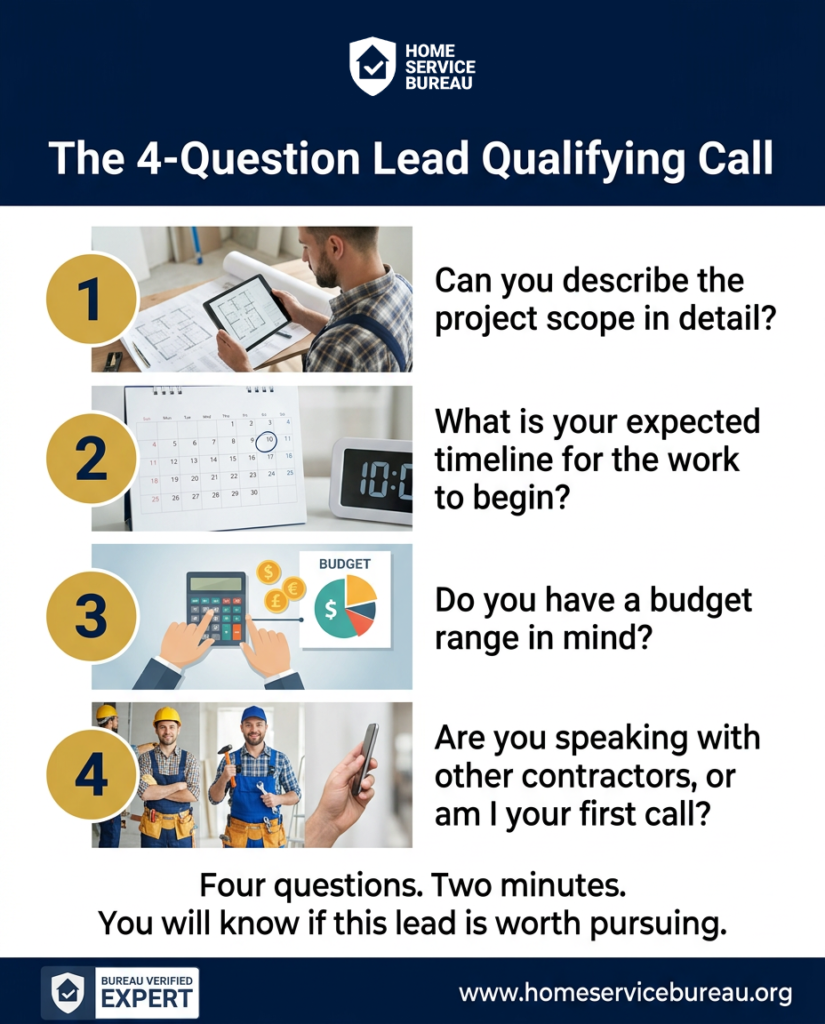
The 4-Question Lead Qualifying Call
Pre-call screening helps contractors eliminate obvious mismatches, but some important details still require a direct conversation.
A short qualification call can clarify the homeowner’s requirements and determine whether the project should progress towards an estimate or consultation.
1. Can You Describe the Project Scope in Detail?
Start by asking the homeowner to explain the work they need.
This conversation helps confirm whether the original enquiry accurately reflects the project and whether additional services or specialised expertise may be necessary.
Listen carefully and clarify any information that could affect the quotation.
2. What Is Your Expected Timeline for the Work to Begin?
Understanding the homeowner’s preferred start date helps determine whether the project fits your schedule.
Ask whether the timeline is fixed or flexible. This information can help you manage expectations and avoid commitments that your team cannot realistically meet.
3. Do You Have a Budget Range in Mind?
Budget discussions help establish whether the homeowner’s expectations align with the likely project requirements.
Ask about their anticipated spending range without making assumptions about affordability.
If the homeowner has not established a budget, explain that a reliable estimate may require further assessment.
A clear conversation about costs can prevent misunderstandings later.
4. Are You Speaking With Other Contractors, or Am I Your First Call?
Understanding whether the homeowner is comparing quotations can provide useful context.
It helps contractors determine the stage of the hiring process and understand when the homeowner expects to make a decision.
However, speaking with multiple contractors should not automatically disqualify an enquiry. Homeowners often compare professionals before committing to a project.
The purpose of this question is to understand the decision-making process, not pressure the homeowner.
These four questions make qualifying home service leads Ontario contractors receive more efficient while keeping the conversation professional and focused.
How to Prioritise Qualified Homeowner Leads
After reviewing the enquiry and completing the initial conversation, contractors should assign each lead a clear status.
High-priority enquiries generally match the business’s service area, trade expertise, available capacity, and project requirements. These contacts may be ready for a site visit or formal quotation.
Other enquiries may require additional information before moving forward. Contractors should request the missing details and schedule an appropriate follow-up rather than repeatedly calling without a clear purpose.
Enquiries outside the business’s service capabilities should receive a professional response explaining the limitation.
A simple lead management system can help contractors record project information, communication history, next steps, and quotation status.
This creates a more organised process and reduces the likelihood of overlooking promising opportunities.
Common Lead Qualification Mistakes Contractors Should Avoid
One common mistake is treating every enquiry as equally valuable. Contractors who respond without reviewing basic project information may spend unnecessary time on unsuitable opportunities.
Another mistake is rejecting enquiries simply because homeowners have not finalised every detail. Some genuine customers need professional guidance before defining their requirements.
Contractors should also avoid assuming that a homeowner with a smaller budget or flexible timeline lacks genuine interest.
Poor follow-up can create additional problems. Even qualified enquiries may become inactive when contractors delay responses or fail to explain the next steps.
Finally, relying entirely on a lead-generation platform without reviewing its qualification criteria can create unrealistic expectations.
Effective screening requires accurate information, reasonable judgement, and consistent communication.
How HSB Supports Better Lead Qualification for GTA Contractors
Home Service Bureau (HSB) provides a structured alternative to open contractor directories through its Bureau Verified programme and regional allocation framework.
The platform focuses on connecting homeowners with contractors whose services and operating regions match their requirements.
HSB’s qualified lead model considers project scope, service category, homeowner location, and readiness to request a quotation.
Its regional allocation approach also aims to limit direct competition by directing relevant enquiries to the designated contractor rather than distributing the same opportunity widely.
For contractors who want to qualify leads before calling GTA contractor prospects, these features can reduce some of the work involved in reviewing unsuitable enquiries.
However, contractors should still confirm project details, timelines, budgets, and their own availability before committing to work.

Conclusion
Contractors do not need to pursue every homeowner enquiry to build a successful business. They need a consistent process for identifying opportunities that match their services, operating areas, and available resources.
Understanding how to qualify homeowner leads GTA contractors receive starts with checking project location, trade compatibility, scope, timeline, and lead source. A focused qualification call then helps confirm the homeowner’s requirements and readiness to move forward.
Home Service Bureau (HSB) supports this approach through Bureau Verified contractor participation, regional allocation, and qualified homeowner lead matching.
Instead of spending unnecessary time competing for poorly defined enquiries, contractors can explore a structured platform that focuses on service relevance and regional fit.
Apply for Bureau Verified status through HSB, check availability in your preferred region, and explore a more focused approach to receiving qualified homeowner leads.
Frequently Asked Questions
1. What is homeowner lead qualification?
Homeowner lead qualification involves reviewing enquiries to determine whether they match a contractor’s services, operating region, availability, and project requirements. It helps businesses prioritise suitable opportunities before investing time in detailed consultations or quotations.
2. How can GTA contractors qualify leads before calling?
Contractors should review the homeowner’s location, requested trade, project description, expected timeline, and enquiry source. These initial checks help identify suitable opportunities and determine which contacts require additional information before a call.
3. Why is project location important when qualifying leads?
Project location affects travel costs, scheduling, service availability, and operational efficiency. Contractors should prioritise enquiries within their established operating areas to manage resources effectively and avoid unnecessary commitments outside their practical service boundaries.
4. What information should a qualified homeowner lead include?
A qualified enquiry should identify the property’s location, requested service, project scope, and preferred timeline. Budget information and quotation readiness provide additional context that helps contractors assess whether the opportunity suits their business.
5. Should contractors reject leads without a confirmed budget?
No, an undefined budget does not automatically indicate an unsuitable enquiry. Contractors should discuss project requirements, explain potential cost considerations, and determine whether the homeowner’s expectations align with the proposed work before deciding.
6. How does HSB help contractors receive qualified leads?
HSB uses contractor verification, regional allocation, and homeowner enquiry information to support relevant lead matching. Its model focuses on connecting suitable contractors with homeowners seeking services within their designated operating regions.
7. What is the difference between lead screening and lead qualification?
Lead screening checks basic information before contact, including location, service type, and project details. Lead qualification involves further discussion to assess budget, timing, requirements, and the homeowner’s readiness to proceed.
8. How can contractors improve their lead conversion rates?
Contractors can improve conversions by prioritising relevant enquiries, responding promptly, clarifying requirements, providing accurate quotations, and maintaining consistent follow-ups. Tracking outcomes also helps identify weaknesses in the qualification and sales process.