

Hiring a contractor is an act of trust. You open your home, commit your budget, and expect a professional to deliver what they agreed to. When that does not happen when work stops unexpectedly, quality falls short of the written scope, or a contractor becomes unresponsive the experience is both financially damaging and genuinely stressful.
Understanding what to do if you hire a bad contractor in Ontario is knowledge every homeowner should have before they need it. The steps are specific, the rights are real, and the process works but only when homeowners know what they are entitled to and act on it in the right sequence.
This guide covers your legal rights as an Ontario homeowner, the five steps to take when contractor not finishing work GTA situations arise, and what changes when you hire through a verified platform. If you are currently in a bad contractor dispute Ontario, this guide gives you a clear path forward.
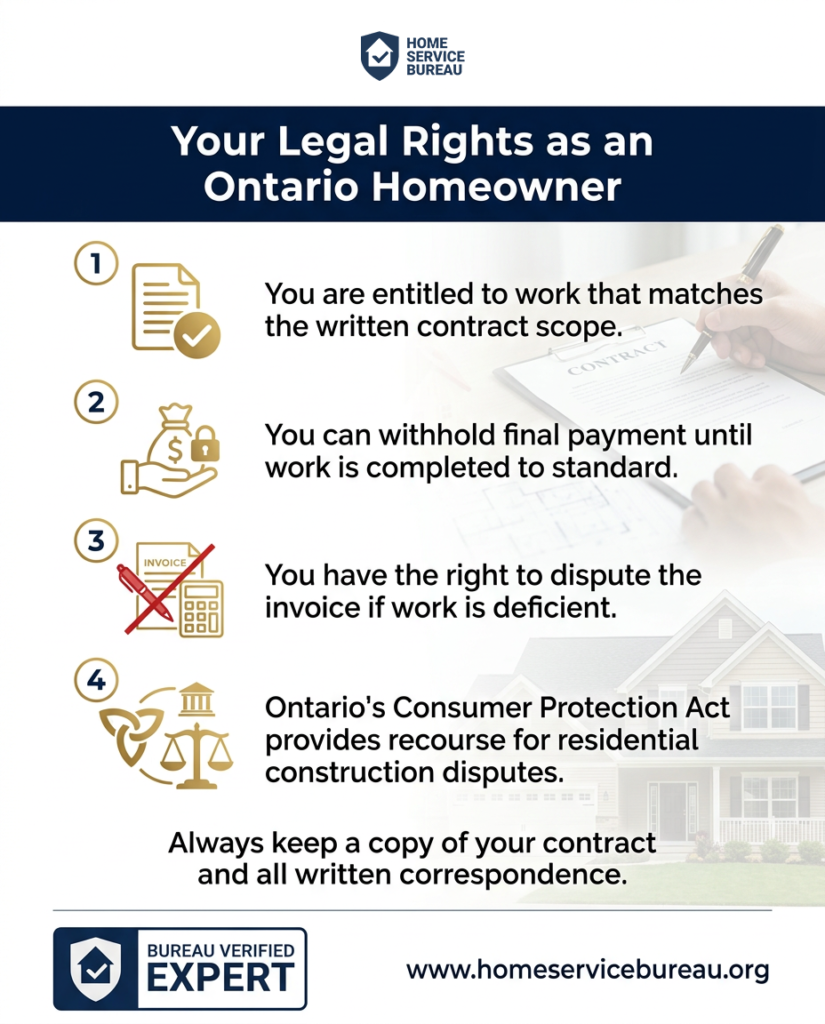
Your Legal Rights as an Ontario Homeowner
Before taking any action, every homeowner needs to understand the rights they already hold. Homeowner rights bad contractor Canada situations in Ontario are governed by specific legislation and knowing those rights is the foundation of every effective dispute resolution.
Right 1 You are entitled to work that matches the written contract scope
A signed contract is a binding legal document. If a contractor delivers work that does not match the agreed scope in quality, quantity, or completion they have breached that contract. The homeowner is entitled to the work described in writing, not the contractor’s post-completion interpretation of what was agreed.
Right 2 You can withhold final payment until work is completed to standard
Ontario law does not require a homeowner to release final payment when work is incomplete or deficient. If the finished product does not meet the written contract standard, the homeowner has the legal right to withhold the outstanding balance until the contractor remedies the deficiency. This right is one of the most important tools available in any bad contractor dispute Ontario.
Right 3 You have the right to dispute the invoice if work is deficient
A contractor who submits an invoice for incomplete or substandard work does not have an automatic legal right to full payment. The homeowner can dispute the invoice in writing, citing the specific deficiencies and the contract terms the work failed to meet. Disputing an invoice is a formal step it requires documentation but it is a right, not an optional escalation.
Right 4 Ontario’s Consumer Protection Act provides recourse for residential construction disputes
The Ontario Consumer Protection Act gives homeowners access to formal dispute mechanisms for residential construction and renovation contracts. This legislation applies to contracts over $50 that are signed in a residential context, and it provides homeowners with rights around cancellation, disclosure, and dispute resolution that apply regardless of what the contractor’s own terms say.
Right 5 Always keep a copy of your contract and all written correspondence
Every right listed above depends on documentation. Without a written contract, without photographs, without a record of communications, the homeowner’s position in any dispute weakens significantly. The single most important protective action any homeowner can take is to retain every document from the moment a contractor is engaged.
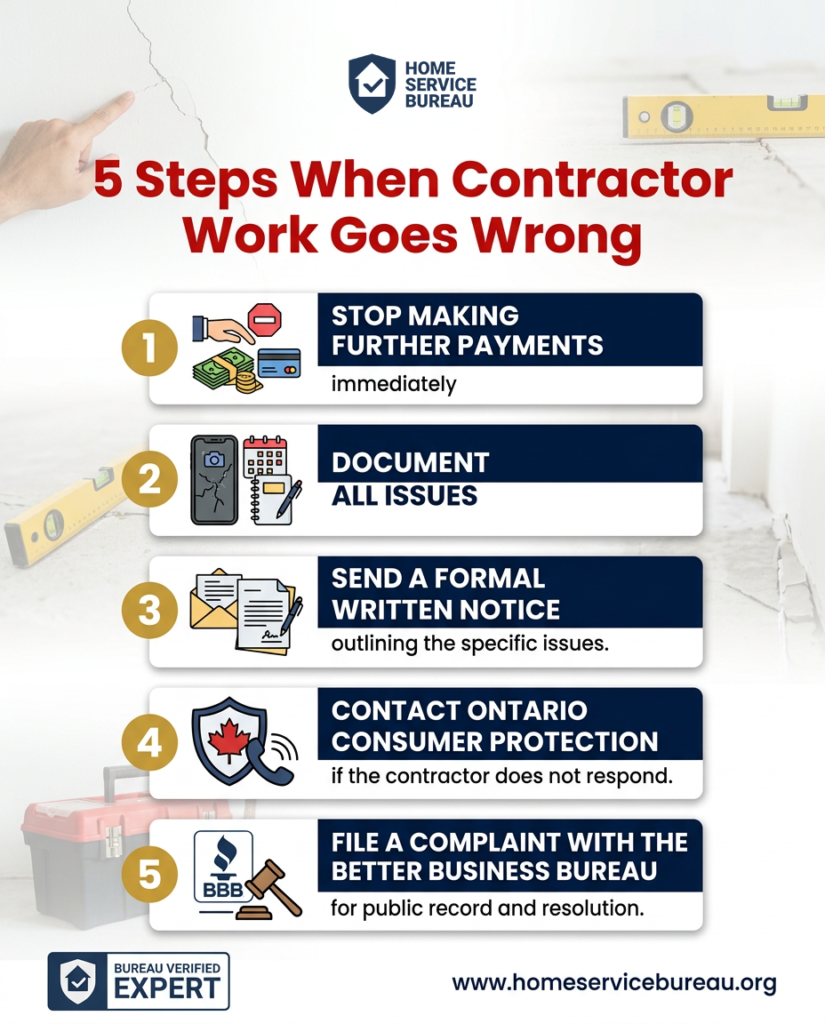
5 Steps When Contractor Work Goes Wrong
When a contractor not finishing work GTA situation develops or when completed work falls short of the agreed standard the following five steps protect the homeowner’s position and maximise the chance of resolution without legal escalation.
Step 1 Stop making further payments immediately
The moment a homeowner identifies that work is deficient, incomplete, or that the contractor has become unresponsive, they should stop all payments beyond what has already been released. Making further payments weakens the homeowner’s negotiating position and reduces the financial leverage available to compel resolution. If the payment schedule is milestone-based, withhold the next milestone until the current deficiency is addressed in writing.
Step 2 Document all issues
Photograph every deficiency, every incomplete area, and every element of the work that does not match the contract scope. Date-stamp every image. Record all conversations with the contractor in writing if a discussion happens by phone, follow it immediately with a written summary sent to the contractor and retained by the homeowner. Documentation is what turns a complaint into a credible, enforceable dispute position.
Step 3 Send a formal written notice outlining the specific issues
A formal written notice is not an aggressive escalation. It is a professional, documented communication that specifies the deficiencies, references the relevant contract terms, and requests a written response within a defined timeframe typically five to ten business days. This notice establishes the homeowner’s formal position, creates a paper trail, and gives the contractor a clear opportunity to respond before escalation. For a contractor complaint Ontario, this step is both legally significant and practically necessary.
Step 4 Contact Ontario Consumer Protection if the contractor does not respond
If the contractor does not respond to the formal written notice within the stated timeframe, the homeowner escalates to Ontario Consumer Protection. This body handles residential construction disputes and provides mediation, complaint registration, and escalation pathways available to homeowners under the Consumer Protection Act. This step is how to resolve contractor dispute GTA situations that cannot be settled directly.
Step 5 File a complaint with the Better Business Bureau for public record and resolution
A BBB complaint creates a public record of the dispute that the contractor must respond to, and it activates a structured dispute resolution process. For homeowners who have exhausted direct resolution attempts, this step adds accountability pressure and creates documentation that may support further legal action if required.
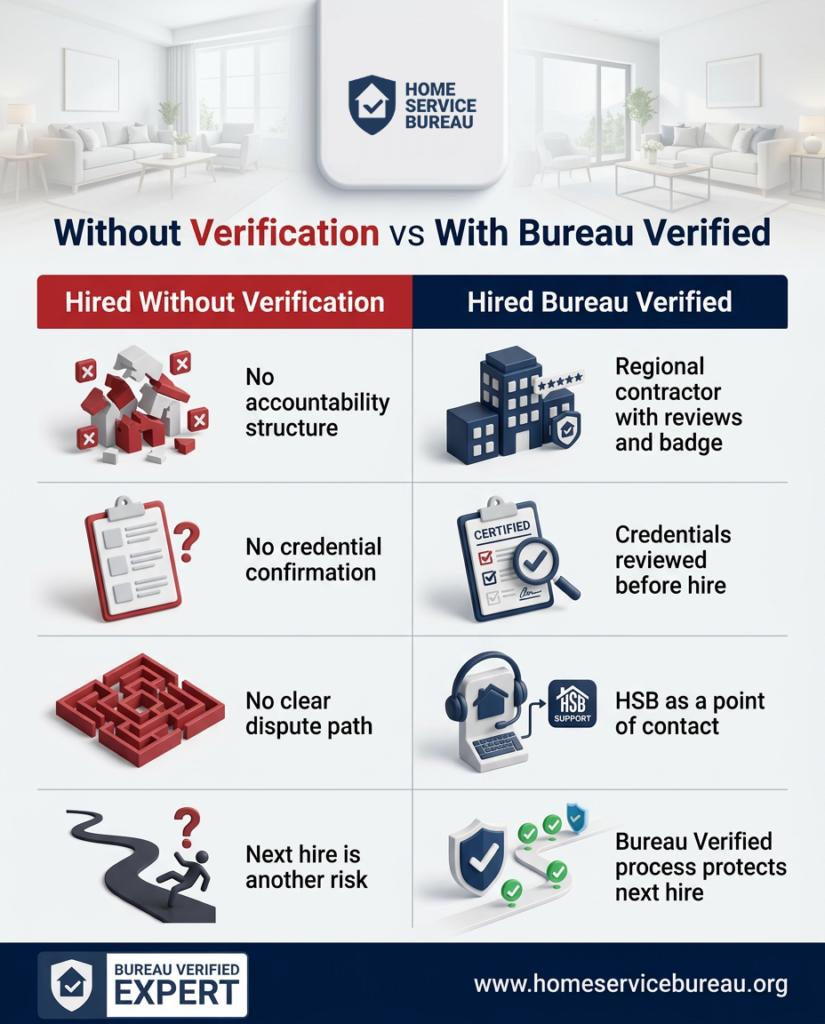
Without Verification vs With Bureau Verified: Why the Starting Point Matters
Understanding what to do if you hire a bad contractor in Ontario is essential knowledge. But the most effective protection is structural it comes from how the contractor is selected before a single payment is made.
The difference between hiring without verification and hiring a Bureau Verified contractor is not marginal. It is the difference between entering a dispute with no accountability structure. And entering one or more accurately, never entering one with a platform-backed verification system that removes the most common sources of contractor risk before the job begins.
Hired Without Verification:
- No accountability structure no independent body assessed the contractor’s credentials, insurance, or history before they were engaged
- No credential confirmation the homeowner accepts the contractor’s self-reported claims with no independent review
- No clear dispute path if something goes wrong, the homeowner navigates the process alone without a platform intermediary
- Next hire is another risk the same selection process that produced the bad outcome is repeated
Hired Bureau Verified:
- Regional contractor with reviews and badge an independently assessed professional with a verifiable track record
- Credentials reviewed before hire licence, insurance, and regional eligibility confirmed before any homeowner enquiry is handled
- HSB as a point of contact a platform intermediary available as a support resource if issues arise during or after the project
- Bureau Verified process protects next hire the verification standard applies to every contractor on the platform, reducing risk structurally rather than individually
The homeowner who hires without verification and then needs to know what to do if you hire a bad contractor in Ontario is managing a problem that a different hiring decision could have prevented entirely. The homeowner who hires Bureau Verified has a credential, a platform structure. And a dispute support pathway that the unverified hiring experience simply does not provide.
How to Resolve a Contractor Dispute in the GTA: The Documentation Standard
How to resolve contractor dispute GTA situations consistently comes down to one variable: the quality and completeness of the homeowner’s documentation.
A homeowner who holds a signed written contract, date-stamped photographs of deficiencies, written records of all contractor communications. And a formal notice sent and retained has a strong position in every dispute resolution pathway from direct negotiation to Consumer Protection mediation to Small Claims Court.
A homeowner who has a verbal agreement, no photographs, and no written communication record has a significantly weaker position regardless of how legitimate their complaint is.
The homeowner rights bad contractor Canada system is built to protect homeowners but it requires homeowners to maintain the documentation that makes those rights enforceable. Build that habit from the first day of every contractor engagement, not after something has already gone wrong.

Conclusion: Know Your Rights and Start With the Right Contractor
Knowing what to do if you hire a bad contractor in Ontario gives every homeowner a path forward when a project goes wrong. The rights are real. The steps are clear.
But the most powerful protection is not knowing how to resolve a bad contractor dispute Ontario after it begins. It is selecting a contractor through a verified platform that removes the conditions that produce disputes in the first place.
Home Service Bureau (HSB) gives GTA homeowners access to Bureau Verified contractors whose credentials licence, insurance, and regional eligibility have been independently confirmed before any homeowner contact is made. When something does go wrong, HSB provides a platform point of contact that unverified hiring simply cannot replicate.
Homeowner rights bad contractor Canada situations are painful to navigate. The right starting point makes most of them avoidable.
Visit homeservicebureau.ca to find a Bureau Verified contractor in your area. And start your next project with the protection that verification provides.
FAQs
Q1: Can I legally withhold payment from a contractor in Ontario if work is incomplete?
A: Yes. Ontario law permits homeowners to withhold final payment when work does not meet the written contract standard. Withholding must be tied to documented deficiencies and communicated to the contractor formally in writing before any payment deadline passes.
Q2: What counts as a formal written notice to a contractor in Ontario?
A: A written communication email or letter that specifically identifies each deficiency, references the relevant contract terms. And requests a written response within a defined timeframe. The homeowner retains a copy. Informal verbal complaints or text messages do not carry the same weight as a formal written notice.
Q3: What does Ontario Consumer Protection do with a contractor complaint?
A: Ontario Consumer Protection registers the complaint, contacts the contractor, and may facilitate mediation between the parties. For disputes involving contracts covered by the Consumer Protection Act. They can investigate and escalate to enforcement where contractor conduct warrants it.
Q4: What is the time limit for filing a contractor dispute claim in Ontario?
A: Ontario’s basic limitation period is two years from the date the homeowner discovered. Or reasonably ought to have discovered the deficiency. Homeowners should not delay initiating a formal dispute. As documentation quality and witness recall diminish over time regardless of legal deadlines.
Q5: Does a BBB complaint force a contractor to pay compensation?
A: No. A BBB complaint creates a public record and activates a dispute resolution process. But the BBB cannot compel payment. It creates accountability pressure and public visibility. For financial recovery, Small Claims Court or mediation through Consumer Protection is the appropriate escalation pathway.
Q6: Can a contractor put a lien on my property if I withhold payment in a dispute?
A: Under Ontario’s Construction Act, contractors and subcontractors can register a lien against a property for unpaid amounts. A homeowner withholding payment for documented deficiencies has a defence. But should seek legal advice promptly if a lien is registered to understand their options and timelines.
Q7: Is it worth going to Small Claims Court over a bad contractor dispute in Ontario?
A: Small Claims Court in Ontario handles disputes up to $35,000 and is designed to be accessible without a lawyer. For documented deficiencies with clear financial impact, it is a practical pathway. The strength of the homeowner’s documentation is the primary factor in outcome quality.
Q8: How does hiring a Bureau Verified contractor reduce the risk of a bad contractor dispute?
A: Bureau Verified contractors have had their licence, insurance, and regional eligibility independently confirmed before receiving homeowner enquiries. This pre-hire verification removes the most common sources of bad contractor dispute Ontario situations uninsured operators. Unverified credentials, and contractors with no accountability structure behind their self-reported claims.