

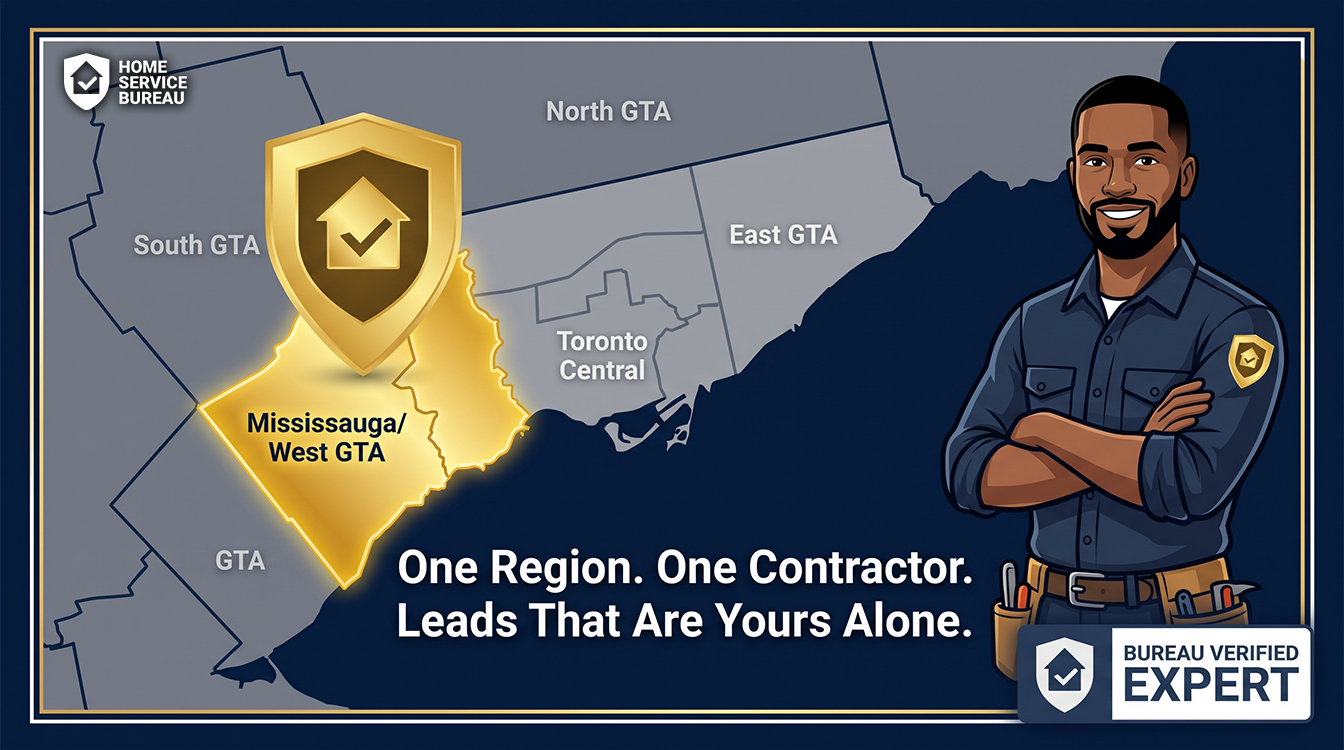
Home services contractors across Canada spend a large share of their marketing budget chasing leads that five other companies are chasing at the same time. The Canadian home services one region one contractor model flips that structure. Instead of competing with other businesses on the same platform for the same homeowner, one contractor gets exclusive rights to a defined area. This article breaks down what that shift actually means for revenue, customer trust, and long-term business planning.
Shared Leads vs Regional Exclusivity: The Real Numbers
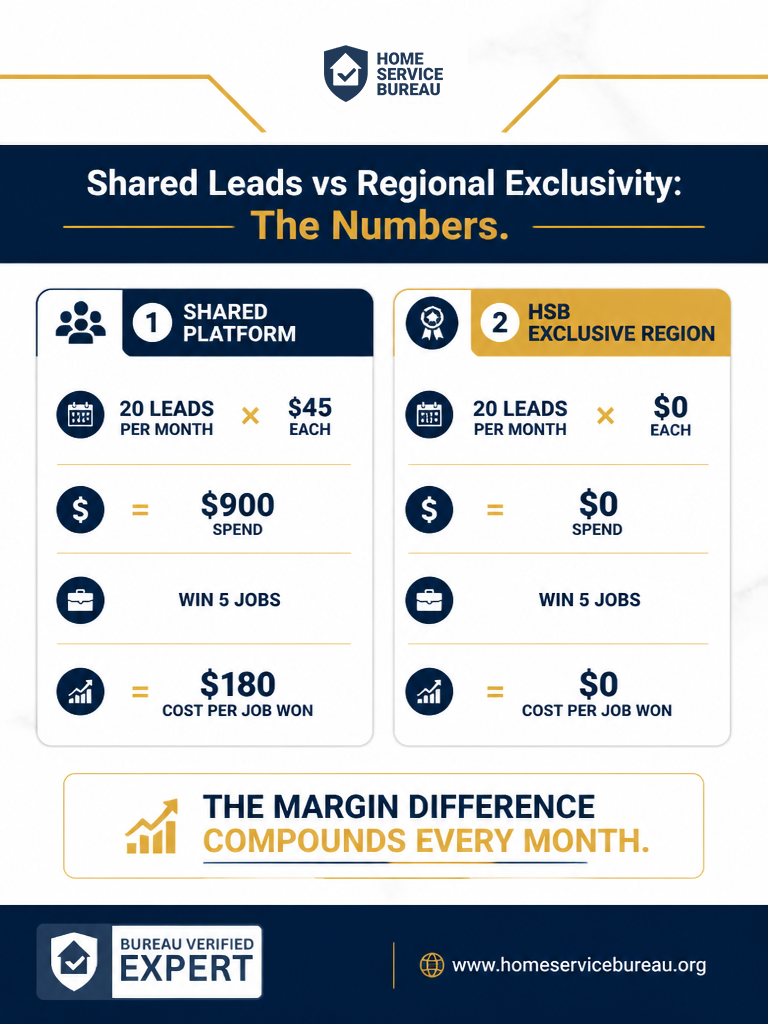
Shared lead platforms sell the same lead to multiple contractors at once. A contractor typically pays a fixed price per lead, regardless of whether that lead converts into a job. If a contractor buys 20 leads a month at roughly $45 each, that’s $900 in spend before a single job closes. If only five of those leads convert into paying work, the cost per job won climbs to $180 money spent purely on acquisition, not on delivering the actual service.
A regional contractor model benefit Canada-based businesses increasingly rely on removes that acquisition cost entirely. Under an exclusive-region setup, a contractor receives the same volume of leads 20 per month, for example at zero cost per lead. The contractor still wins jobs based on skill, reputation, and service quality, but the cost per job won drops to zero because no one else is bidding on the same homeowner. That margin difference doesn’t show up once; it compounds every single month, freeing up budget that would otherwise go toward lead fees and redirecting it toward equipment, staffing, or growth.
For contractors running tight margins in a competitive trade, this distinction matters more than most marketing pitches let on. It’s not just about getting leads it’s about what percentage of revenue those leads actually cost to convert.
How Regional Exclusivity Changes the First Customer Call
The financial difference is only part of the story. The customer experience changes just as dramatically, and that shift affects how quickly trust gets established.
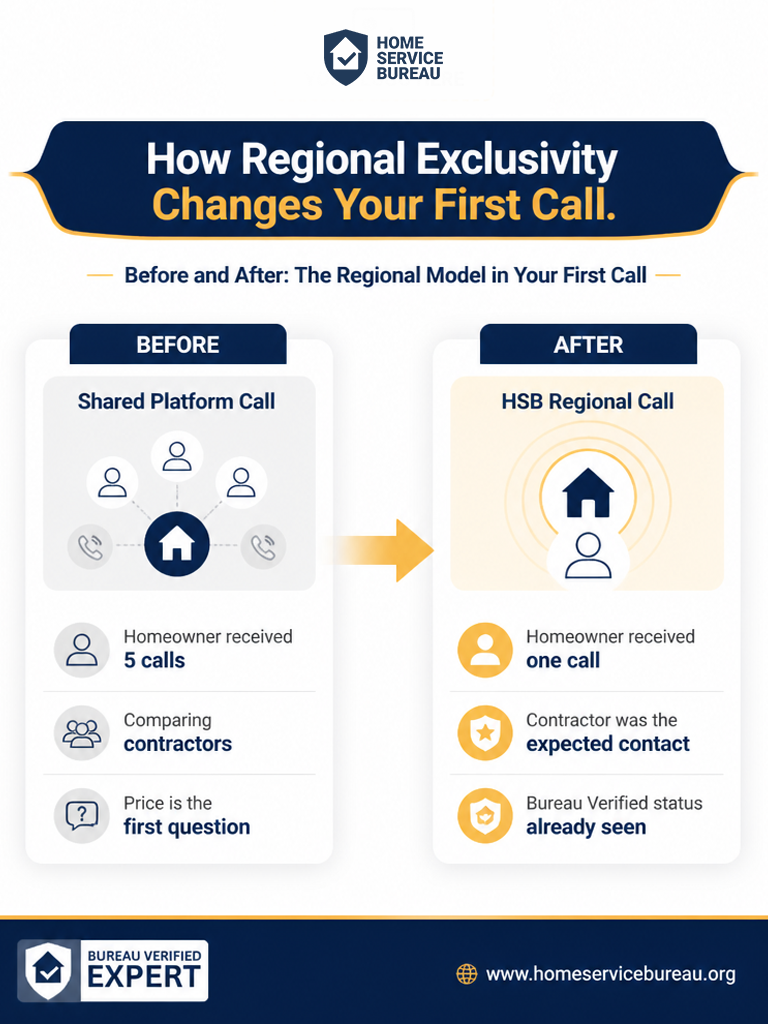
On a shared platform, a homeowner submitting a request typically receives calls from several contractors within minutes of each other. That homeowner is now comparing quotes, fielding repeat pitches, and more often than not treating price as the very first question in the conversation. The contractor isn’t just selling a service; they’re competing on the phone in real time against businesses the homeowner has never heard of.
Under a one region one contractor setup, that dynamic disappears. The homeowner receives a single call. The contractor is the expected contact, not one of several strangers vying for the job. Because verification status has already been established before the lead reaches the homeowner, trust is front-loaded into the interaction rather than something the contractor has to build from scratch on a cold call. The conversation starts from a position of credibility instead of price comparison, which tends to shorten sales cycles and improve close rates.
4 Gains From a One Region One Contractor Model
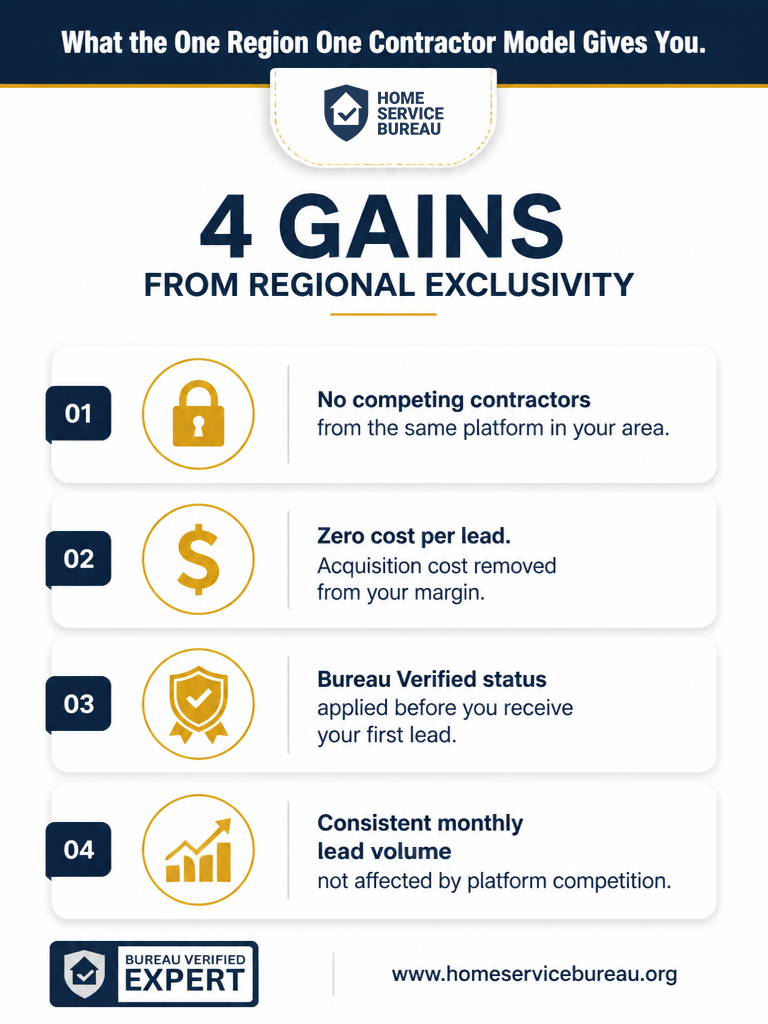
Zooming out, the benefits of this model tend to cluster around four consistent gains for contractors:
No competing contractors from the same platform in the same area. A defined territory means no internal competition from businesses using the same lead source, which removes a major source of pricing pressure.
Zero cost per lead. Because acquisition cost is removed from the margin equation, contractors keep more of what they earn on every completed job.
Verified status applied before the first lead arrives. Rather than earning trust lead by lead, contractors enter each conversation with credibility already established.
Consistent monthly lead volume unaffected by platform competition. Lead flow doesn’t fluctuate based on how aggressively other contractors are bidding for the same homeowners, which makes revenue easier to forecast.
Together, these four gains change how a contractor plans growth. Instead of budgeting for unpredictable acquisition costs, a business can plan staffing, inventory, and scheduling around a more stable lead pipeline.
Why GTA Contractors Are Choosing Regional Exclusivity
GTA contractors regional exclusivity has become a notable trend as the market in and around the Greater Toronto Area grows more saturated with shared-lead platforms. Population density in the region means multiple contractors often chase the same shared leads within the same postal codes, driving up cost-per-lead and shrinking margins for everyone involved.
An exclusive region contractor GTA arrangement solves this by assigning a defined territory to a single business. Instead of splitting a densely populated market with several competitors, a contractor operating under this model captures the full lead volume generated within their designated area. In a market as competitive as the GTA, that kind of territorial clarity often makes the difference between a business that scales predictably and one that constantly resets its marketing spend every quarter.
What to Look for in a Licensed Contractor Program in Ontario
Not every regional exclusivity program delivers on its promises, so due diligence matters. For licensed contractors in Ontario one per area programs to actually work, a few conditions need to be in place.
First, verification standards need to be applied before leads are distributed, not after complaints arise. Second, the exclusivity boundary needs to be clearly defined geographically, so there’s no ambiguity about whether a competing contractor might be assigned to an overlapping zone. Third, lead volume commitments should be transparent and consistent, rather than vague promises that shift month to month. Contractors evaluating any exclusivity program should ask for specifics on all three points before committing.

Conclusion
The shift from shared-lead platforms to a Canadian home services one region one contractor model isn’t a minor pricing tweak it changes the cost structure, the customer experience, and the predictability of a contracting business all at once. Removing per-lead costs, eliminating platform-level competition, and front-loading trust into the first customer call all add up to a model built for sustainable growth rather than constant bidding wars.
The HSB one contractor per area model, offered through Home Service Bureau, applies this exact structure. Contractors get Bureau Verified status before their first lead arrives, exclusive rights to their assigned region, and consistent monthly lead volume without competing against other businesses on the same platform. For contractors ready to move away from shared-lead economics, Home Service Bureau’s regional exclusivity program is worth a direct look at homeservicebureau.org.
Frequently Asked Questions
1. What does “one region one contractor” actually mean?
It means only one contractor within a defined geographic area receives leads through that platform. No other business on the same platform competes for the same homeowners in that territory, removing internal competition entirely.
2. How does regional exclusivity reduce costs for contractors?
It removes per-lead fees. Instead of paying for every lead regardless of conversion, contractors receive leads at no acquisition cost, which directly lowers the cost per job won each month.
3. Is regional exclusivity only useful for large contracting businesses?
No. Smaller contractors often benefit the most, since they typically have tighter margins and less room to absorb high per-lead acquisition costs common on shared platforms.
4. Does exclusivity affect lead volume?
Exclusivity typically stabilizes lead volume rather than reducing it. Because leads aren’t split across competing contractors, volume stays consistent and isn’t affected by how many other businesses are bidding.
5. Why does verification status matter before the first call?
Pre-established verification builds trust before the homeowner ever picks up the phone. This shortens the sales conversation and shifts the discussion away from price comparison toward service quality.
6. Are GTA contractors particularly affected by shared-lead competition?
Yes. High population density in the GTA means many contractors often bid on the same shared leads, which drives up acquisition costs and compresses margins more than in less saturated markets.
7. What should contractors verify before joining an exclusivity program?
Contractors should confirm clear geographic boundaries, upfront verification standards, and transparent, consistent monthly lead volume commitments before signing on to any regional exclusivity arrangement.
8. How does this model support long-term business planning?
Predictable lead volume and zero acquisition cost make revenue easier to forecast, allowing contractors to plan staffing, equipment purchases, and scheduling around stable, dependable monthly demand.