


Most contractors who lose a client’s trust do not lose it because of the quality of their work. They lose it because of silence. A homeowner living through a renovation or repair project is making one of the most significant financial decisions connected to their property. They have granted access to their home. They have committed a budget. And they are depending on a professional to keep them informed throughout the process.
When that information does not arrive or arrives inconsistently, or arrives too late the homeowner does not simply feel frustrated. They feel ignored. That feeling does not stay private. It appears in reviews, in conversations with neighbours, and in the decision about whether to call the same contractor again.
Understanding GTA contractors homeowner project communication expectations is not a soft skill. It is a core competency that directly affects a contractor’s reputation, referral rate, and ability to retain clients beyond a single project. This blog covers exactly what homeowner communication expectations GTA look like in practice and what every contractor operating in Ontario needs to do to meet them consistently.
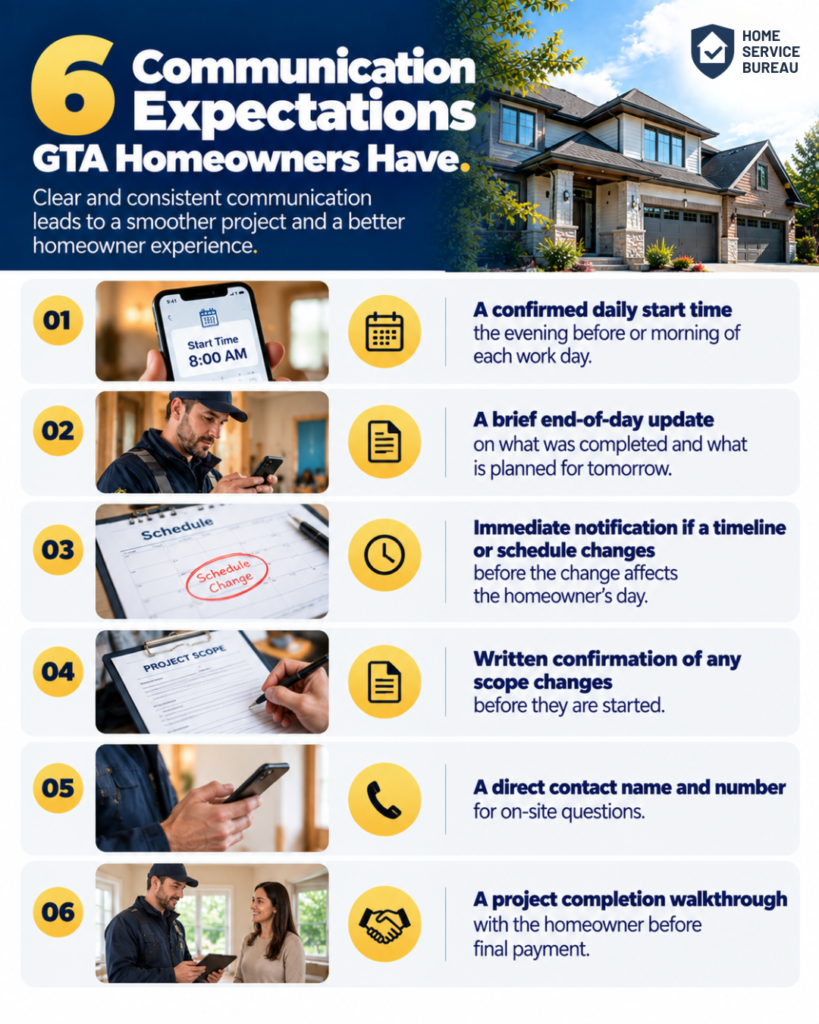
6 Communication Expectations GTA Homeowners Have
Clear and consistent communication leads to a smoother project and a better homeowner experience. The homeowner communication expectations GTA homeowners hold are not unreasonable. They are specific, practical, and achievable by any contractor who builds them into a standard operating process.
01 A confirmed daily start time the evening before or morning of each work day. Homeowners arrange their days around contractor access. An unconfirmed start time forces them to hold their entire morning open without knowing whether anyone will arrive, or to leave and risk missing the crew. Confirming the start time the evening before or morning of each work day takes under two minutes and eliminates one of the most consistent sources of homeowner frustration in the GTA market.
02 A brief end-of-day update on what was completed and what is planned for tomorrow. A homeowner who does not receive any update at the end of a work day has no way to assess whether the project is on track. A brief end-of-day message of three to four sentences covering what was completed and what is planned for the following day gives them visibility without requiring a phone call or a site visit. This is the single highest-impact contractor update frequency Ontario habit a contractor can build.
03 Immediate notification if a timeline or schedule changes, before the change affects the homeowner’s day. Delays happen on every project of meaningful scale. The issue is not the delay it is when the homeowner finds out. A homeowner notified 24 hours in advance of a schedule change can plan accordingly. A homeowner who discovers the change when the crew does not arrive has been failed regardless of how valid the reason is.
04 Written confirmation of any scope changes before they are started. Scope changes are a standard feature of home renovation and repair work. What is not standard but should be is written confirmation of every change before work begins. A verbal agreement about additional work is the most reliable source of payment disputes in Canadian home services contractor communication. Written confirmation protects both parties and eliminates the ambiguity that turns a minor adjustment into a damaging disagreement.
05 A direct contact name and number for on-site questions. Homeowners should not have to work to reach someone when they have a question about their own property. A direct contact name and number not a general inbox or a number that goes to voicemail gives homeowners confidence that they can get a timely answer when something comes up. This is a baseline expectation of licensed contractors in Ontario project communication that many contractors still fail to provide.
06 A project completion walkthrough with the homeowner before final payment. The completion walkthrough is the final communication touchpoint of every project and the one with the highest impact on how the homeowner remembers the entire experience. Walking the homeowner through every element of the completed work, confirming their satisfaction, and addressing any outstanding questions before final payment produces a closing experience that generates reviews and referrals. Skipping it produces the opposite.
Your Daily Project Update Template
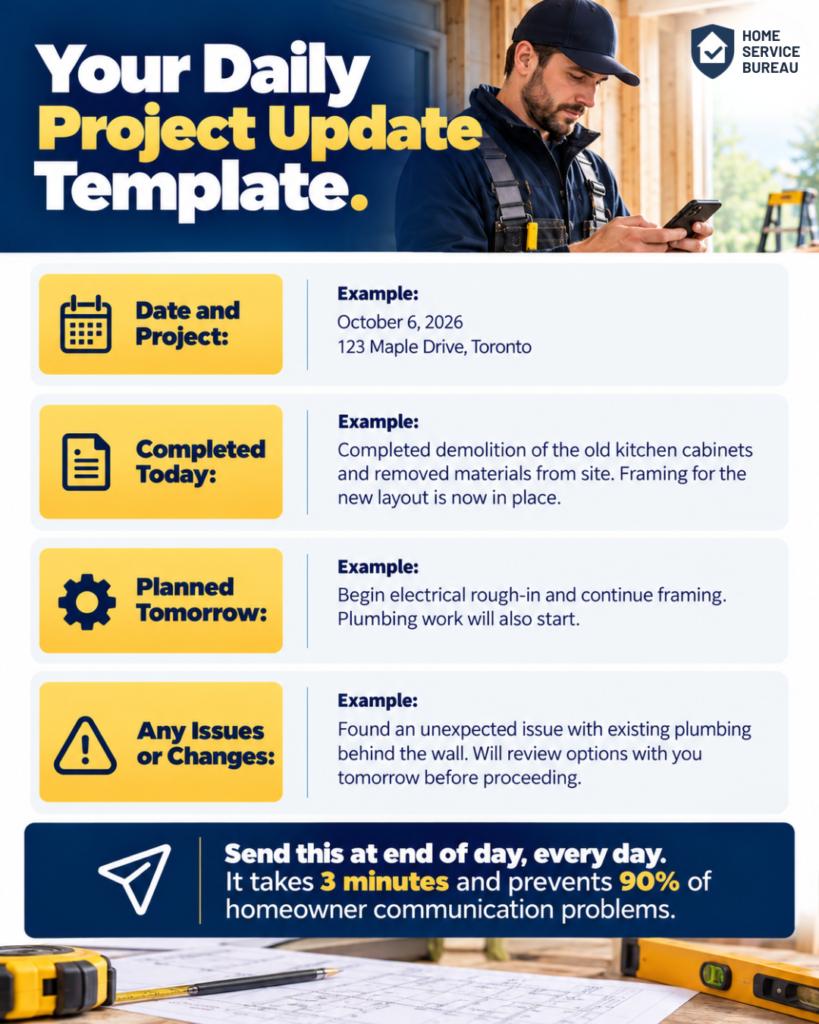
The most practical tool for meeting contractor update frequency Ontario expectations consistently is a daily project update template. It takes three minutes to complete, requires no phone call, and prevents the majority of homeowner communication problems before they develop.
A complete daily update contains four elements:
Date and Project Identify the date and property address so the homeowner has a clear record for their own reference. This is especially useful for multi-phase projects or homeowners managing several contractors simultaneously.
Completed Today A brief description of what was actually finished during the work day. This does not need to be technical. It needs to be specific enough that the homeowner understands what progress was made and can see that the project is moving forward.
Planned Tomorrow A brief statement of what the crew intends to accomplish the following day. This gives the homeowner visibility into the immediate next steps and allows them to flag any concerns or access issues before they become disruptions.
Any Issues or Changes An honest note about anything unexpected that came up during the day a material delay, an unforeseen condition behind a wall, a subcontractor scheduling issue and how the contractor plans to address it. Raising issues proactively in a daily update is a far better communication experience than waiting until a problem has already affected the homeowner’s day.
Send this at the end of every work day. It builds the project communication standard GTA contractor clients recognise and remember and the habit that separates contractors who get referrals from those who do not.
3 Communication Failures That Hurt Your Reputation
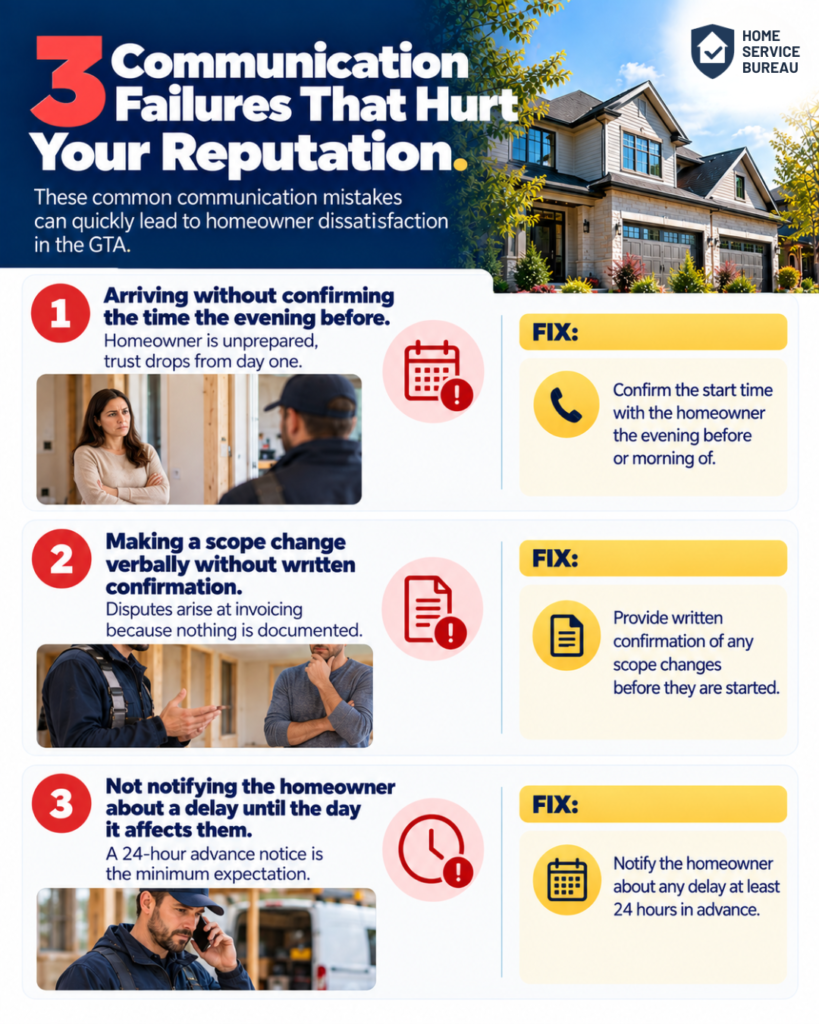
Understanding what homeowner communication expectations GTA require is only half the picture. Understanding what breaks trust and how to fix it is equally important. These three communication failures are the most consistently documented sources of homeowner dissatisfaction across the Canadian home services contractor communication market.
Failure 1 Arriving without confirming the time the evening before. When a contractor arrives without confirming in advance, the homeowner is unprepared. They may not have cleared access, secured pets, arranged childcare, or made the scheduling adjustments their day required. The homeowner does not experience this as a minor inconvenience. They experience it as a signal that the contractor does not consider their time worth respecting and trust drops from day one.
The fix: Confirm the start time with the homeowner the evening before or morning of every single work day. No exceptions.
Failure 2 Making a scope change verbally without written confirmation. A verbal scope change agreed on site in a quick conversation feels efficient in the moment. At invoicing, it becomes the source of a dispute because the homeowner’s memory and the contractor’s record do not match. Disputes at invoicing produce withheld payments, negative reviews, and referrals that never happen.
The fix: Provide written confirmation of any scope change before work on that change begins. A brief message is sufficient. The documentation is what matters.
Failure 3 Not notifying the homeowner about a delay until the day it affects them. A delay that is communicated 24 hours in advance gives the homeowner time to adjust. A delay communicated the morning it occurs when the homeowner has already arranged their day around the crew arriving is a communication failure that no explanation fully remedies. The homeowner remembers not the delay but the way they found out.
The fix: Notify the homeowner about any delay at least 24 hours in advance. A 24-hour notice is the minimum project communication standard GTA contractor clients expect and remember.
Why Communication Is a Competitive Advantage in the GTA
The GTA contractor market is competitive. Homeowners have choices and increasingly, they exercise those choices based on factors beyond price and technical skill. GTA contractors homeowner project communication expectations have risen significantly. As homeowners gain access to more information, more reviews, and more options for selecting and evaluating trades.
A contractor who meets the six communication expectations above, sends a daily project update consistently. And avoids the three documented communication failures occupies a distinct position in the market. They are not simply a skilled tradesperson. They are a professional that homeowners recommend to their neighbours, return to for their next project, and leave detailed positive reviews for because the experience of working with them was different from the standard.
Licensed contractors in Ontario project communication quality is now one of the most significant differentiators available to contractors who want to build a sustainable, referral-driven business in the GTA market. It costs nothing to implement. It requires only consistency and the commitment to treat every homeowner’s time and property as if they were a long-term client because they are.

Conclusion: Communication Is the Standard That Sets You Apart
GTA contractors homeowner project communication expectations are not rising because homeowners are becoming more demanding. They are rising because the standard of what a professional contractor looks like is becoming clearer and the gap between contractors who meet it and those who do not is becoming more visible.
Home Service Bureau (HSB) connects GTA homeowners with Bureau Verified contractors who already operate to this standard. The Bureau Verified credential confirms a contractor’s licence, insurance, and regional eligibility and the platform’s regional exclusivity model ensures that every homeowner inquiry reaches a contractor who is genuinely local, genuinely qualified, and genuinely accountable.
For contractors who take Canadian home services contractor communication seriously, HSB provides the platform position that matches that professionalism and the homeowner trust that comes with it. Visit homeservicebureau.ca to check your region and apply for Bureau Verified status today.
FAQs
Q1: How often should a GTA contractor update a homeowner during an active project?
A: A brief daily end-of-day update covering completed work, next-day plans. And any issues meets the homeowner communication expectations GTA homeowners consistently report. Daily updates prevent most communication-related disputes before they develop.
Q2: Does written scope change confirmation need to be a formal document?
A: No. A brief message text, email, or written note confirming the change and its cost before work begins is sufficient. The requirement is documentation, not format. Written confirmation prevents the invoicing disputes that verbal agreements consistently produce.
Q3: What is the minimum advance notice for a schedule change in Ontario?
A: Twenty-four hours is the documented minimum expectation for contractor update frequency Ontario. Homeowners who receive 24-hour notice can adjust their plans. Those who receive same-day notice cannot and the experience damages trust regardless of how valid the reason is.
Q4: Why does a daily project update prevent homeowner communication problems?
A: Most homeowner dissatisfaction during a project stems from uncertainty about progress and inability to raise concerns in real time. A daily update addresses both. It confirms progress and creates a natural channel for the homeowner to ask questions without resorting to repeated calls.
Q5: Does the project completion walkthrough affect final payment outcomes?
A: Yes. A walkthrough before final payment allows the homeowner to raise any outstanding concerns in person while the contractor is on site. Addressing those concerns at handover rather than after final payment is disputed produces better outcomes for both parties and stronger reviews consistently.
Q6: How does poor communication affect a contractor’s referral rate in the GTA?
A: Homeowners recommend contractors based on the experience of working with them, not just the quality of the output. Poor communication produces negative experiences that homeowners share actively. Strong communication produces positive experiences that generate referrals without the contractor needing to ask.
Q7: Is a direct contact number required or just a best practice?
A: In the context of licensed contractors in Ontario project communication, a direct contact name and number is a professional standard that homeowners expect on every project. It is not legally mandated, but its absence consistently registers as unprofessional in homeowner feedback across the Ontario market.
Q8: How does Bureau Verified status relate to communication standards?
A: Bureau Verified status signals to homeowners that the contractor has met a professional standard assessed by an independent body. Contractors who pair Bureau Verified credentials with strong project communication standard GTA contractor habits build a cumulative trust profile that competitors without either cannot match.