


Renovations rarely go wrong because of bad workmanship alone. They go wrong because expectations drift, decisions stall, and small misunderstandings pile up until nobody is sure what was agreed. Homeowners who manage home renovation GTA without stress almost always share one habit: they build structure into the project before the first hammer swings. This guide walks through how to set that structure, what daily communication should look like, and which habits quietly create tension you can avoid entirely.
Why Renovation Stress Usually Starts Before Construction Does
Most homeowners assume stress arrives with the dust and noise. In reality, it usually begins during the planning stage, when the scope stays loosely defined and everything rests on verbal understanding. When nobody writes down what is included, both sides fill the gaps with assumptions and those assumptions collide once work begins.
Good GTA contractors renovation management starts by removing ambiguity early. A written scope, a realistic timeline, and clear decision-making rules cost nothing to establish but prevent the majority of mid-project conflicts. Homeowners who invest a few extra hours up front consistently report calmer projects than those who rush to start.
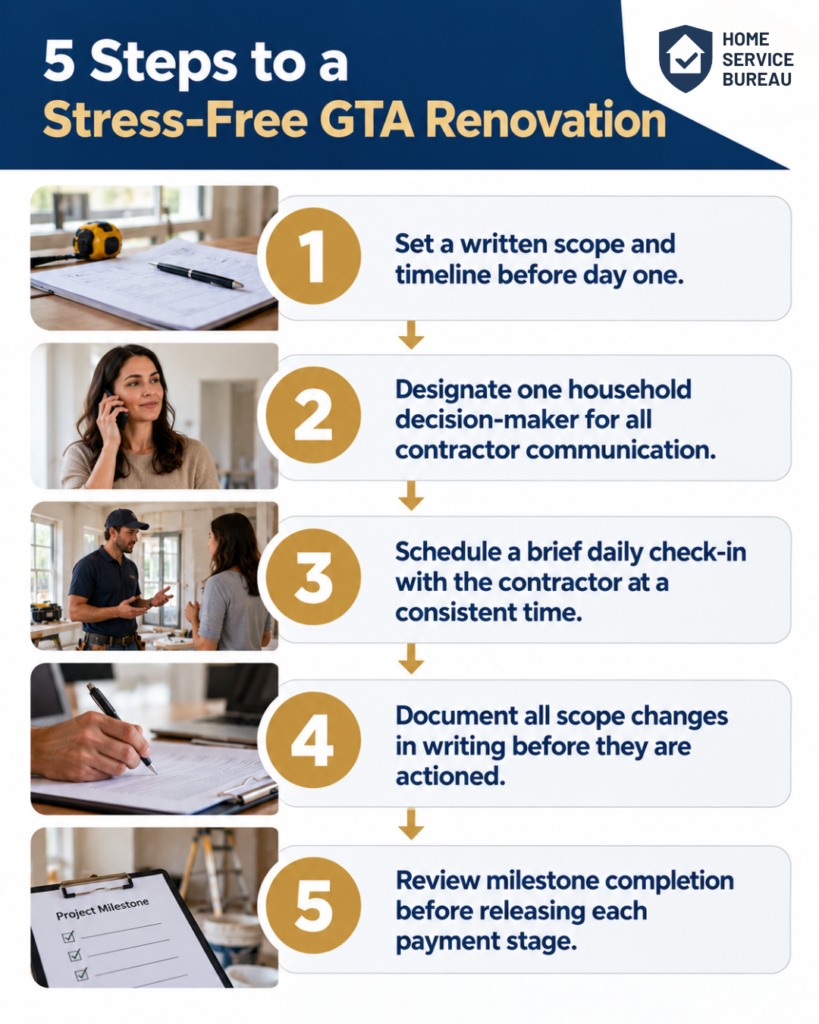
5 Steps to a Stress-Free GTA Renovation
A structured approach turns a chaotic project into a predictable one. These five steps form the backbone of a stress-free renovation Ontario homeowners can actually enjoy.
1. Set a written scope and timeline before day one. Document every task, material, and finish before work begins. A written scope becomes the reference point both sides return to whenever a question arises, and it removes the guesswork that leads to disputes later.
2. Designate one household decision-maker for all contractor communication. When multiple household members give instructions, crews receive conflicting direction and lose time. Choosing a single point of contact keeps messaging consistent and speeds up approvals considerably.
3. Schedule a brief daily check-in with the contractor at a consistent time. A short, predictable conversation replaces the scattered interruptions that slow crews down. Consistency matters more than length here.
4. Document all scope changes in writing before they are actioned. Every change to the original plan should appear in writing, with its cost and schedule impact noted, before any work starts on it.
5. Review milestone completion before releasing each payment stage. Tying payments to verified progress protects your budget and gives you natural checkpoints to catch issues early rather than at the end.
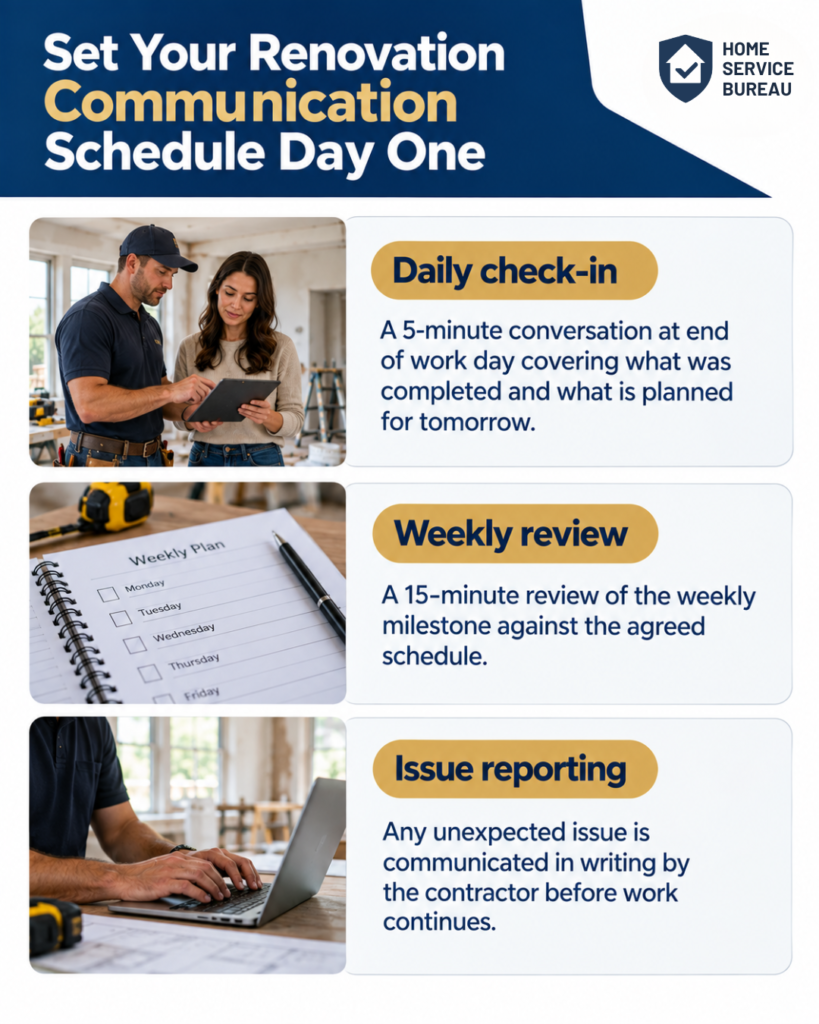
Set Your Renovation Communication Schedule on Day One
Strong licensed contractors in Ontario project management practices depend heavily on communication rhythm. Establish that rhythm on the first day rather than letting it develop by accident.
Daily check-in. Hold a five-minute conversation at the end of each work day covering what the crew completed and what they plan for tomorrow. This short exchange catches small problems before they compound and keeps you informed without disrupting the schedule.
Weekly review. Set aside fifteen minutes each week to compare the completed milestone against the agreed schedule. This longer conversation gives both parties space to discuss upcoming decisions, material deliveries, and any timeline adjustments.
Issue reporting. Agree that the contractor communicates any unexpected issue in writing before work continues. Hidden damage, structural surprises, and supply problems all need a paper trail so the cost and schedule impact stays transparent.
Setting these three touchpoints on day one removes the most common source of friction: not knowing what is happening inside your own home.

Replace These 3 Behaviors to Reduce Renovation Stress
Some of the most useful Canadian home services homeowner renovation tips involve changing homeowner habits rather than contractor behaviour. Three patterns cause disproportionate stress on renovation sites.
Stressful: making verbal scope changes mid-project. Casual hallway requests feel efficient but create disputes about what was agreed and who absorbs the cost. Better: submit all changes in writing before they start. A brief written change request that notes the added cost and time keeps everyone protected.
Stressful: checking in too frequently through the day. Repeated interruptions pull crews off task and stretch timelines, which then creates more anxiety about delays. Better: set one consistent daily check-in time. Save your questions for that window and let the crew work uninterrupted the rest of the day.
Stressful: waiting until the end to review quality. Discovering issues after everything is finished makes corrections expensive, disruptive, and emotionally exhausting. Better: review each completed milestone as it is finished. Inspecting work in stages means small corrections happen while access is still easy and materials are still on site.
Building Your GTA Home Renovation Homeowner Guide
Every household benefits from keeping its own simple GTA home renovation homeowner guide for the duration of the project. This does not need to be complicated a single folder or shared document holding the signed contract, the written scope, all change requests, the payment schedule, warranty documents, and permit paperwork covers nearly everything.
Keeping records in one place means you never have to search through text messages to confirm what was agreed. It also makes the final walkthrough far simpler, because you can compare finished work directly against the original documented scope rather than relying on memory.
Photographs help too. Taking dated photos at each milestone creates a visual record of progress that supports both you and your contractor if any question about workmanship arises later.
Managing Budget and Timeline Expectations Realistically
Renovation timelines in busy urban markets rarely run perfectly. Material lead times shift, inspections get scheduled around municipal availability, and older homes frequently hide conditions nobody could predict. Homeowners who plan for this reality experience far less frustration than those who treat the original completion date as immovable.
Build a contingency into both your budget and your calendar. Setting aside a reserve for unforeseen conditions turns a surprise into a manageable adjustment instead of a crisis. Similarly, allowing buffer weeks in your timeline means a short delay does not cascade into missed moving dates or cancelled plans.
Discuss these buffers openly with your contractor at the start. Contractors generally appreciate homeowners who acknowledge uncertainty, and the conversation often surfaces risks they have already anticipated based on experience with similar properties.
Knowing When to Step Back and Let the Crew Work
Trust is the hardest part of renovation management for many homeowners. After signing a substantial contract, the instinct to supervise closely feels natural. But constant oversight rarely improves quality and almost always slows progress.
Hire carefully, verify licensing and insurance before signing, then give the crew room to do the work you contracted them for. Your structured check-ins, milestone reviews, and written change process already give you meaningful control. Adding hourly supervision on top of that structure produces stress without producing better results.

Ending Words
A calm renovation is not a matter of luck. It comes from writing things down, communicating on a predictable schedule, handling changes formally, and reviewing work in stages instead of all at once. Homeowners who put this structure in place before construction starts spend far less energy managing conflict and far more enjoying the result.
The single biggest factor, though, remains who you hire. Verified, licensed, properly insured contractors bring their own project management discipline to the job, which makes your side of the process considerably easier. Home Service Bureau (HSB) helps homeowners connect with Bureau Verified contractors whose credentials have been checked, so you can start your project with confidence rather than uncertainty. Explore HSB to find verified professionals before your next renovation begins.
Frequently Asked Questions
How can I reduce stress during a home renovation? Set a written scope before work begins, choose one household decision-maker, hold consistent daily check-ins, document every change in writing, and review each milestone before releasing payment.
Why should only one person communicate with the contractor?
Multiple decision-makers create conflicting instructions that confuse crews and slow progress. A single point of contact keeps direction consistent and helps approvals happen faster and more clearly.
How often should I check in with my renovation contractor?
Hold one brief daily check-in at a consistent time, plus a longer weekly review comparing progress against the schedule. Avoid repeated interruptions throughout the working day.
Should renovation scope changes always be in writing?
Yes. Every change should be documented with its cost and schedule impact before work starts, protecting both the homeowner and contractor from later disputes about what was agreed.
When should I inspect renovation work quality?
Review each milestone as it finishes rather than waiting until completion. Early inspection makes corrections cheaper and easier while access remains open and materials stay on site.
How much contingency should I plan for a renovation?
Set aside both a budget reserve and extra calendar time for unforeseen conditions, since older properties and material lead times frequently create adjustments nobody can predict in advance.
What documents should I keep during a renovation?
Keep the signed contract, written scope, all change requests, payment schedule, permit paperwork, warranty terms, and dated milestone photographs together in one accessible folder throughout the project.
Should payments be tied to renovation milestones?
Yes. Releasing payment only after verifying completed milestones protects your budget, creates natural inspection checkpoints, and keeps progress aligned with the schedule agreed at the outset.