


Every growing trade business reaches the same crossroads: take every job that comes in, or build around a clear territory. Licensed contractors in Ontario who choose the second path usually grow faster and more profitably. A defined service area gives your crews, your marketing, and your finances a shared direction before scaling begins.
Many owners treat territory as an afterthought. They accept work wherever it appears and hope volume will fix the inefficiencies. Growth built this way multiplies problems along with revenue. This guide explains why defining your service area before scaling in Ontario protects your margins, strengthens your reputation, and prepares your company for sustainable expansion.
What a Defined Service Area Really Means
A defined service area is a specific geographic region where you commit to working, marketing, and building relationships. You set the boundaries deliberately, based on travel time, customer density, and the crews you can realistically support.
This approach does not limit your ambition. It sharpens it. When you know exactly where you operate, every business decision becomes easier, from hiring to advertising to scheduling. For Canadian home services contractor scaling, that clarity separates companies that grow steadily from those that stall under their own complexity.
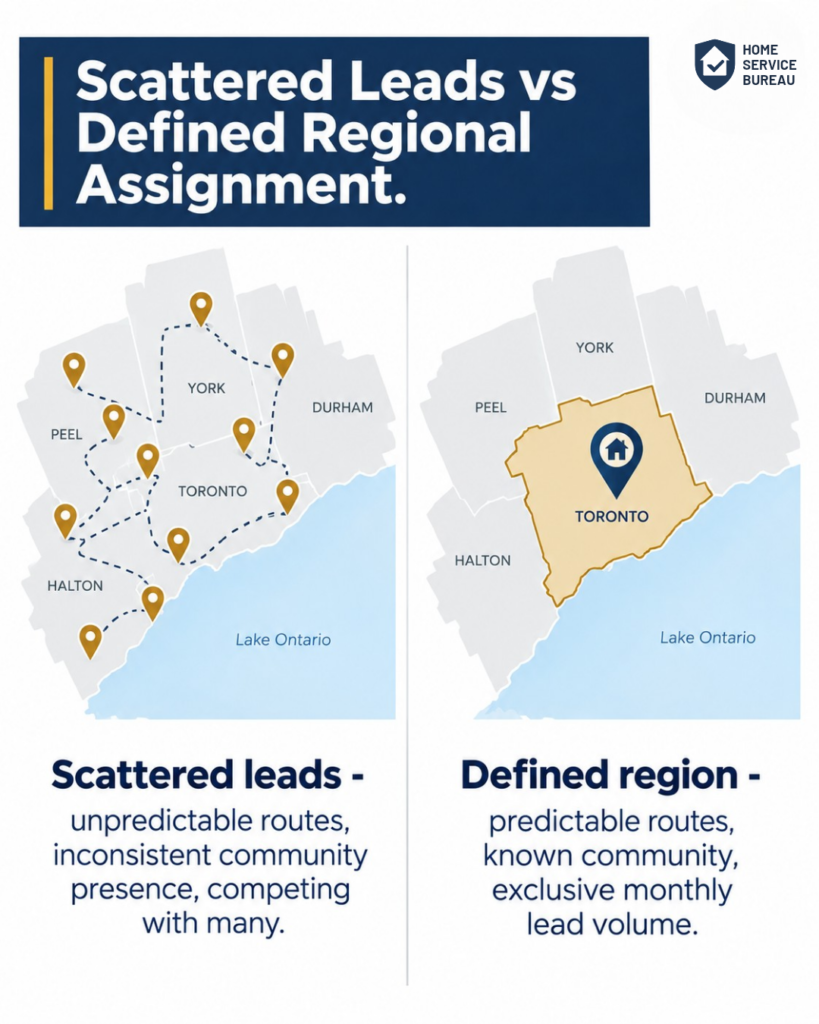
Scattered Leads vs Defined Regional Assignment
Lead flow shapes your daily operations more than most owners admit. Compare the two models side by side.
Scattered leads arrive from many directions. Your crews drive unpredictable routes, your community presence stays inconsistent, and you compete with many other contractors for the same inquiries. You also struggle to forecast your month because demand shifts constantly.
A defined regional assignment works differently. You serve one known region, your routes stay predictable, and your name becomes familiar to the people living there. When a platform grants you exclusive regional leads, you also stop competing against rivals who buy the same inquiries. That stability lets you plan crews, materials, and cash flow with confidence.
Active planning beats reactive scrambling. A contractor who knows next month’s likely lead volume can hire, schedule, and invest with purpose.
4 Reasons Service Area Definition Comes Before Scaling
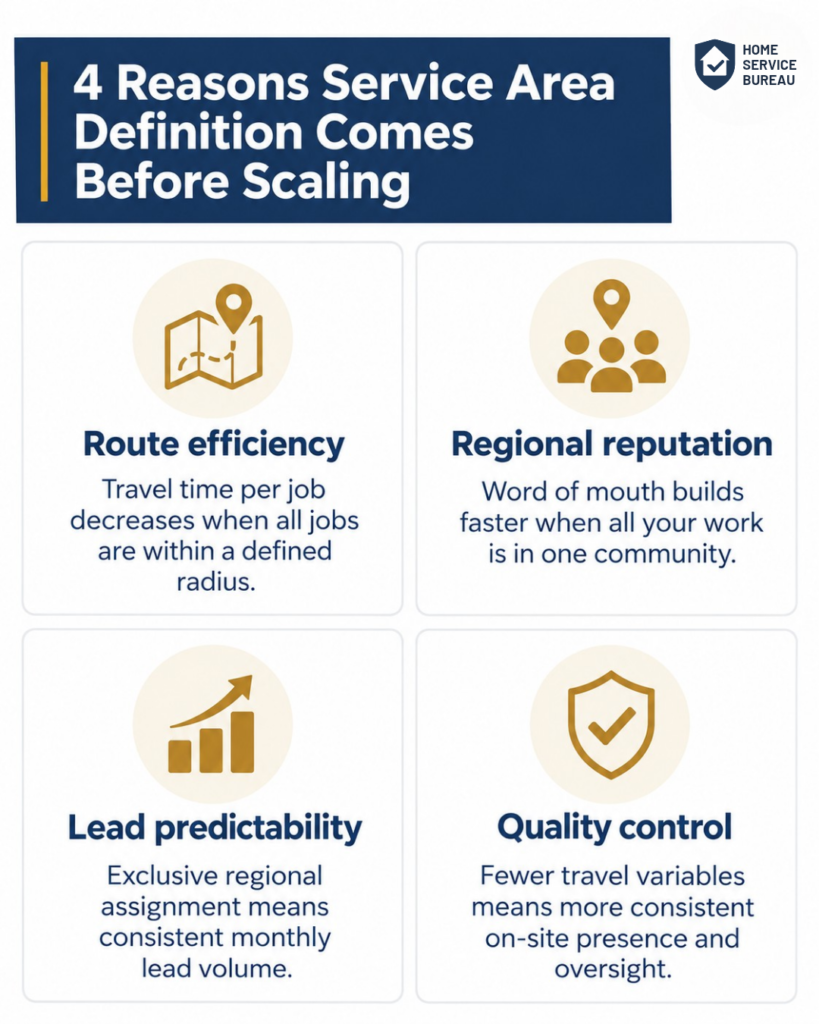
These four reasons explain why GTA contractors service area definition deserves attention long before you add crews or trucks.
1. Route Efficiency
Travel time per job drops when every job sits within a defined radius. Your crews spend more hours on the tools and fewer hours in traffic. Across the Greater Toronto Area, congestion makes this difference especially large. Shorter routes also reduce fuel spending and vehicle wear, which protects your margins on every project.
2. Regional Reputation
Word of mouth builds faster when all your work happens in one community. Neighbours see your vehicles, notice your finished projects, and share your name with friends and family. Homeowners trust contractors they hear about repeatedly from people nearby. A scattered footprint dilutes that effect, while a focused one compounds it.
3. Lead Predictability
Exclusive regional assignment produces consistent monthly lead volume. You stop guessing whether next month will bring a flood or a drought of inquiries. Predictable demand supports better hiring decisions, smarter purchasing, and calmer cash flow management.
4. Quality Control
Fewer travel variables mean more consistent on-site presence and oversight. You can inspect work, support your crews, and respond to customer concerns quickly when every site sits within reach. Quality problems multiply when supervisors spread themselves across a huge territory. Tight geography keeps standards high.
Why Scaling Without Boundaries Backfires
Growth exposes every weakness in your operation. If you add crews before defining your territory, you add drivers, fuel costs, and supervision gaps at the same time. Revenue rises, but profit often falls.
Unbounded growth also confuses your marketing. You cannot build a strong local brand when you chase customers everywhere. Your message turns generic, your reviews scatter across different communities, and your referrals lose momentum.
A sound contractor growth strategy GTA owners can trust starts with depth before breadth. You earn dominance in one region, prove your systems, and only then expand. This sequence protects your reputation and your cash.
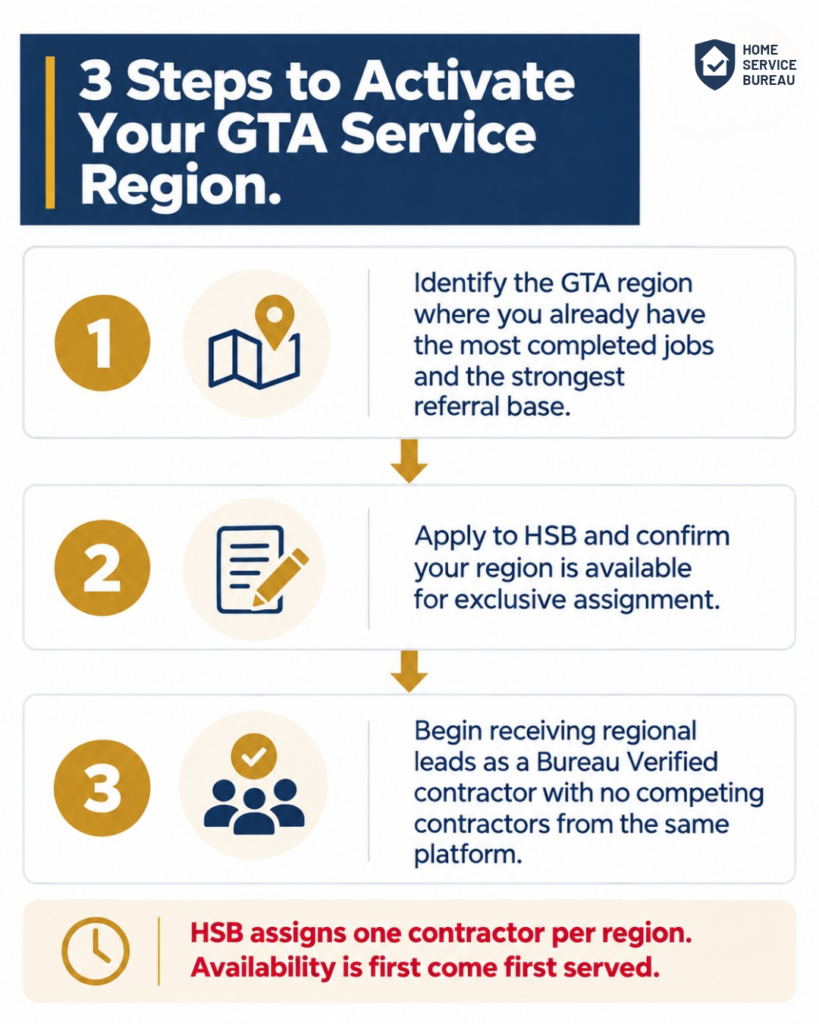
3 Steps to Activate Your GTA Service Region
You can move from scattered work to regional focus with a simple process.
Step 1: Identify your strongest region. Review your completed jobs and referral history. Choose the GTA region where you already hold the most completed work and the strongest referral base. That history gives you a proven foundation.
Step 2: Apply and confirm availability. Apply to HSB and confirm your chosen region is available for exclusive assignment. Regions go to one contractor each, so check availability early.
Step 3: Start receiving regional leads. Begin receiving leads as a Bureau Verified contractor with no competing contractors from the same platform. Track your response times, close rates, and customer feedback so you can refine your approach.
Availability works on a first-come, first-served basis, so waiting carries a real cost. A region you hesitate over may belong to someone else next month.
Practical Tips for Defining Your Service Area
Follow these actions before you scale:
- Map your current jobs. Plot every completed project and look for natural clusters.
- Measure travel time, not distance. Traffic patterns matter more than kilometres.
- Set a realistic radius. Match it to the crews and supervisors you actually have.
- Align marketing with the region. Direct your messaging, reviews, and local outreach to one community.
- Review quarterly. Adjust boundaries only when data supports the change.
Each step reinforces the others. Together, they turn geography into a competitive advantage.

Bottom Line
Licensed contractors in Ontario build stronger businesses when they treat a defined service area as the foundation of scaling. Clear boundaries improve route efficiency, speed up local reputation, stabilize lead volume, and protect quality. Each benefit compounds as your company grows.
The HSB regional model scaling Ontario contractors can access removes much of the guesswork. HSB assigns one contractor per region, so you receive exclusive regional leads as a Bureau Verified professional with no competing contractors from the same platform. You gain a known community, predictable routes, and a dependable monthly lead flow.
If you want to define your service area before scaling in Ontario, act now. Identify your strongest GTA region, apply to HSB, and confirm availability. Regions go on a first-come, first-served basis, so the sooner you move, the better your chance of securing yours.
Frequently Asked Questions
1. What is a defined service area for a contractor?
A defined service area is a specific geographic region where a contractor accepts and completes jobs. It sets clear boundaries for travel, marketing, staffing, and lead intake, so the whole business grows with real focus.
2. Why should licensed contractors in Ontario define a service area before scaling?
Defining the area first protects margins. You cut unpaid travel time, build a recognizable local reputation, and forecast demand accurately. Growth then rests on a stable base instead of stretching crews across many unpredictable routes.
3. How does a defined service area reduce travel costs?
When every job sits inside one radius, crews spend less time driving and more time working. Shorter routes lower fuel spending, reduce vehicle wear, and allow your team to complete more jobs per working day.
4. What does GTA contractors service area definition involve?
It involves choosing one GTA region, mapping the neighbourhoods you serve, setting a travel radius, and aligning marketing and crew schedules to that zone. You then measure results and adjust carefully before you expand further.
5. What is the HSB regional model?
The HSB regional model assigns one Bureau Verified contractor to each service region. That contractor receives exclusive regional leads without competing contractors from the same platform, which creates steady, predictable monthly lead volume for them.
6. How do I know which GTA region to choose first?
Choose the region where you already hold the most completed jobs and the strongest referral base. Existing customers, repeat work, and local trust give you a proven foundation, which lowers risk during your early scaling.
7. Does exclusive regional assignment guarantee more revenue?
No platform can ever guarantee revenue. Exclusive assignment removes competition from the same platform and stabilizes lead flow, but your response speed, pricing, workmanship, and customer service still determine how many leads become paying jobs.
8. When should a contractor expand beyond the first service area?
Expand once your first region delivers consistent jobs, reliable crew schedules, strong reviews, and healthy margins. Add a new region only when your systems handle current demand without strain or any drop in service quality.