


Homeowners across Canada compare multiple quotes before they hire anyone to work on their property. A Canadian home services contractor professional quote does more than list a price. It builds trust, sets expectations, and protects both the contractor and the homeowner from disputes down the road. Contractors who submit vague, one-line estimates often lose jobs to competitors who present clear, itemized documents. This guide walks through exactly what a strong quote should contain, the mistakes that weaken proposals, and how a properly structured estimate helps close more work.
Why a Professional Quote Matters for Canadian Home Services Contractors
A quote is often the homeowner’s first real impression of how a contractor runs their business. A rushed, handwritten total tells the client little about the scope of work or the quality of materials being used. A detailed, well-formatted quote signals experience, transparency, and accountability three qualities homeowners actively look for before signing a contract.
Beyond winning the job, a thorough quote also reduces the risk of miscommunication once work begins. When every task, material, and cost is documented up front. Both parties have a shared reference point if questions arise mid-project. This is especially important in a market where labour and material costs shift frequently, and where homeowners are increasingly cautious about hiring unverified trades.
What Every Professional Contractor Quote Must Include
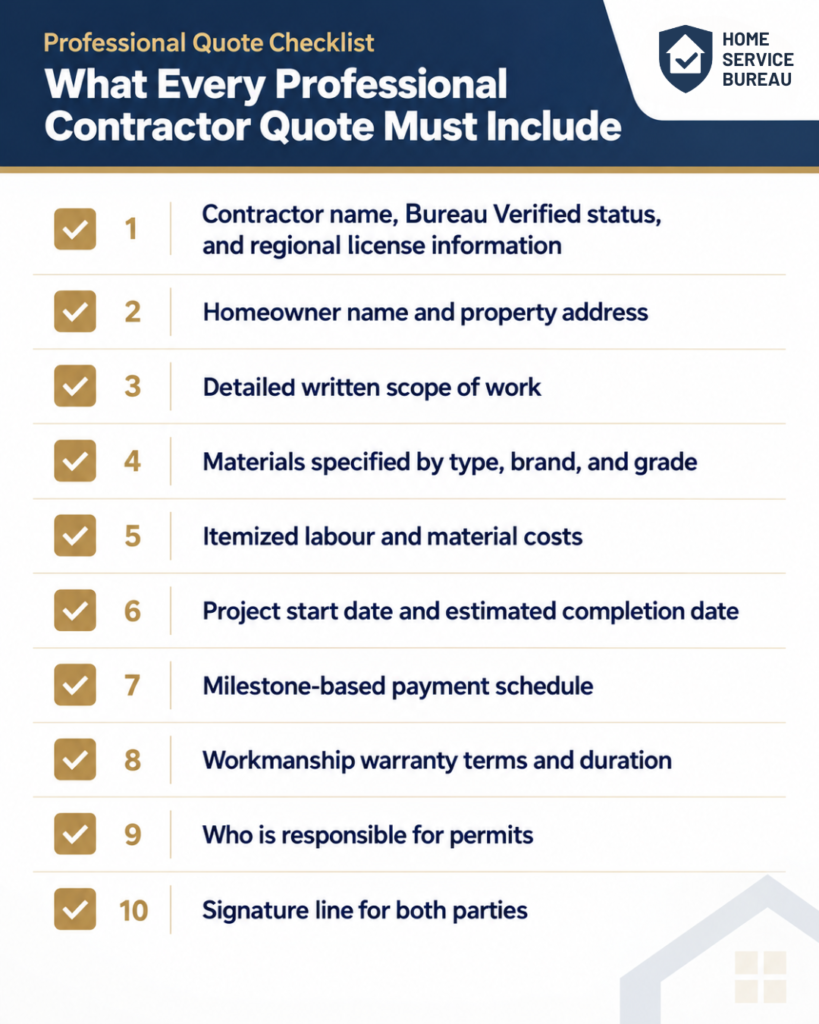
A properly built quote should never leave the homeowner guessing. At minimum, it should contain the following elements:
- Contractor name, verification status, and regional license information homeowners want proof that they are dealing with a legitimate, licensed business.
- Homeowner name and property address this personalizes the document and confirms the job location.
- A detailed written scope of work outlining exactly what tasks are included, step by step.
- Materials specified by type, brand, and grade vague references to “standard materials” leave room for disputes later.
- Itemized labour and material costs separating these two categories builds credibility.
- A project start date and estimated completion date timelines matter as much as pricing to most homeowners.
- A milestone-based payment schedule breaking payments into stages tied to project progress.
- Workmanship warranty terms and duration this reassures the client that the work is backed by a guarantee.
- Clarity on who is responsible for permits this avoids confusion about legal and municipal obligations.
- A signature line for both parties formalizing the agreement protects everyone involved.
Together, these ten elements form the backbone of any professional estimate GTA contractor teams should be issuing to every client, regardless of project size.
Common Quote Mistakes and How to Fix Them
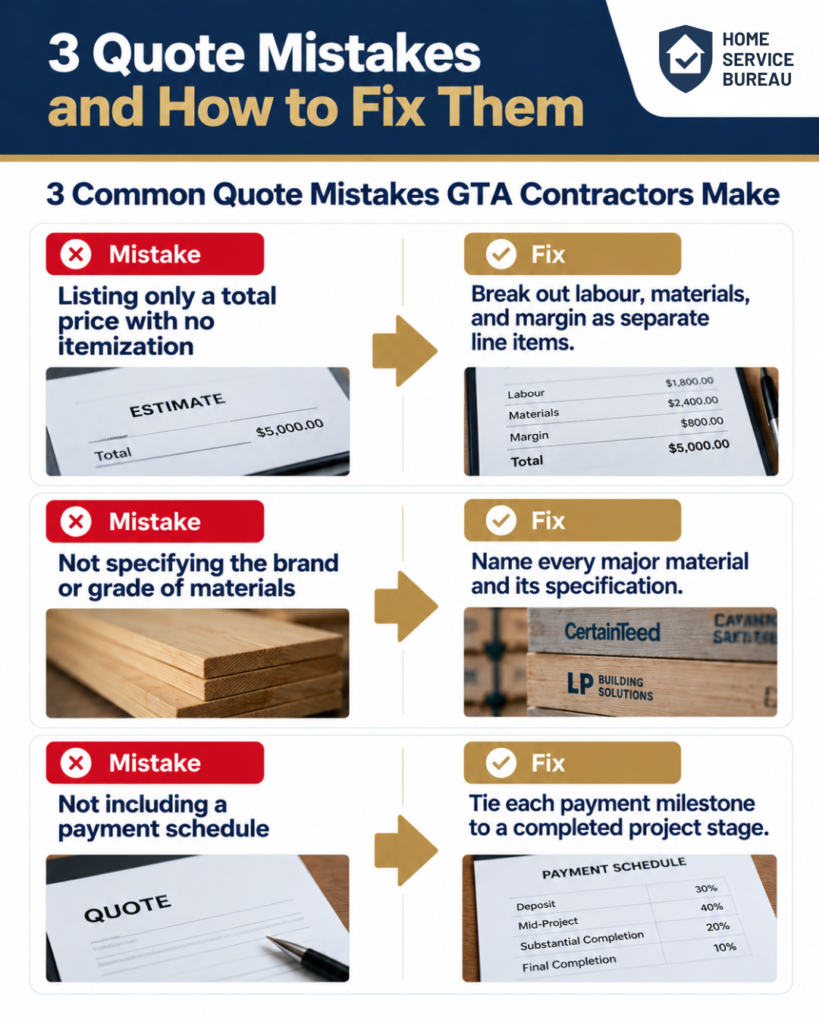
Even experienced contractors sometimes submit quotes that undersell their professionalism. Three mistakes show up repeatedly across the industry.
Listing only a total price with no itemization. A single number tells the homeowner nothing about where their money goes. The fix is simple: break out labour, materials. And margin as separate line items so the client can see exactly what they are paying for.
Failing to specify the brand or grade of materials. When a quote only says “lumber” or “flooring,” homeowners cannot compare it fairly against another contractor’s proposal. Naming every major material and its specification removes ambiguity and demonstrates attention to detail.
Leaving out a payment schedule. A quote without payment terms can create tension mid-project. Tying each payment milestone to a completed project stage. Such as a deposit, a mid-project payment. And a final payment upon completion keeps both sides aligned and reduces the chance of payment disputes.
Fixing these three issues alone can dramatically improve how a quote is received and how quickly a homeowner feels comfortable signing.
How a Professional Quote Reduces Objections and Closes More Jobs
A well-structured quote does more than inform it actively reduces the objections that stall a sale. When a detailed scope of work is included, the homeowner no longer has to ask what is and is not covered, which removes a common source of hesitation. When costs are itemized rather than bundled into one number, the conversation shifts away from the total price and toward the value being delivered. And when a written workmanship warranty is included, homeowner confidence increases noticeably before they sign, because they know the work is protected if something goes wrong.
In short, the quote itself becomes a sales tool. Contractors who invest a little extra time into formatting and detail routinely see higher conversion rates than those who submit bare-bones estimates.
What to Include in a Contractor Quote in Ontario
Understanding what to include in contractor quote Ontario homeowners expect requires attention to provincial norms around licensing disclosure and consumer protection. Ontario homeowners are increasingly aware of licensing verification tools. And often ask contractors directly about registration status before agreeing to any work. A quote that proactively states license details, insurance coverage. And verification status answers this question before it is even raised, which speeds up decision-making on the homeowner’s side.
Ontario-based quotes should also account for regional permit requirements, since many municipalities have different rules around inspections and approvals depending on the scope of work. Stating clearly who handles the permit application the contractor or the homeowner prevents delays once the project begins.
Building a GTA Contractors Quote Template
Contractors operating in fast-moving, competitive markets benefit from having a standardized GTA contractors quote template they can reuse across jobs. A template ensures consistency, reduces the time spent drafting each new estimate, and guarantees that no critical section. Like warranty terms or payment milestones gets accidentally omitted.
A strong template typically groups information into sections: business and licensing details at the top, project scope. And materials in the middle, and cost breakdown, timeline, and signatures at the bottom. Keeping this structure consistent across every job. This also makes it easier for office staff or estimators to fill in details quickly without starting from a blank page each time.

Contractor Quote Breakdown Canada: Structuring Costs Clearly
A clear contractor quote breakdown Canada clients can understand should separate costs into distinct categories. Rather than combining everything into a single figure. Labour, materials, and margin should each appear as their own line. So the homeowner can see how the total was calculated. This structure also makes it easier to adjust a quote if the scope changes mid-negotiation, since each component can be revised independently instead of recalculating an opaque lump sum.
Licensed Contractors in Ontario Estimate Format
Following a consistent licensed contractors in Ontario estimate format helps homeowners quickly identify legitimate, verified businesses. This format should always open with license and verification details, followed by a scope of work. An itemized cost breakdown, a timeline, a payment schedule, warranty terms, and a signature section. Contractors who follow this format consistently build a reputation for professionalism that carries over from one job to the next through word of mouth and repeat referrals.

Ending Thoughts
A professional, well-structured quote is one of the simplest ways a Canadian home services contractor can stand out in a crowded market. Clear licensing information, itemized costs, defined timelines. And written warranty terms all work together to build trust and reduce objections before a homeowner even picks up the phone. Contractors who consistently follow this structure not only close more jobs but also protect themselves from disputes once work begins.
For contractors who want their business verified and their credentials visible to homeowners searching for trustworthy trades, Home Service Bureau (HSB) offers a straightforward path to Bureau Verified status. Getting listed with HSB gives homeowners an added layer of confidence when reviewing a quote, helping contractors convert more estimates into signed contracts.
Frequently Asked Questions
What should a professional contractor quote always include?
It should include contractor licensing details, a detailed scope of work, itemized labour and material costs, a project timeline, a payment schedule, warranty terms, and a signature line for both parties.
Why is itemization important in a contractor quote?
Itemization separates labour, materials, and margin into clear categories, helping homeowners understand exactly what they are paying for and reducing the likelihood of price-related disputes later.
How does a payment schedule help a contractor quote?
A milestone-based payment schedule ties payments to completed project stages, keeping cash flow predictable for the contractor while reassuring the homeowner that payments match actual progress.
Should a contractor quote mention licensing information?
Yes, licensing and verification details should appear near the top of the quote, since homeowners increasingly check this information before agreeing to hire any contractor.
What is the benefit of specifying material brands in a quote?
Naming exact material brands and grades removes ambiguity, allows fair comparison between quotes, and prevents disagreements about quality once the project is underway.
Does a warranty need to be included in every quote?
Yes, stating workmanship warranty terms and duration builds homeowner confidence and shows that the contractor stands behind the quality of their completed work.
Who is typically responsible for permits on a home services project?
Responsibility varies by project and municipality, so the quote should clearly state whether the contractor or the homeowner is handling permit applications and related fees.
How can a standardized quote template help a contracting business?
A standardized template saves time, ensures consistency across every job, and guarantees that critical sections like scope, cost breakdown, and warranty terms are never accidentally left out.